artificial hanging baskets, topiary balls, hedges and topiary trees
Artificial topiary balls
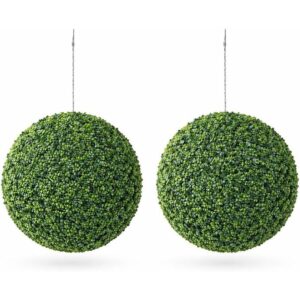
Artificial topiary balls are an easy way to add neat, year-round greenery to entrances, patios and gardens. Our range includes realistic faux topiary balls in different sizes, foliage styles and colours, with no trimming or watering required.
There are plenty of artificial topiary balls on the market but not all are the same! Here are a few factors to watch out for:
Size
Check the size is as you would expect it to be. Typically, a good quality artificial topiary ball will be between 30 and 40cm. Smaller topiary balls may not look right on brackets, although this will all depend on the space and size of bracket you have.
Assembly
Some topiary balls have to be assembled at home and it can be really tricky to achieve the full, attractive look that you see in the product photos! The better quality topiary balls are already assembled for you so all you'll need to do is a minimal amount of 'fluffing out' to get the perfect shape.
UV Fade Resistance
Topiaries can look amazing when they first arrive but can quickly fade in the elements - especially the sunlight! Look for UV fade resistance topiary balls to ensure yours last a long time.
Pack size
Make sure you are certain of whether you're getting one or two topiaries. The higher quality topiary balls can be sold separately. This isn't an issue as such, but most people want two to achieve the look they want, so checking what you're getting will ensure you order the right amount.
Chain
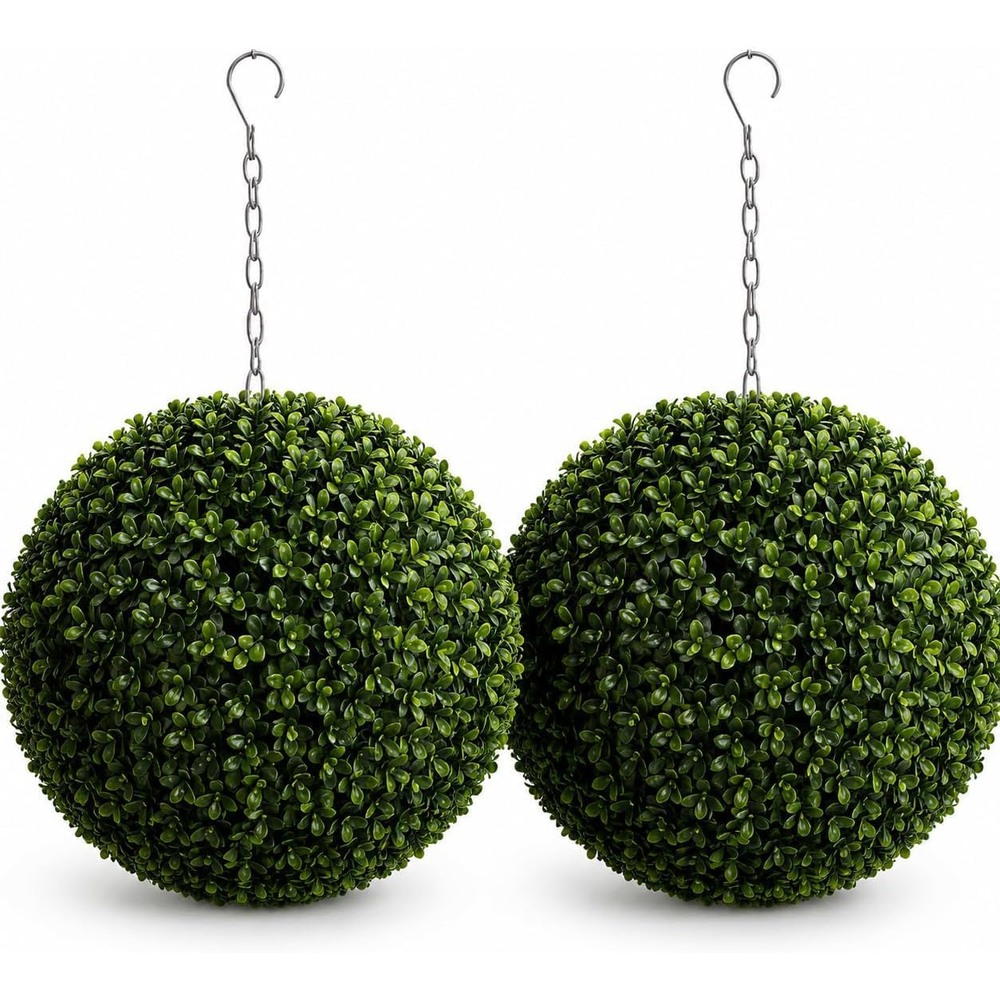
The cheaper topiary balls come with poor chains which will rust and discolour with the rain. A quality ball will include a galvanised hanging chain. Galvanisation is the process of applying a protective zinc coating to prevent rusting. Often the chain will be coated with something like zinc. Galvanised chains last far longer.
Artificial topiary balls – the complete buying guide
Artificial topiary balls have become one of the most popular ways to smarten up a front door, porch or patio, and it's easy to see why. Real box (buxus) balls need clipping two or three times a year, and in much of the UK they're now under constant attack from box blight and box tree caterpillar – the RHS itself advises gardeners to consider alternatives. A good faux topiary ball gives you the same crisp, formal shape with no watering, no clipping and no caterpillars, and it looks the same in January as it does in June.
The catch is that quality varies enormously. Two balls that look identical in a product photo can be worlds apart once they arrive and once they've spent a summer in the sun. This guide covers what genuinely makes a difference, so you buy once and buy well.
Which type of topiary ball do you want?
Most people picture a green boxwood ball, but there are three broad types and they suit different jobs.
Type
Best for
Things to know
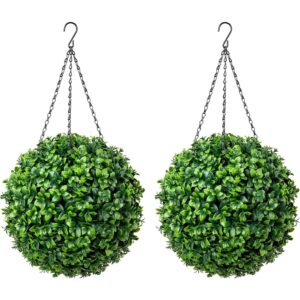
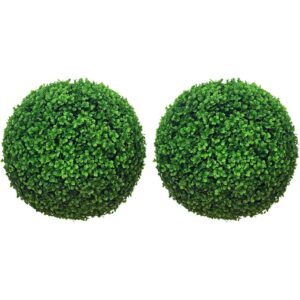
Boxwood (buxus) balls
Front doors, formal entrances, pots, year-round outdoor use
The most realistic and most weather-tolerant option. Moulded plastic leaves hold their colour better than fabric. The classic "pair either side of the door" look.
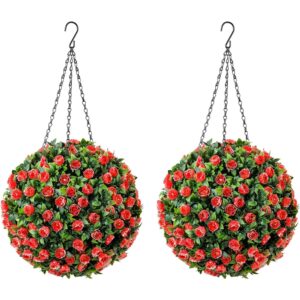
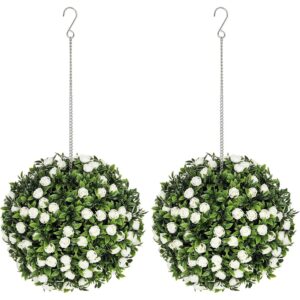
Flower balls (rose, lavender, heather, hydrangea)
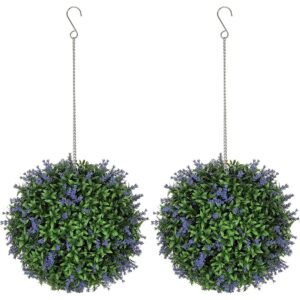
Hanging basket alternative, porches, weddings and events, indoors
Give you colour that real topiary never could. Petals are usually fabric, which fades faster than moulded foliage – fine in a sheltered spot, but think twice about a full-sun south-facing wall unless UV resistance is specifically stated.
Mixed foliage and grass balls
Contemporary schemes, softer informal look
Less formal than boxwood. Check density carefully – wispier foliage can show the frame underneath.
If you want something that will pass for a real plant at a glance, choose boxwood. If you want the cheerfulness of a hanging basket without the watering, a flower ball is the better pick.
Getting the size right
Size is the thing people most often get wrong, and they almost always go too small. A ball that looks substantial on a screen shrinks dramatically once it's hanging against a house. Two points to understand first:
Diameters are measured leaf tip to leaf tip. The dense-looking body of a 38cm ball is a few centimetres smaller than that, so don't size down "to be safe".
Standard sizes are roughly 23cm, 28cm, 30cm, 38cm, 40cm and 48–60cm. The 28cm and 38cm sizes are by far the most common.
As a rule of thumb:
23–28cm – window boxes, small table pots, narrow porches, or a cluster of three in a border. On a standard wall bracket a 28cm ball can look a little mean.
30–40cm – the all-rounder. Right for brackets either side of a typical front door, and for 20–25cm pots on a doorstep.
48–60cm – statement pieces for wide porches, gateposts, large planters or commercial entrances.
If you're torn between two sizes, go larger. And if you're buying a pair, make sure both are exactly the same stated size – two balls a size apart either side of a door reads as a mistake, not a design choice.
Sizing for pots: you want the ball to sit in the pot with a generous dome showing, not perched on top like a lollipop. Aim for a pot opening around 55–65% of the ball's diameter – so a 20–25cm pot for a 38cm ball, or 15–18cm for a 28cm ball.
Sizing for brackets: the bracket needs to project far enough from the wall that the ball doesn't rub against it. Allow the ball's radius plus around 10cm of clearance. For a 38cm ball that means a bracket of at least 30cm (12") projection; a 25cm (10") bracket is tight. Remember the chain adds to the drop too – chains are typically 20–38cm long, so a 38cm ball on a 38cm chain hangs about 76cm below the hook.
Pre-assembled or two halves?
This is the single biggest difference between a cheap topiary ball and a good one, and it's rarely obvious from the listing.
Budget balls – particularly from marketplace sellers – are shipped as two hemispheres you clip together yourself. In theory it takes five minutes. In practice, reviews consistently mention clips that don't line up, visible seams, bald patches where the halves meet, and balls arriving squashed from the box. Some sellers include zip ties and spare tufts of foliage precisely because they know the join won't be perfect.
A quality ball arrives fully assembled on a rigid frame with the chain already attached. All you'll need to do is spend a minute or two bending the stems outwards to fluff it up after transit. If the listing doesn't say "pre-assembled" or "ready to hang", assume it isn't.
What good foliage looks like
Once a ball is up at head height nobody is inspecting individual leaves, but a few things separate realistic from obviously fake:
Density. You shouldn't be able to see the frame or the inside of the ball from any angle. Hold the photos up at full size and look for gaps.
Two-tone leaves. Better balls mix a lighter and darker green, mimicking new growth. A single flat shade of lime green is the giveaway of a cheap one.
Varied leaf size and angle. Real box isn't uniform. Leaves that are all identical and all pointing outwards look like a bath sponge.
Matt rather than glossy. A shiny plastic sheen catches the light and screams artificial. Moulded polyethylene (PE) leaves generally look more natural than thin flat PVC.
UV resistance – the thing that decides how long it lasts
The most common complaint about artificial topiary isn't that it looks fake on arrival – it's that it faded. Green pigments break down unevenly in sunlight, so a cheap ball doesn't just go pale, it drifts towards an odd blue-grey, and the plastic turns brittle so leaves snap off in the wind. This can happen within a single summer on a south-facing wall.
Every seller now says "UV resistant", so look for what's behind the claim:
A stated colour guarantee (two years is a good benchmark) or a reference to recognised weathering tests such as ISO 4892.
Whether UV protection is in the plastic itself (a UV-stabilised polymer) rather than just a sprayed coating, which wears off.
Reviews that mention how the ball looked after a year, not just on delivery.
Realistically, a properly UV-treated boxwood ball keeps its colour for several years in full sun, longer in a shaded or north-facing position, and indefinitely indoors. Flower balls will fade sooner than boxwood in the same spot – hang them in a porch or under an overhang if you want them to last.
If the ball is only going indoors – a hallway, a conservatory, a wedding table – UV resistance is irrelevant and you can save your money.
Chain and frame
A small detail that makes a big difference to how the ball looks after a few months. Look for a galvanised chain (zinc-coated steel), ideally a triple chain joined to a single ring so the ball hangs level. Cheap untreated or painted chains rust within a season, streak the foliage and look shabby against a freshly painted door.
Check too that the chain is attached to the frame rather than just hooked through the foliage, and that the frame itself is a rigid plastic sphere or mesh rather than something flimsy that will go oval. A bonus of a well-attached chain is that you can turn the ball upside down and bury the chain in a pot as an anchor.
Hanging, potting or planting
Hanging. Most topiary balls weigh 1–1.5kg – less than a planted-up hanging basket – so any decent hanging basket bracket will hold one. Choose powder-coated or stainless steel for the bracket itself and fix into brickwork rather than mortar. A hook height of around 1.8–2m works for either side of a door; unlike a basket, a topiary ball doesn't drip, so you can also hang it above a doorway or in a covered porch without staining the step.
In a pot. This is where the weight becomes a weakness. An unsecured ball in a pot is a beach ball on a windy day. Either bury the chain in the compost or gravel, push a thin stake or tent peg through the mesh and into the pot, or cable-tie the frame to the pot's drainage holes. A few bricks or stones in the base of the pot will keep the whole thing upright.
In a border. Pin the ball to the ground with a couple of tent pegs through the frame. Groups of three in different sizes look far more natural than one on its own.
Indoors and events. Flower balls on a stand or bowl make easy table centrepieces, and smaller balls work as pomanders hung with ribbon. Indoors, anything goes – it's only outside that materials really get tested.
Singles, pairs and what you should pay
Read the listing carefully for pack size. Many balls – especially better quality ones – are sold individually, while cheaper ones often come as pairs, so the headline prices aren't comparing like with like. Most people want two, and the disappointment of one ball turning up when you expected two is a very common review.
As a rough guide to UK prices:
£10–20 per ball – usually 28cm, often two-halves assembly, UV claims unverified. Fine indoors or for a single season.
£20–40 per ball – the sweet spot. Pre-assembled 38cm boxwood with a galvanised chain and genuine UV stabilisation lives here.
£40–90 per ball – premium brands with lab-tested foliage, longer guarantees and the densest leaf coverage. Worth it for a prominent south-facing entrance; probably not for a shaded side passage.
Looking after them
There isn't much to it, which is the point.
Fluff the foliage outwards when it arrives. If a ball has been squashed in transit, leaving it in a warm room or in the sun for a day will relax the stems, and a hairdryer on low speeds things up.
Rinse with a hose a couple of times a year. For grime or cobwebs, a soft brush and a bucket of warm water with a drop of washing-up liquid.
Give it a quarter turn every month or two so one side doesn't take all the sun.
In a named storm, lift hanging balls down. They're light and nothing good happens to a 38cm sphere in 70mph gusts.
Battery or solar fairy lights wind through the foliage easily for Christmas and come out again in January without a trace.
Checklist before you buy
Boxwood for realism and durability; flower ball for colour in a sheltered spot
Size measured leaf tip to leaf tip – when in doubt, go bigger
Pre-assembled and ready to hang, not two halves
Dense, two-tone, matt foliage with no visible frame
UV protection backed by a guarantee or test standard, not just the words
Galvanised triple chain attached to a rigid frame
Bracket projection of at least 30cm for a 38cm ball
Know whether the price is for one ball or two
FAQs
What is an artificial topiary ball?
An artificial topiary ball is a sphere of faux foliage – usually boxwood, but also flowers such as roses or lavender – fixed to a rigid frame, normally with a hanging chain attached. It replicates the clipped box balls used in formal gardens, but needs no watering, trimming or protection from box blight and box tree caterpillar. They're hung on brackets like hanging baskets, sat in pots, or pegged into borders.
Can fake topiary balls be left outside all year round?
Yes, provided they're made for outdoor use. Look for UV stabilisation (ideally backed by a colour guarantee or a test standard such as ISO 4892) and a galvanised chain. A good quality boxwood ball copes with rain, frost and snow. The only time to bring one in is during a severe storm, as they're light enough to be blown off a bracket.
How long do artificial topiary balls last before they fade?
A properly UV-treated boxwood ball typically holds its colour for several years in direct sun and considerably longer in a shaded or north-facing position. Cheap balls without genuine UV protection can turn blue-grey and brittle within a single summer. Flower topiary balls with fabric petals fade sooner than moulded boxwood foliage, so they're best in a porch or under an overhang. Indoors, any topiary ball will last much longer with the caveat that some UV can come in the windows.
What size topiary ball should I buy for either side of my front door?
For a typical UK front door, 38 - 40cm is the right size for wall brackets, and 28 - 30cm for doorstep pots. Diameters are measured leaf tip to leaf tip, so the ball will look slightly smaller than the number suggests – if you're undecided between two sizes, choose the larger. Make sure a pair are exactly the same stated size.
What bracket do I need for a hanging topiary ball?
Any sturdy hanging basket bracket will do – most topiary balls weigh only 1 - 1.5kg (at most). The important measurement is the projection from the wall: allow the ball's radius plus around 10cm of clearance, so a 30cm (12") bracket for a 38cm ball. Choose powder-coated or stainless steel so the bracket lasts as long as the ball, and fix into brick rather than mortar.
How do I stop an artificial topiary ball blowing out of a pot?
Bury the chain in the compost or gravel, push a thin stake or tent peg through the ball's mesh frame into the pot, or cable-tie the frame to the pot's drainage holes. Adding a few bricks or stones to the base of the pot stops the whole thing toppling. A pot opening around 55 - 65% of the ball's diameter gives the most natural look.
Do artificial topiary balls come in pairs?
Some do and some don't, and it's one of the most common causes of disappointment. Better quality balls are often sold individually, while cheaper ones tend to come as pairs, so check the pack size before comparing prices. If you want the classic matched look either side of a door, you'll need two of exactly the same size.
Do I have to assemble a faux topiary ball?
It depends on the ball. Budget balls are often shipped as two hemispheres you clip together, which can leave visible seams and gaps. Better balls arrive fully assembled on a frame with the chain attached – you just bend the stems outwards to fluff them up. Look for "pre-assembled" or "ready to hang" in the description.
How do I clean an artificial topiary ball?
Rinse it with a garden hose a couple of times a year. For stubborn dirt or cobwebs, use a soft brush and warm water with a drop of washing-up liquid, then rinse and let it drip dry. Avoid pressure washers, which can strip leaves from the stems.
My topiary ball arrived squashed – how do I fix it?
Bend the stems outwards by hand to redistribute the foliage, then leave the ball in a warm room or in the sun for a day so the plastic relaxes back to shape. A hairdryer on a low setting speeds this up. Most transit creases disappear within 24–48 hours.
Can I put lights on an artificial topiary ball?
Yes. Battery-operated or solar fairy lights wind easily through the foliage and are a popular way to dress topiary balls for Christmas. Choose lights rated for outdoor use, keep the battery box tucked inside the ball or behind the bracket, and they'll come out again without leaving a trace. Some balls are also sold pre-lit with LEDs built in.
Are artificial topiary balls cheaper than real box balls?
Considerably. A real clipped box ball of 30 - 40cm costs upwards of £100 and needs clipping two or three times a year, plus treatment or replacement if box blight or box tree caterpillar arrives. A good quality artificial 38cm ball is typically £20 - 40 and needs nothing but an occasional rinse (plus you have the option of hanging them).
Can I use a rose or lavender topiary ball outdoors?
Yes, in the right spot. Flower topiary balls are a lovely alternative to a hanging basket and look good all year, but fabric petals fade faster than boxwood foliage in strong sun. Hang them in a porch, under an overhang or on a north- or east-facing wall for the longest life, and check the listing states UV resistance.
We use cookies on our website to give you the most relevant experience by remembering your preferences and repeat visits. By clicking “Accept All”, you consent to the use of ALL the cookies. However, you may visit "Cookie Settings" to provide a controlled consent. View privacy & cookies policy.
This website uses cookies to improve your experience while you navigate through the website. Out of these, the cookies that are categorized as necessary are stored on your browser as they are essential for the working of basic functionalities of the website. We also use third-party cookies that help us analyze and understand how you use this website. These cookies will be stored in your browser only with your consent. You also have the option to opt-out of these cookies. But opting out of some of these cookies may affect your browsing experience.
Necessary cookies are absolutely essential for the website to function properly. These cookies ensure basic functionalities and security features of the website, anonymously.
Cookie
Duration
Description
cookielawinfo-checkbox-advertisement
1 year
The cookie is set by GDPR cookie consent to record the user consent for the cookies in the category "Advertisement".
cookielawinfo-checkbox-analytics
11 months
This cookie is set by GDPR Cookie Consent plugin. The cookie is used to store the user consent for the cookies in the category "Analytics".
cookielawinfo-checkbox-functional
11 months
The cookie is set by GDPR cookie consent to record the user consent for the cookies in the category "Functional".
cookielawinfo-checkbox-necessary
11 months
This cookie is set by GDPR Cookie Consent plugin. The cookies is used to store the user consent for the cookies in the category "Necessary".
cookielawinfo-checkbox-others
11 months
This cookie is set by GDPR Cookie Consent plugin. The cookie is used to store the user consent for the cookies in the category "Other.
cookielawinfo-checkbox-performance
11 months
This cookie is set by GDPR Cookie Consent plugin. The cookie is used to store the user consent for the cookies in the category "Performance".
viewed_cookie_policy
11 months
The cookie is set by the GDPR Cookie Consent plugin and is used to store whether or not user has consented to the use of cookies. It does not store any personal data.
Functional cookies help to perform certain functionalities like sharing the content of the website on social media platforms, collect feedbacks, and other third-party features.
Cookie
Duration
Description
na_id
1 year 1 month
This cookie is set by Addthis.com to enable sharing of links on social media platforms like Facebook and Twitter
na_rn
1 month
This cookie is used to recognize the visitor upon re-entry. This cookie allows to collect information on user behaviour and allows sharing function provided by Addthis.com
na_sc_e
1 month
This cookie is used to recognize the visitor upon re-entry. This cookie allows to collect information on user behaviour and allows sharing function provided by Addthis.com
na_sr
1 month
This cookie is set by Addthis.com. This cookie is used for sharing of links on social media platforms.
na_srp
1 minute
This cookie is used to recognize the visitor upon re-entry. This cookie allows to collect information on user behaviour and allows sharing function provided by Addthis.com
na_tc
1 year 1 month
This cookie is set by the provider Addthis. This cookie is used for social media sharing tracking service.
ouid
1 year 1 month
The cookie is set by Addthis which enables the content of the website to be shared across different networking and social sharing websites.
Performance cookies are used to understand and analyze the key performance indexes of the website which helps in delivering a better user experience for the visitors.
Cookie
Duration
Description
_gat
1 minute
This cookies is installed by Google Universal Analytics to throttle the request rate to limit the colllection of data on high traffic sites.
d
3 months
This cookie tracks anonymous information on how visitors use the website.
YSC
session
This cookies is set by Youtube and is used to track the views of embedded videos.
Analytical cookies are used to understand how visitors interact with the website. These cookies help provide information on metrics the number of visitors, bounce rate, traffic source, etc.
Cookie
Duration
Description
__gads
1 year 24 days
This cookie is set by Google and stored under the name dounleclick.com. This cookie is used to track how many times users see a particular advert which helps in measuring the success of the campaign and calculate the revenue generated by the campaign. These cookies can only be read from the domain that it is set on so it will not track any data while browsing through another sites.
_ga
2 years
This cookie is installed by Google Analytics. The cookie is used to calculate visitor, session, campaign data and keep track of site usage for the site's analytics report. The cookies store information anonymously and assign a randomly generated number to identify unique visitors.
_gid
1 day
This cookie is installed by Google Analytics. The cookie is used to store information of how visitors use a website and helps in creating an analytics report of how the website is doing. The data collected including the number visitors, the source where they have come from, and the pages visted in an anonymous form.
Advertisement cookies are used to provide visitors with relevant ads and marketing campaigns. These cookies track visitors across websites and collect information to provide customized ads.
Cookie
Duration
Description
DSID
1 hour
This cookie is setup by doubleclick.net. This cookie is used by Google to make advertising more engaging to users and are stored under doubleclick.net. It contains an encrypted unique ID.
IDE
1 year 24 days
Used by Google DoubleClick and stores information about how the user uses the website and any other advertisement before visiting the website. This is used to present users with ads that are relevant to them according to the user profile.
test_cookie
15 minutes
This cookie is set by doubleclick.net. The purpose of the cookie is to determine if the user's browser supports cookies.
uid
1 year 1 month
This cookie is used to measure the number and behavior of the visitors to the website anonymously. The data includes the number of visits, average duration of the visit on the website, pages visited, etc. for the purpose of better understanding user preferences for targeted advertisments.
uuid
3 months
To optimize ad relevance by collecting visitor data from multiple websites such as what pages have been loaded.
VISITOR_INFO1_LIVE
5 months 27 days
This cookie is set by Youtube. Used to track the information of the embedded YouTube videos on a website.






 A warm welcome from The Artificial Flowers Company. We offer artificial flower arrangements, silk flowers, hanging baskets, topiary balls, topiary plants and much more - we hope you find what you're looking for!
