artificial hanging baskets, topiary balls, hedges and topiary trees
Artificial wedding flowers
Bouquets, buttonholes, arches, table flowers and cake flowers that look fresh-picked on the day and stay that way forever. Order months ahead, match any colour, forget wilting, pollen and seasonality.
Artificial wedding flowers: the complete buying guide
Last updated: October 2026
Wedding flowers are the one floral purchase most people make exactly once, under pressure, with no chance to get it wrong. That's precisely why artificial flowers have gone from a budget compromise to a mainstream choice: they can be made months ahead, checked, photographed and stored, and they'll look identical at 3pm in a hot marquee as they did at 9am. But a wedding is also the hardest test an artificial flower will ever face. A bouquet is held at chest height, photographed at close range and looked at by every guest. This guide covers what to buy, how much, how to build it yourself if you want to, how to make sure it photographs well, and where real flowers still earn their place.
1. Why artificial wedding flowers?
Couples choose artificial flowers for reasons that have little to do with price. The flowers you want are available in any month, in any colour, in any quantity. They're made weeks ahead, so there is nothing to go wrong on the morning. They don't wilt in a hot room, brown in a cold church or drop petals down a dress. Nobody sneezes. A destination wedding's flowers travel in a suitcase and come home again. And at the end of the day the bouquet is a keepsake rather than compost. The honest trade-offs are scent, which they don't have, and realism, which depends entirely on what you buy and how it's styled. The rest of this guide is about getting those two things right.
2. Real vs artificial: cost, risk and what you keep
UK couples spend around £1,000–£1,500 on fresh wedding flowers on average, from £200–£500 for a simple setup to £3,000–£5,000+ for full installations. Roughly, by item:
Item
Fresh (UK florist)
Artificial (quality, bought or made)
Bridal bouquet
£80–£250
£30–£150 ready-made; £40–£90 in stems to make your own
Bridesmaid bouquet
£40–£100 each
£15–£60 each
Buttonhole
£8–£20 each
£3–£10 each
Corsage
£12–£30 each
£5–£15 each
Table centrepiece
£30–£150 per table
£15–£60 per table, reusable
Ceremony flowers / arch
£300–£1,500
£100–£400 in stems and garlands for a half arch
Cake flowers
£20–£60
£10–£25
Whole wedding
£1,000–£5,000+
£300–£1,500 self-sourced; £1,000–£3,000 from an artificial florist
Risk of late delivery or wilting
Real
None, if ordered early
What you keep
Nothing
Everything
Two honest caveats. A premium bespoke artificial bouquet from an artificial-flower florist can cost as much as a fresh one, because you're paying for hours of skilled work either way; the saving comes from buying stems and making it yourself, or from reusing venue flowers. And the biggest single cost in fresh weddings is centrepieces multiplied by tables, which is also where artificial saves most, since you can hire them, resell them or keep them.
3. Quality: the wedding test is stricter
Everything in our general artificial flowers guide about judging quality applies here, with one difference: at a wedding, "good from a metre away" isn't good enough for the personal flowers. Bouquets, buttonholes and corsages are held, hugged, photographed in macro and sniffed by aunts. For those pieces:
Real-touch (PU or latex) for the focal flowers. Roses, peonies, ranunculus, calla lilies and tulips in real-touch pass the close-up test; printed polyester usually doesn't.
Top-grade wired silk for the rest, with colour variation within each petal, sealed edges and petals you can shape.
Foliage matters more than flowers. Eucalyptus, olive, ruscus and ferns with matt, two-tone, veined leaves are what make an arrangement read as real. Shiny single-colour greenery lets everything down.
Matt finish throughout. Shiny petals and leaves bounce light like plastic, and flash photography finds them instantly (see section 14).
Venue flowers seen from a few metres (arches, aisle ends, high tables, hanging installations) can use good mid-range silk and bulk foliage. Spend where the camera goes close.
Reliably convincing: roses (especially garden and David Austin styles), peonies, ranunculus, anemones, hydrangea, calla lilies, tulips, phalaenopsis orchids, magnolia and blossom, gypsophila, eucalyptus and most greenery, dried-look grasses and bunny tails.
Buy carefully, use sparingly: dahlias, lilies, sunflowers, gerberas, proteas. Good versions exist; cheap ones look it.
Usually avoid: sweet peas, cosmos, lavender, carnations, delphinium spires, anything with hundreds of tiny printed petals.
Two more rules. Choose flowers that could plausibly be in season on your date: peonies at a June wedding are believable, peonies in December are a tell. And choose colours that exist in nature, including the slightly imperfect ones. A "wildflower" bouquet of mixed, slightly uneven blooms is far more convincing than a perfect dome of identical roses.
5. Colour matching: order samples
Screens lie, and "dusty pink" means six different things to six manufacturers. Before you commit to forty stems, order one or two of each flower you're considering and look at them in daylight next to a swatch of the bridesmaid fabric, the ribbon and the table linen. Many sellers offer sample stems or a small sample fee refundable against an order. Then buy everything you need from the same product in one order, because dye batches vary and a mismatched rose in the middle of a bouquet shows. Add 10–15% spare stems: you'll break some, and you'll want them for the cake and the car.
6. How many flowers do I need?
Counting heads, not stems (a spray rose with four heads counts as three or four), these are reliable starting points:
Piece
Focal flowers
Secondary flowers
Foliage and filler
Total stems
Bridal bouquet, round hand-tied (25–30cm across)
5–7
7–10
6–10
18–27
Bridal bouquet, loose garden style
5–7
8–12
10–15
23–34
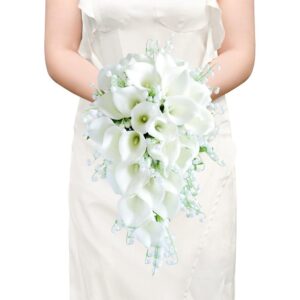
Cascading / teardrop bouquet
7–9
10–15
15–20 (incl. trailing)
32–44
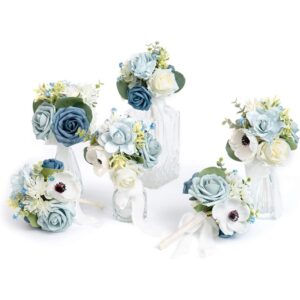
Bridesmaid bouquet (18–22cm)
3–4
4–6
4–6
11–16
Flower girl posy
1–2
2–3
2–3
5–8
Buttonhole
1
0–1 bud
2–3 sprigs
3–5 pieces
Wrist corsage
1–2
2–3 small
2–3 sprigs
5–8 pieces
Table centrepiece, low (bud vases ×3)
3
3–6
3–6
9–15
Table centrepiece, medium arrangement
3–5
5–8
6–10
14–23
Arch, one corner cluster
5–8
8–12
2–3 garlands + 10–20 stems
20–40
Arch, two corners or asymmetric half
10–15
15–25
3–4 garlands + 20–40 stems
60–100
Arch, fully covered
25–40
40–60
6–8 garlands + 50–100 stems
120–200+
Cake, two tiers
2–3
3–5 small
3–5 sprigs
8–13
If you're torn, buy more foliage rather than more flowers. Greenery is cheaper, it's what makes an arrangement look grown, and a flower-heavy bouquet reads as artificial faster than a foliage-heavy one.
7. Bouquets: ready-made, bespoke or DIY
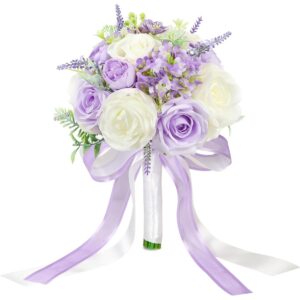
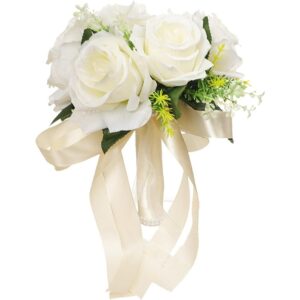
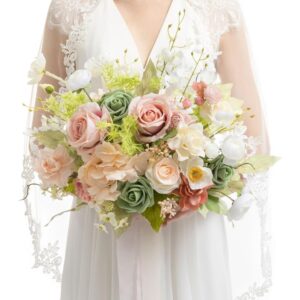
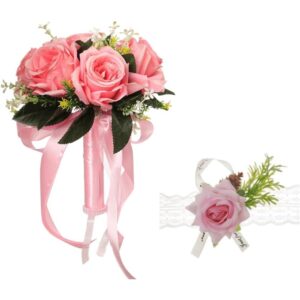
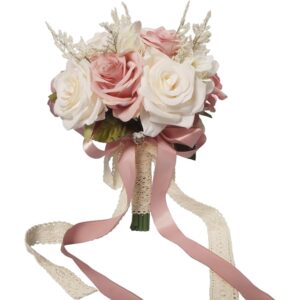
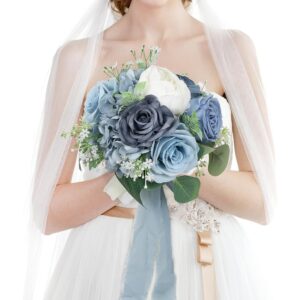
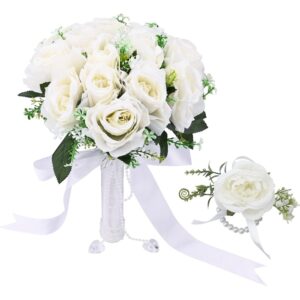
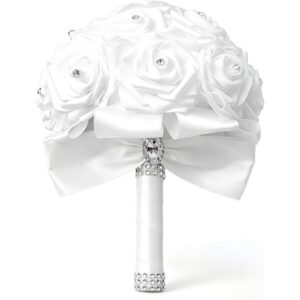
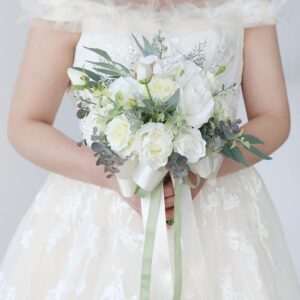
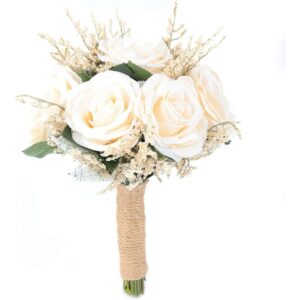
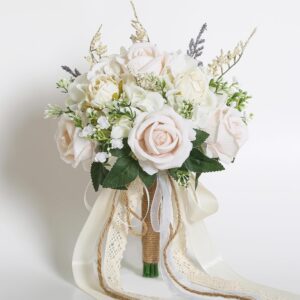
Ready-made bouquets (£30–£150) arrive finished and are the lowest-risk route. Check that the listing names the materials (real-touch, wired silk), states the diameter and the handle length, and shows close-ups of the foliage. Expect to spend ten minutes shaping it on arrival; nothing looks right straight from the box.
Bespoke from an artificial-flower florist (£100–£300 for a bridal bouquet, often with a minimum spend of £350–£1,200 for a full set) gets you a designer's eye, matched bridesmaid and buttonhole sets, and someone else's problem if a stem snaps. Many will send samples and most deliver 4–10 days before the wedding.
DIY costs £40–£90 in stems for a bridal bouquet, £15–£30 per bridesmaid, and takes about 30–45 minutes each once you've done one. The advantages are control, the ability to make it months ahead and remake it if you hate it, and a story. The risk is that a badly built bouquet is the most photographed object of the day. The method is below.
8. How to make a bridal bouquet
You'll need: stems as per the table above, wire cutters (not scissors; nearly every stem has a wire core), green floral tape (stem wrap), 22-gauge floral wire or thin cable ties, 2–3m of ribbon (double-faced satin, velvet or chiffon), pearl-headed pins, and optionally a hot glue gun.
Prepare every stem. Open and shape each flower, bend leaves so they aren't in one plane, and strip leaves from the lower two-thirds of each stem. If a flower head is floppy, push a length of wire up into the base and tape it to the stem.
Start with 3–5 focal flowers held loosely in one hand at slightly different heights. Tape where you're holding them.
Add secondary flowers around them, turning the bouquet a quarter turn after each stem so it builds evenly, and angling each new stem slightly (the spiral technique) rather than pushing them in parallel. Tape every three or four stems.
Add foliage last, mostly around the edge and slightly lower than the flowers, with a few pieces pushed through the centre. Let two or three stems trail lower than the rest.
Step back and check from the front, which is the side that will face the camera when you hold it. Pull a couple of flowers forward and push one back so it has depth.
Bind firmly with a final wrap of tape or two cable ties, then cut all stems level with wire cutters, leaving a handle of 15–20cm. Shorter looks stumpy; longer gets in the way of the dress.
Wrap the handle. Start at the bottom, overlap the ribbon as you spiral up, keep tension, and finish at the top with a pin or a dab of glue. For a tidy knot-free finish, leave a loop at the bottom, feed the ribbon through it at the top and pull the tail to hide the end.
Weight check. A bridal bouquet should be comfortable to hold for an hour. If it's heavy, remove a few stems from the centre; they don't show.
Do the bridesmaid bouquets to the same recipe at two-thirds the stem count so they match. Make the bridal bouquet last, when you're practised.
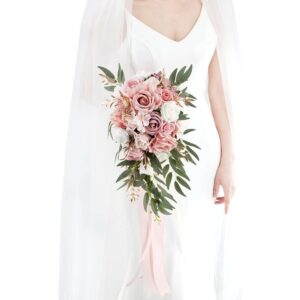
9. Cascading and teardrop bouquets
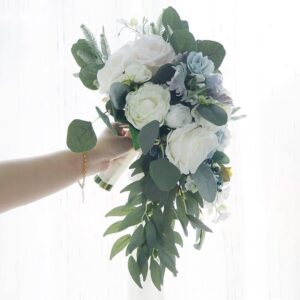
A cascade needs a bouquet holder: a plastic handle with a dome of dry foam (not wet oasis) in a cage. Push the trailing stems in first, low at the front, so they hang 30–50cm; then the focal flowers above them; then fill the dome and the back. Dab waterproof glue at the base of heavier stems so they can't pull out, and wrap the handle in ribbon. A teardrop is the same idea with a shorter trail (15–25cm). Both are heavier at the front, so hold the bouquet low in front of you, not upright, and practise once in the mirror.
10. Buttonholes and corsages
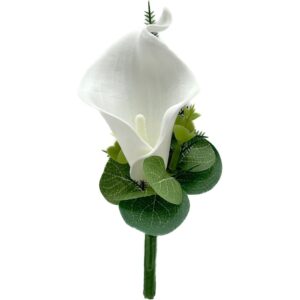
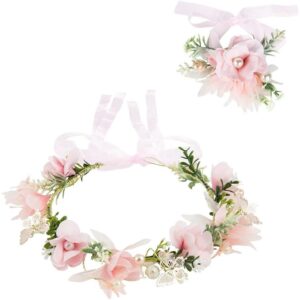
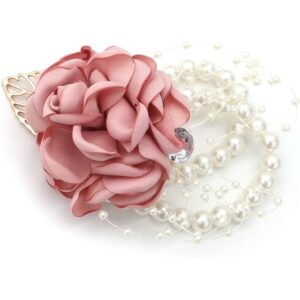
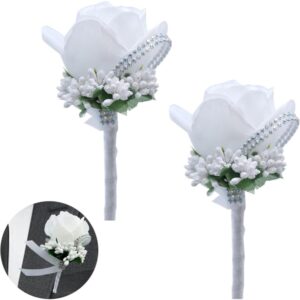
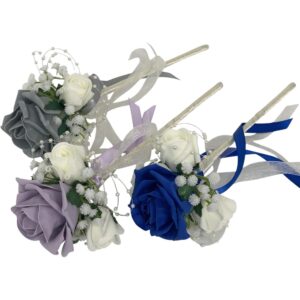
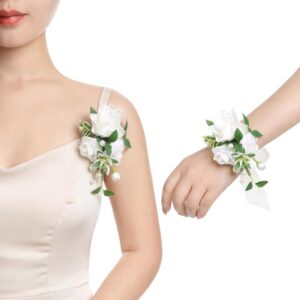
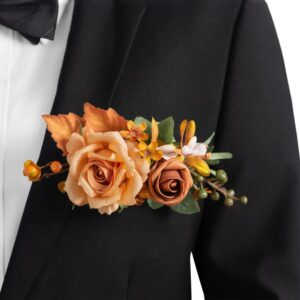
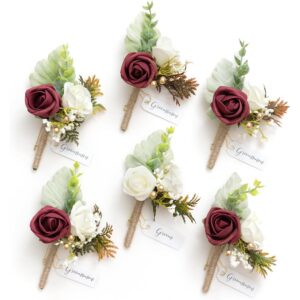
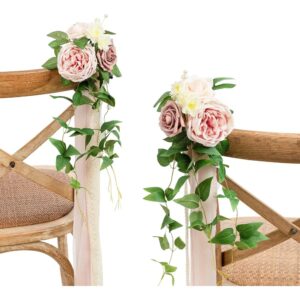
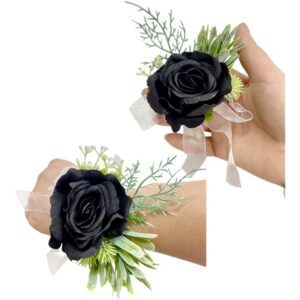
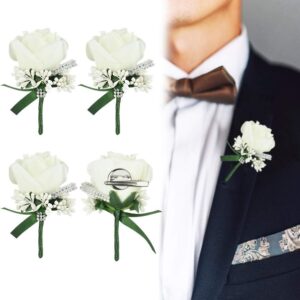
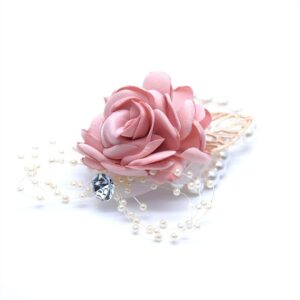
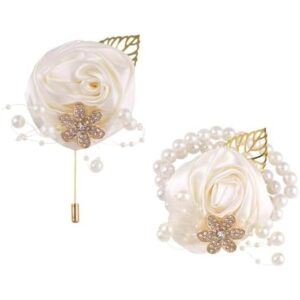
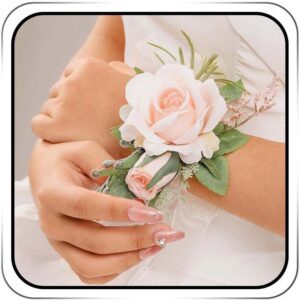
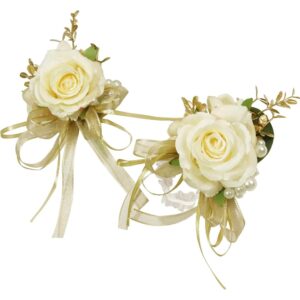
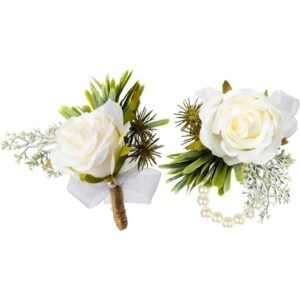
A buttonhole is one flower, a bud if you like, two or three sprigs of foliage, and nothing else; the commonest mistake is adding too much. Cut stems to about 5–7cm with wire cutters, bind with a cable tie or wire, tape, trim level, and wrap the stem in ribbon or twine, finishing with glue or a pearl pin. Add a pin or a magnetic back. Magnets won't damage silk lapels but carry a small-parts and pacemaker caveat, so pins are safer for older guests. A wrist corsage is one or two slightly larger flowers with fillers wired into a diagonal cluster, attached to an elastic wristlet with wire first and glue second, and finished with ribbon. Make these first; they're a good way to learn the tape.
11. Arches, backdrops and hanging installations
Arches are where artificial flowers save the most money and the most stress, because you can build them entirely in advance.
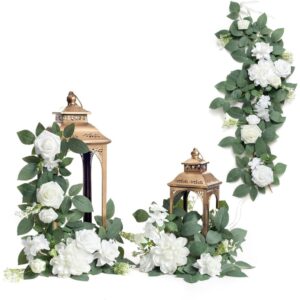
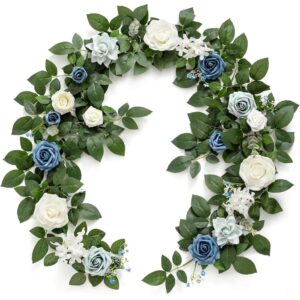
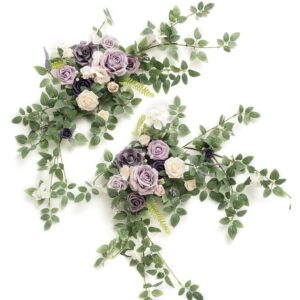
Work in clusters, not single stems. Bundle one focal flower, one or two secondary flowers and some foliage with tape, then fix each bundle to the frame with black or green cable ties (metal and PVC frames), floral wire (wood or circular frames) or pins (fabric-covered frames). Hide the ties behind leaves and trim the ends.
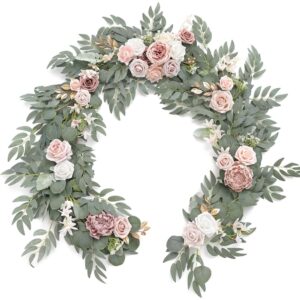
Start with greenery garlands along the frame to create a base, then place the largest flowers at the visual focal points, usually one upper corner and the opposite lower side, then fill with secondary flowers and sprigs.
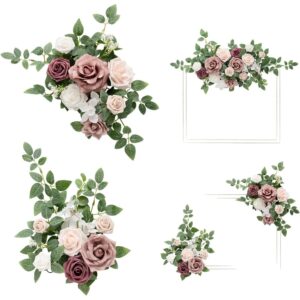
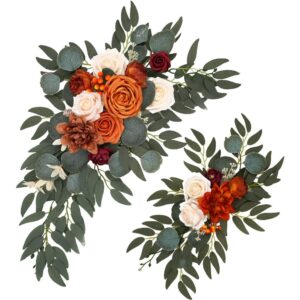
Go asymmetric. A fuller top corner with a lighter trail on the opposite side is both more contemporary and more forgiving than perfect symmetry, and uses half the stems.
Pre-build on foam cages or chicken wire. Arrange flowers into a dry foam cage or a crumpled chicken-wire pillow at home, then cable-tie the finished cluster to the arch on the day in minutes. Hired arches often can't be drilled or glued; cages and ties leave no trace.
Taper. Base clusters should be fuller than the top so the arch doesn't look top-heavy, and check the look from six metres back, which is where guests and the ceremony photographer stand.
Outdoors, weight the frame. A decorated arch is a sail; sandbags on the feet or stakes into the lawn, and a plan for wind.
Hanging installations (wisteria, greenery clouds over the top table) use the same cluster-and-tie method on a hoop or a wire grid. Check the venue's fixing rules and weight limits before you buy, and allow a ladder and two people for the install.
12. Table centrepieces and venue flowers
Centrepieces are the budget multiplier: fifteen tables at £50 fresh is £750 that goes in the bin. With artificial you have options: three bud vases per table with a single stem and a sprig each (£10–£15 a table, and very current); a low mixed arrangement in a bowl on dry foam (£20–£40); or a tall statement on a stand for every third table. Keep sightlines clear (under 30cm or over 60cm) so guests can talk, and use the same stems as the bouquets so the whole wedding reads as one scheme. Make them all at least a month ahead, store them in boxes with tissue between, and fluff on the day. After the wedding they become gifts, resale stock or the hall table for the next decade.
13. Cake flowers: the food-safety rules
Anything touching a cake is a food-contact material, and the Food Standards Agency's guidance is the same for artificial as for fresh: the stem must never go into the cake unprotected. Wash and dry the flowers thoroughly first, cut stems short, and either use posy picks (food-grade plastic spikes that take the stem) pushed only into the surface, or sit flowers on the cake board and between tiers without penetrating the sponge. Ordinary floral tape is not food-safe because of its adhesive, so don't rely on it as a barrier. Keep wire out of the cake entirely, and tell your baker what you're using, because if they place the flowers the responsibility is theirs. Two tiers need two or three focal flowers, a few small ones and some foliage; let the baker see a sample so the colours sit well against the icing.
14. Making them look real in photos
Cameras punish two things: shine and symmetry. Real petals scatter light softly; cheap plastic reflects it, and a direct flash (your photographer's on-camera flash, or a guest's phone) will flare off a glossy leaf and give the game away in one frame.
Buy matt. Real-touch and good silk have no sheen; that's most of the battle.
Style for depth. Vary heights, let a few stems lean and trail, turn one or two flowers away from the camera and leave small gaps. A perfect round dome of identical heads photographs as a prop.
Dust and check for glue. Dust reads grey in close-ups; a glue blob at a calyx reads as plastic. Wipe everything the day before and look at every join.
Tell your photographer. A good one will use bounced or diffused light for the bouquet shots and shoot from slightly above, where silk flowers look best. Golden hour and overcast light flatten the difference between real and artificial to almost nothing.
Mix in one real thing. A few stems of fresh eucalyptus or a sprig of real rosemary in a silk bouquet adds movement at the edges and scent, and the eye credits the whole bouquet with being real.
15. The hybrid approach
The most common choice now is neither all fresh nor all artificial. The pattern that works: artificial for the bouquet you'll keep, the buttonholes and corsages (which die by the speeches anyway), the arch, the hanging pieces and the centrepieces; fresh for a few stems of scented foliage tucked into the bouquet, the flower girl's petals, and anything you want to smell as you walk in. You get the keepsakes, the reliability and most of the saving, and a room that smells of flowers.
16. Packages, hire and resale
Packages (a bridal bouquet, two to four bridesmaid bouquets, buttonholes and corsages in a matched set) run from £30–£60 for basic sets to £300–£800 from artificial florists, and save you matching colours across pieces. Check what's included, the stem quality (real-touch or not) and the delivery date before the wedding.
Hire is a growing option for venue flowers: a company delivers centrepieces, arches and aisle flowers four or five days before, you return them with a prepaid label afterwards, and "normal wedding-day wear" is accepted. Full styling packages with hire start around £1,000–£2,200. Personal flowers are almost always yours to keep. Hire makes sense if you don't want fifteen centrepieces in the loft.
Resale is the other exit. Good artificial centrepieces and arch pieces sell readily to other couples, often for half what you paid, which brings the true cost of a self-sourced wedding down further still.
17. Timeline, storage and the day itself
6–9 months out: decide fresh, artificial or hybrid; order samples.
4–6 months: order everything from one batch, plus 10–15% spare. Make buttonholes and corsages first as practice.
2–3 months: make or receive bouquets and centrepieces; photograph them in daylight and adjust.
Storage: boxes with tissue, heads up and not crushed, in a cool dry room away from radiators, damp and sunlight. Never in a loft that bakes or a garage that sweats.
The week before: dust, fluff, check every join and ribbon, pack a small kit (wire cutters, tape, glue gun, pins, spare stems, cable ties) for the venue.
The day before: fix arch clusters and centrepieces if the venue allows; if not, allow 60–90 minutes and two people on the morning.
The morning: give bouquets a final shape in front of a mirror. Nothing else to do, which is the point.
18. After the wedding
Dust the bouquet, stand it in a vase (no water) or a glass dome out of direct sun, and it will look the same in ten years. Buttonholes make gifts for the groomsmen. Centrepieces become home décor, go to the next couple, or get listed for sale. If a flower fades over the years, swap that one stem rather than the bouquet. Our cleaning guide covers the dusting.
19. Buyer's checklist
Have you ordered samples and checked them in daylight against fabric swatches?
Are the focal flowers in the bouquet, buttonholes and corsages real-touch or top-grade wired silk, with matt finish?
Is the foliage matt, veined and two-tone? (It matters more than the flowers.)
Have you counted heads against the quantities table and added 10–15% spare?
Is everything ordered from one batch?
Do you have wire cutters, floral tape, wire or cable ties, ribbon and pins?
For the arch: cable ties, garlands first, asymmetric plan, a way to weight it outdoors, and venue fixing rules checked?
For the cake: posy picks, flowers washed, baker informed?
Have you told your photographer the flowers are artificial so they light them kindly?
A few stems of real scented foliage to tuck in?
Somewhere cool, dry and dark to store everything for months?
A plan for the centrepieces afterwards: keep, hire, gift or sell?
If you have a question we haven't covered, get in touch and we'll be glad to help.
FAQs
Are artificial wedding flowers cheaper than real ones?
Usually. UK couples spend around £1,000 - £1,500 on fresh wedding flowers; a self-sourced artificial wedding typically costs £300 - £1,500 and a bespoke artificial florist £1,000 - £3,000. A bridal bouquet is £80 - £250 fresh against £30 - £150 artificial, and centrepieces, the biggest multiplier, can be hired or resold afterwards.
How many artificial flowers do I need for a bridal bouquet?
For a round hand-tied bouquet 25 - 30cm across, allow 5 - 7 focal flowers, 7 - 10 secondary flowers and 6 - 10 stems of foliage and filler, about 18 - 27 stems in total. A loose garden style needs more foliage; a cascade needs 30 - 45 stems including trailing greenery. Bridesmaid bouquets use roughly two-thirds of that.
How many artificial flowers do I need for a wedding arch?
A single corner cluster needs 20 - 40 stems plus two or three garlands; an asymmetric half arch 60 - 100 stems; a fully covered arch 120 - 200 or more. Start with greenery garlands cable-tied to the frame, then add flowers in taped bundles at the focal points. Asymmetric designs look more natural and use far fewer stems.
Do artificial wedding flowers look fake in photos?
Only if they're shiny or styled too neatly. Choose matt real-touch or good silk flowers with realistic foliage, vary the heights, let a few stems trail, dust everything and check for glue marks. Tell your photographer so they use diffused rather than direct flash. In soft daylight, quality artificial flowers are indistinguishable from fresh.
Can I put artificial flowers on a wedding cake?
Yes, with the same food-safety rules as fresh: wash the flowers, never push an unprotected stem or wire into the cake, and use food-grade posy picks pushed only into the surface, or rest flowers on the board and between tiers. Floral tape isn't food-safe because of its adhesive. Tell your baker what you're using.
What's the best way to attach artificial flowers to a wedding arch?
Bundle a focal flower, one or two secondary flowers and foliage with floral tape, then fix each bundle with cable ties on metal or PVC frames, floral wire on wooden or circular frames, or pins on fabric-covered frames. Hide ties behind leaves and trim the ends. Pre-build clusters on dry foam cages at home and tie them on at the venue.
How far in advance can I order artificial wedding flowers?
As early as you like. Order samples six to nine months out, buy everything from one batch four to six months ahead, and make or receive bouquets two to three months before. Store them boxed with tissue in a cool, dry, dark room and they'll look identical on the day.
Should I choose real-touch flowers for a wedding bouquet?
For the bouquet, buttonholes and corsages, yes. These are held, photographed close up and looked at by every guest, and real-touch roses, peonies, ranunculus and calla lilies pass that test where printed polyester doesn't. Venue flowers seen from a distance can use good mid-range silk. Check for latex allergies if the bride will hold a latex-coated bouquet for hours.
Can I mix real and artificial wedding flowers?
Yes, and it's the most popular approach. Use artificial for the keepsake bouquet, buttonholes, corsages, arch and centrepieces, and tuck a few stems of fresh scented foliage such as eucalyptus or rosemary into the bouquet. The real greenery adds movement and scent, and guests credit the whole arrangement with being fresh.
What do I do with artificial wedding flowers afterwards?
Keep the bouquet in a vase or glass dome out of direct sun; it will last a decade or more. Give buttonholes to the groomsmen. Centrepieces and arch pieces can be kept for the home, gifted, returned if hired, or resold to another couple, often for about half what you paid.
We use cookies on our website to give you the most relevant experience by remembering your preferences and repeat visits. By clicking “Accept All”, you consent to the use of ALL the cookies. However, you may visit "Cookie Settings" to provide a controlled consent. View privacy & cookies policy.
This website uses cookies to improve your experience while you navigate through the website. Out of these, the cookies that are categorized as necessary are stored on your browser as they are essential for the working of basic functionalities of the website. We also use third-party cookies that help us analyze and understand how you use this website. These cookies will be stored in your browser only with your consent. You also have the option to opt-out of these cookies. But opting out of some of these cookies may affect your browsing experience.
Necessary cookies are absolutely essential for the website to function properly. These cookies ensure basic functionalities and security features of the website, anonymously.
Cookie
Duration
Description
cookielawinfo-checkbox-advertisement
1 year
The cookie is set by GDPR cookie consent to record the user consent for the cookies in the category "Advertisement".
cookielawinfo-checkbox-analytics
11 months
This cookie is set by GDPR Cookie Consent plugin. The cookie is used to store the user consent for the cookies in the category "Analytics".
cookielawinfo-checkbox-functional
11 months
The cookie is set by GDPR cookie consent to record the user consent for the cookies in the category "Functional".
cookielawinfo-checkbox-necessary
11 months
This cookie is set by GDPR Cookie Consent plugin. The cookies is used to store the user consent for the cookies in the category "Necessary".
cookielawinfo-checkbox-others
11 months
This cookie is set by GDPR Cookie Consent plugin. The cookie is used to store the user consent for the cookies in the category "Other.
cookielawinfo-checkbox-performance
11 months
This cookie is set by GDPR Cookie Consent plugin. The cookie is used to store the user consent for the cookies in the category "Performance".
viewed_cookie_policy
11 months
The cookie is set by the GDPR Cookie Consent plugin and is used to store whether or not user has consented to the use of cookies. It does not store any personal data.
Functional cookies help to perform certain functionalities like sharing the content of the website on social media platforms, collect feedbacks, and other third-party features.
Cookie
Duration
Description
na_id
1 year 1 month
This cookie is set by Addthis.com to enable sharing of links on social media platforms like Facebook and Twitter
na_rn
1 month
This cookie is used to recognize the visitor upon re-entry. This cookie allows to collect information on user behaviour and allows sharing function provided by Addthis.com
na_sc_e
1 month
This cookie is used to recognize the visitor upon re-entry. This cookie allows to collect information on user behaviour and allows sharing function provided by Addthis.com
na_sr
1 month
This cookie is set by Addthis.com. This cookie is used for sharing of links on social media platforms.
na_srp
1 minute
This cookie is used to recognize the visitor upon re-entry. This cookie allows to collect information on user behaviour and allows sharing function provided by Addthis.com
na_tc
1 year 1 month
This cookie is set by the provider Addthis. This cookie is used for social media sharing tracking service.
ouid
1 year 1 month
The cookie is set by Addthis which enables the content of the website to be shared across different networking and social sharing websites.
Performance cookies are used to understand and analyze the key performance indexes of the website which helps in delivering a better user experience for the visitors.
Cookie
Duration
Description
_gat
1 minute
This cookies is installed by Google Universal Analytics to throttle the request rate to limit the colllection of data on high traffic sites.
d
3 months
This cookie tracks anonymous information on how visitors use the website.
YSC
session
This cookies is set by Youtube and is used to track the views of embedded videos.
Analytical cookies are used to understand how visitors interact with the website. These cookies help provide information on metrics the number of visitors, bounce rate, traffic source, etc.
Cookie
Duration
Description
__gads
1 year 24 days
This cookie is set by Google and stored under the name dounleclick.com. This cookie is used to track how many times users see a particular advert which helps in measuring the success of the campaign and calculate the revenue generated by the campaign. These cookies can only be read from the domain that it is set on so it will not track any data while browsing through another sites.
_ga
2 years
This cookie is installed by Google Analytics. The cookie is used to calculate visitor, session, campaign data and keep track of site usage for the site's analytics report. The cookies store information anonymously and assign a randomly generated number to identify unique visitors.
_gid
1 day
This cookie is installed by Google Analytics. The cookie is used to store information of how visitors use a website and helps in creating an analytics report of how the website is doing. The data collected including the number visitors, the source where they have come from, and the pages visted in an anonymous form.
Advertisement cookies are used to provide visitors with relevant ads and marketing campaigns. These cookies track visitors across websites and collect information to provide customized ads.
Cookie
Duration
Description
DSID
1 hour
This cookie is setup by doubleclick.net. This cookie is used by Google to make advertising more engaging to users and are stored under doubleclick.net. It contains an encrypted unique ID.
IDE
1 year 24 days
Used by Google DoubleClick and stores information about how the user uses the website and any other advertisement before visiting the website. This is used to present users with ads that are relevant to them according to the user profile.
test_cookie
15 minutes
This cookie is set by doubleclick.net. The purpose of the cookie is to determine if the user's browser supports cookies.
uid
1 year 1 month
This cookie is used to measure the number and behavior of the visitors to the website anonymously. The data includes the number of visits, average duration of the visit on the website, pages visited, etc. for the purpose of better understanding user preferences for targeted advertisments.
uuid
3 months
To optimize ad relevance by collecting visitor data from multiple websites such as what pages have been loaded.
VISITOR_INFO1_LIVE
5 months 27 days
This cookie is set by Youtube. Used to track the information of the embedded YouTube videos on a website.












 A warm welcome from The Artificial Flowers Company. We offer artificial flower arrangements, silk flowers, hanging baskets, topiary balls, topiary plants and much more - we hope you find what you're looking for!
