Artificial olive trees: buying guide
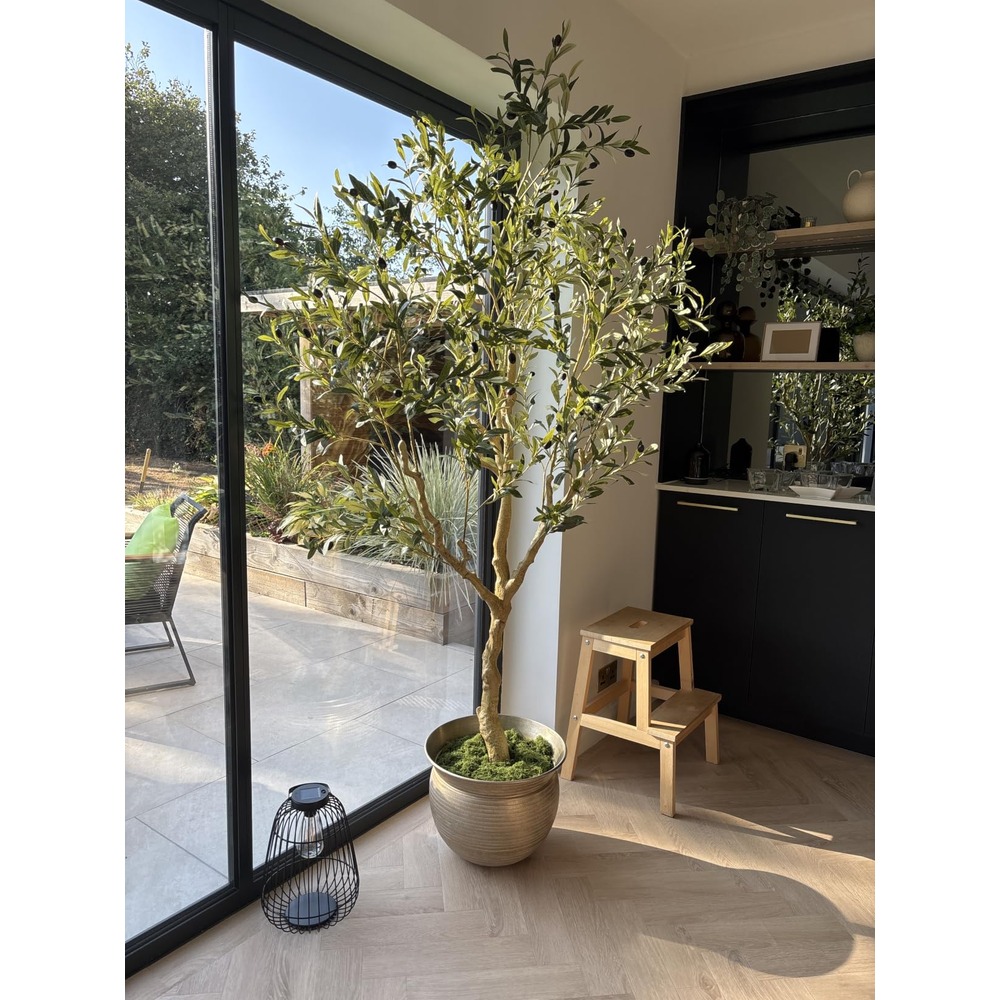
Olive trees are the most popular artificial tree we sell, and for good reason. A real olive wants Mediterranean sun, dry air and a frost-free winter, which is why so many of them sulk, drop leaves and die in British living rooms. A good artificial olive tree gives you the same soft grey-green canopy and sculptural trunk with none of that risk, and in a room with half-decent light most visitors will not spot the difference.
The catch is that olive trees are also one of the easiest artificial trees to get wrong. The leaves are small and pale, so cheap colouring shows; the trunk is meant to be gnarled, so a straight plastic pole looks obviously fake; and the canopy is supposed to be airy, so a sparse tree looks sparse rather than natural. This guide covers the details that are specific to olive trees. For general advice on artificial trees (materials, fire ratings, cleaning and so on) see our main artificial trees buying guide.
What makes a fake olive tree look real
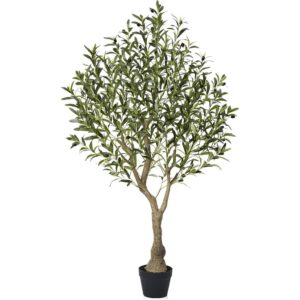
Three things separate a convincing artificial olive tree from one that looks like it came out of a mould, and you can judge all three from decent product photos and reviews.
The leaves
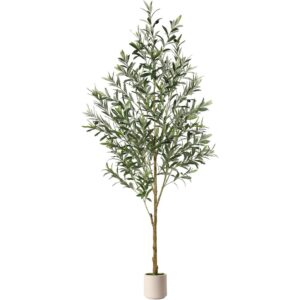
Real olive leaves are narrow, lance-shaped and matte. The upper surface is a muted grey-green or sage, and the underside is noticeably paler and silvery. That two-tone effect is what gives an olive tree its characteristic shimmer when the leaves face different directions, and it is the first thing to look for. Avoid trees whose leaves are a single flat green, bright or glossy. A touch of silver on the reverse is a sign the manufacturer has paid attention.
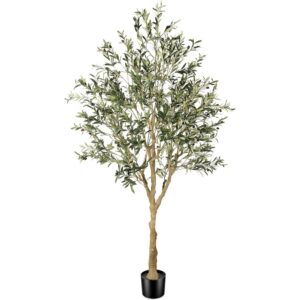
Density matters as much as colour. Listings often quote a leaf count, and it is worth reading. A 150 to 180cm tree generally needs well over a thousand leaves to look full from across the room; the better trees at that height carry two to three thousand. Trees with a few hundred leaves tend to look like a bottle brush however carefully you shape them, and "sparse" is by far the most common complaint in reviews of cheaper olive trees.
The trunk
An olive trunk should be pale, twisted and a little knotty. Manufacturers get there in three ways:
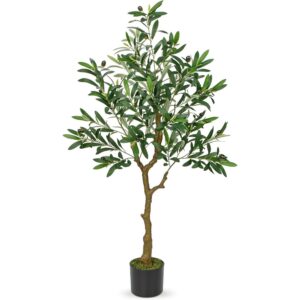
- Real wood trunks use a piece of natural timber with the artificial branches set into it. Each one is slightly different and they read as real even close up, which matters for a tree you will walk past every day. They are also heavier, which helps stability.
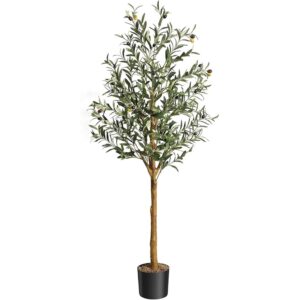
- Moulded trunks in PE or PU can be excellent or terrible depending on the finish. Look for varied colouring and genuine bark texture rather than a uniform brown coating, and check close-up photos for visible seams.
- Wrapped or taped stems are the budget option. They are fine on small tabletop trees but on anything over about 120cm the joins where leaf sprays meet the branch tend to give the game away.
Whichever type you choose, check the branches are wired so you can shape them. A tree with fixed, uniformly upright branches cannot be made to look natural.
The olives
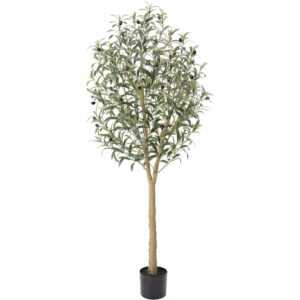
Fruit is optional, and worth thinking about. Well-made olives add a lovely Mediterranean detail, but cheap ones are the most frequently mocked feature of fake olive trees: too shiny, too uniform, and far too many of them. If a tree you like is heavy with fruit, the fix is simple: snip off two thirds of the olives with scissors and leave a scattering. Trees without fruit avoid the problem entirely and tend to look more like the mature, silvery specimens people picture. If you have toddlers or a dog that chews, the olives are small and detachable, so a fruitless tree is the safer choice.
Styles of artificial olive tree
Olive trees come in a handful of distinct shapes, and the right one depends on where it is going.
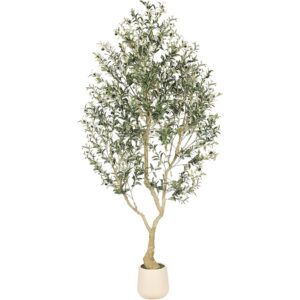
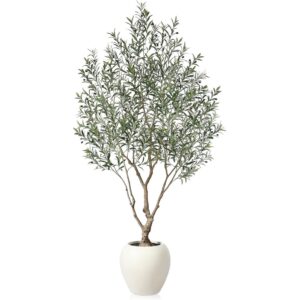
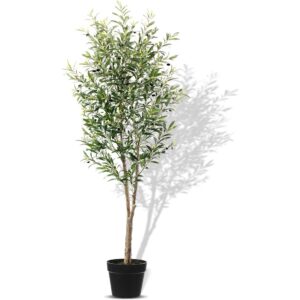
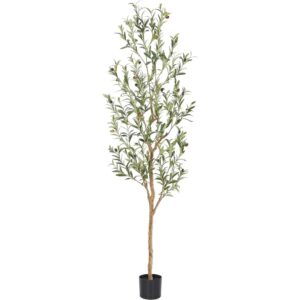
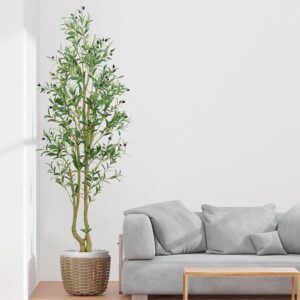
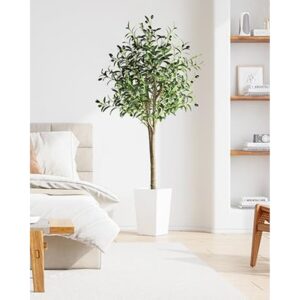
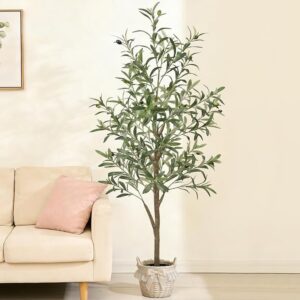
- Natural canopy trees (around 120 to 240cm) have an open, slightly irregular crown and are what most people mean by an artificial olive tree. They suit a corner, beside a sofa, flanking a fireplace or at the end of a hallway.
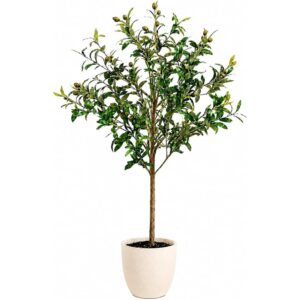
- Topiary or lollipop olives have a clear stem and a clipped ball of foliage. They are formal, symmetrical and best bought in pairs for either side of a front door, a porch or a doorway.
- Olive bushes and multi-stem trees are shorter and wider, with foliage starting low down. They work on a console table, a sideboard or a wide hearth where a tall tree would look stalky.
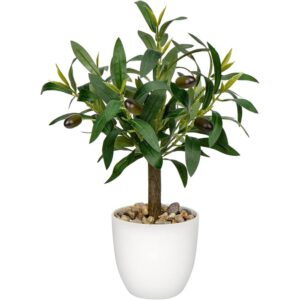
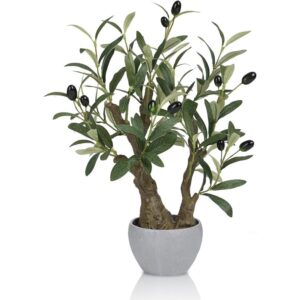
- Bonsai and tabletop olives (around 35 to 65cm) are for shelves, desks and windowsills. The trunk is the main event at this scale, so pick one with a convincingly gnarled stem.
One naming trap to avoid: a "black olive tree" in the artificial trade is usually a different plant altogether (the tropical Bucida), with tiny rounded dark-green leaves and a layered canopy. It is a handsome tree, but it does not look like a Mediterranean olive.
Choosing the right size
Measure the floor-to-ceiling height, then work backwards. Most UK rooms have ceilings of around 2.3 to 2.4m, and a tree of 150 to 180cm fills that height comfortably while leaving the 30 to 40cm of clear space above the canopy that stops it looking crammed in. Two things catch people out:
- Quoted heights almost always include the pot. If you plan to stand the tree in a tall decorative planter rather than drop it in, add the extra height before you decide.
- Spread matters as much as height. Olive canopies are wide relative to their height, often 60 to 90cm on a 180cm tree, and a tree squeezed into a narrow corner looks worse than a smaller one that fits. Wired branches let you pull the shape narrower, but only so far.
| Height | Where it works |
|---|
| 35 to 65cm | Shelves, desks, windowsills, bathroom and kitchen surfaces |
| 90 to 125cm | Console tables and sideboards, or on the floor beside a chair, in a small hallway or a bedroom corner |
| 150 to 180cm | The standard floor-standing size for a living room, dining room or office with normal ceilings |
| 200 to 250cm | Large artificial olive trees for high ceilings, stairwells, open-plan spaces, receptions and shop floors. Nearly all ship in sections and need assembling |
If you are between two sizes and the tree will be a focal point, go larger. A slightly oversized olive tree looks intentional; a slightly undersized one looks like a houseplant that has not grown in.
Indoor or outdoor?
Most artificial olive trees are made for indoors, and the silvery leaf colour that makes them attractive is also what makes fading obvious. Unless a tree is specifically described as UV-resistant or UV-stabilised, keep it out of strong direct sun, and remember that sun through glass counts: a south-facing bay window or a conservatory will bleach an indoor tree over a couple of summers. In a bright room, turn the tree a quarter turn every month or two so any change is even.
For a patio, balcony, porch or front door, buy a tree sold as suitable for outdoor use. Two further points apply specifically to olive trees outside:
- They are top-heavy. A wide canopy on a slim trunk in a light plastic pot is a sail. The single most common outdoor complaint is the tree blowing over, so plan to re-pot into a heavy planter weighted with sand, gravel or bricks, or stand it somewhere sheltered.
- British weather is wet more than it is sunny. Choose a pot with drainage or stand the tree under cover so rainwater does not pool in the base, and bring real-wood-trunk trees under shelter for the winter if you can.
A sheltered porch or covered doorway is a good compromise: a pair of outdoor-rated olive topiaries either side of a front door is the classic use, and they will last far longer there than in open sun.
Pots, planters and stability
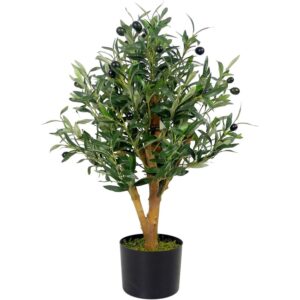
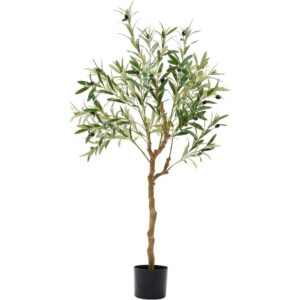
Nearly every artificial olive tree arrives in a small black plastic nursery pot, weighted with a disc of cement or plaster. It is designed to be hidden, not displayed, and leaving it on show is the fastest way to make a good tree look cheap. The pot is also usually glued to the trunk, so do not try to remove it; simply drop the whole thing into a decorative planter.
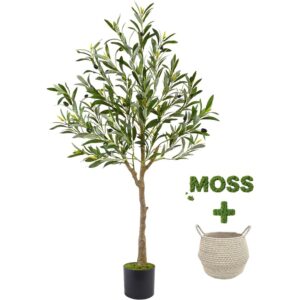
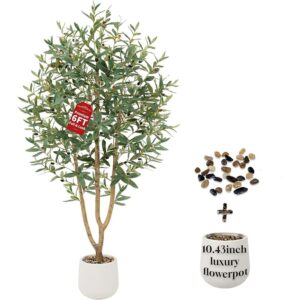
Choose a planter whose opening is a few centimetres wider than the nursery pot. For a 150 to 180cm tree that typically means a planter at least 30cm across; smaller than that and the tree looks rootless, because no real tree of that size could live in it. Pack the gap with crumpled paper, offcuts of foam or gravel so the tree stands straight, then dress the surface with moss, bark or pale stones to hide the plastic. Terracotta, aged stone, pale concrete and woven seagrass all suit olive trees particularly well; glossy ceramics tend to fight with the muted foliage.
Some trees are sold already in a decorative planter. These save a job, but check the planter material in the listing. Many are plastic made to look like stone or ceramic, which is fine indoors but may not be heavy enough on its own for a windy spot.
What to expect when it arrives
Artificial olive trees are shipped compressed, and large ones arrive as a trunk plus a bag of numbered branches that slot into sockets. Set aside twenty minutes to an hour. Fit the branches, then work from the bottom up, bending each one outwards and slightly down and turning the leaf sprays so they face different directions. Aim for a slightly lopsided crown with some gaps you can see through; real olive trees are never a perfect ball. A handful of loose leaves in the box is normal and not a sign of a faulty tree.
Two small warnings from reviews. On some sectional trees the branches sit in their sockets rather than lock, so lift the tree by the trunk or pot when moving it rather than by a branch. And if a tree looks flat on one side, it has usually been shaped to face forwards; rotate the branches around the trunk rather than assuming it is faulty.
What you get at each price
Prices vary a great deal, but as a rough guide for floor-standing trees of around 150 to 180cm: under about £80 you will usually get a wrapped or basic moulded trunk and a thinner canopy that needs careful shaping and a good planter to look its best; between roughly £80 and £200 is where most of the genuinely convincing trees sit, with denser foliage, two-tone leaves and a textured or real wood trunk; above that you are paying for exceptional leaf counts, UV protection for outdoors, or a tree that comes in a substantial planter. Giant trees of 2.4m and above are a different category and are priced accordingly. Whatever your budget, a well-shaped mid-range tree in a generous planter will beat an expensive one left in its nursery pot.
Quick checklist
- Matte, grey-green leaves with a paler underside, not flat bright green
- A leaf count in the thousands for a 150cm-plus tree
- A textured or real wood trunk with no obvious seams or shiny plastic
- Wired branches you can shape
- Olives that look matte and sparse, or none at all
- Quoted height includes the pot; check the spread too
- UV-resistant if it is going outside or in a sunny window
- Budget for a planter at least 30cm wide for floor-standing trees
FAQs
Can artificial olive trees go outside? Only if the tree is sold as UV-resistant or suitable for outdoor use. Standard indoor olive trees fade quickly in direct sun because the pale grey-green leaves show colour loss easily. Even outdoor-rated trees last longest in a sheltered or covered spot, and because olive trees are top-heavy they should be re-potted into a heavy planter so they do not blow over.
What size artificial olive tree should I buy for a living room? For a typical UK room with a ceiling of 2.3 to 2.4m, a tree of 150 to 180cm is the usual choice. It fills the height without crowding the ceiling. Go for 200cm or more only if you have high ceilings or an open-plan space. Remember the quoted height normally includes the pot, and check the spread of the canopy, which is often 60 to 90cm on a 180cm tree.
Does the height of an artificial olive tree include the pot? Almost always, yes. Heights are measured from the base of the nursery pot to the top of the foliage. If you plan to stand the tree in a tall decorative planter rather than drop it inside one, add the planter height to work out the finished size.
How do I make a fake olive tree look real? Three things make the biggest difference. Shape it properly: bend the branches outwards and slightly down and leave a few gaps rather than making a perfect ball. Re-pot it into a decorative planter at least 30cm wide and cover the surface with moss, bark or stones to hide the plastic nursery pot. Place it somewhere with natural or lamp light rather than a dark corner. If it has a lot of olives, snipping most of them off also helps.
Should I choose an artificial olive tree with or without olives? It is a matter of taste, but fruitless trees are the safer bet. Well-made olives add character, but cheap ones are often too shiny and too plentiful and are the feature most likely to look fake. If you buy a tree with fruit, you can always remove some. Trees without olives are also the better choice in homes with small children or pets, as the olives are small and can be pulled off.
Is a real wood trunk worth paying for? Usually, yes, if the tree will be seen close up. A natural timber trunk has genuine grain, knots and irregular shape that moulded plastic struggles to match, and the extra weight makes the tree more stable. A well-finished moulded trunk can look very good from a normal viewing distance, so if the tree is going in a corner or across a room, a good moulded trunk is perfectly acceptable.
Do artificial olive trees need assembling? Small and sometimes medium trees usually arrive in one piece but compressed, so they need shaping. Large trees of around 180cm and above typically ship as a trunk with separate numbered branches that slot into sockets. Allow twenty minutes to an hour to assemble and shape a large tree. A few loose leaves in the box is normal.
How do I stop an artificial olive tree falling over? Re-pot it. The small nursery pot has a weighted base but it is rarely enough for a tall, wide-canopied tree, especially outdoors or in a home with pets and children. Drop the nursery pot into a larger, heavier planter and pack the gap with gravel, sand or bricks before dressing the top with moss or stones.
Will an artificial olive tree fade in a sunny window? It can. Sunlight through glass fades indoor-grade foliage just as it does outside, and the pale olive leaf colour shows it more than darker greens would. Keep indoor trees out of strong direct sun where possible, or turn the tree every month or two so any fading is even. For a very bright conservatory or south-facing window, choose a UV-resistant tree.
What is the difference between an artificial olive tree and an artificial black olive tree? Despite the name, a black olive tree is usually a different plant, the tropical Bucida, which has small rounded dark-green leaves in flat layers. It does not have the silvery, narrow-leaved Mediterranean look of a true olive. If you want the classic olive tree appearance, look for grey-green, lance-shaped leaves.
What size planter does an artificial olive tree need? For a floor-standing tree of 150cm or more, a planter at least 30cm in diameter looks right; anything smaller makes the tree look as if it could not possibly have roots. The opening should be a few centimetres wider than the nursery pot so it drops in and sits below the rim. Terracotta, aged stone, pale concrete and woven baskets all suit olive trees well.
How many leaves should a good artificial olive tree have? Leaf count is a useful guide to how full the tree will look. A convincing 150 to 180cm tree generally has well over a thousand leaves, and the best have two to three thousand. Trees with only a few hundred leaves at that height tend to look thin however carefully they are shaped, which is the most common complaint in reviews of cheaper olive trees.
 A warm welcome from The Artificial Flowers Company. We offer artificial flower arrangements, silk flowers, hanging baskets, topiary balls, topiary plants and much more - we hope you find what you're looking for!
