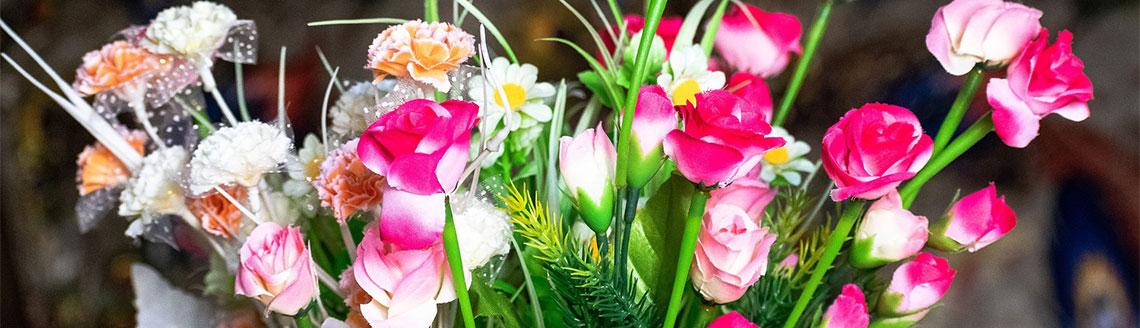
One of the most common worries we hear from people styling artificial window boxes is that the finished display looks a little too perfect. Real plants are gloriously messy. They grow at different speeds, lean towards the light, fade unevenly and sprawl in directions you never planned. Faux flowers, on the other hand, can sometimes turn out so tidy and symmetrical that they give the game away.
The good news is that a natural-looking window box is well within reach. With a few simple tricks around spacing, height, colour and a willingness to embrace a little imperfection, you can create a display that fools passers-by and looks wonderfully alive all year round. Here is how to stop your artificial window box looking too neat.
Why “too neat” gives the game away
Nature rarely produces a row of identical blooms at exactly the same height, evenly spaced and all facing forward. Yet that is precisely what happens if you pop your stems straight into a box without thinking about how real plants actually grow.
The eye is surprisingly good at spotting this. A perfectly balanced, mirror-image arrangement reads as artificial even from a distance. The aim is to introduce the gentle randomness you would see in a thriving real planter, where some flowers reach for the sun, others tuck themselves away, and foliage tumbles and gathers in irregular clumps.
Embrace uneven spacing
The single biggest improvement you can make is to stop spacing your flowers evenly. Real plants cluster, crowd and leave little gaps. When you are poking stems into your foam or base, resist the urge to keep them an equal distance apart.
A few practical ways to break up the spacing:
- Group two or three flowers of the same type closely together, then leave a slightly larger gap before the next cluster.
- Work in odd numbers. Threes, fives and sevens tend to look more organic than neat pairs or fours.
- Let some stems sit deeper in the box while others stand slightly proud, so they are not all emerging from the same level.
- Allow a few flowers to overlap and lean against their neighbours rather than standing perfectly upright in their own space.
It can feel counterintuitive to deliberately bunch things up, but this is exactly how a healthy, established planter behaves once it has filled out.
Mix your heights for a natural silhouette
A flat, level top is another quick giveaway. In a real window box, taller plants jostle above shorter ones, buds sit lower than open blooms, and foliage pokes up at all sorts of angles.
A popular and reliable approach is to build around a taller centrepiece, then surround it with shorter flowers and let foliage soften the edges. From there, vary everything:
- Trim or reposition stems so no two of the same flower sit at identical heights.
- Place taller, statement pieces slightly towards the back, with lower blooms and trailing greenery towards the front.
- Use the bendable nature of good quality wired stems to tilt some flowers forward, others to the side, and a few almost upright.
- Let a few stems stand noticeably taller than the rest, as a real plant would when it sends up a new flower spike.
If your window box sits on a balcony, railing or sill where it will be seen from below or the side, trailing elements such as an artificial ivy bush or a fern-style trailing plant work beautifully to cascade over the edge and break up that rigid horizontal line.
Choose flowers with natural colour variation
Cheaper faux flowers often suffer from flat, uniform colour, where every petal is the identical shade of pink or yellow. Real petals are far more subtle, shifting from pale to deep, with shadows in the centre and lighter edges.
When choosing silk flowers and artificial blooms for a window box, look for:
- Multiple shades within a single flower, so petals fade from one tone to another.
- Foliage that includes a few darker, lighter or even slightly browned leaves rather than one solid green.
- A mix of open flowers, half-open blooms and tight buds, which adds realism and suggests a plant at different stages.
You can also mix several colours and flower types rather than relying on a single uniform variety. Silk hydrangeas, geraniums and other classic window box favourites all come in tones that sit happily alongside one another, and the gentle contrast reads as far more natural than a single block of colour.
Layer different textures and shapes
Realism comes from variety, not just in colour but in form. A box made entirely of round, full flower heads looks staged. Real planting combines spiky, rounded, feathery and trailing shapes all at once.
Try combining:
- Larger, showy focal flowers as the stars of the display.
- Smaller filler flowers to soften the gaps between them.
- Different leaf shapes, from broad and glossy to fine and ferny.
- Trailing foliage to spill over the front and sides.
This layering also helps fill any awkward gaps and hides the mechanics of the arrangement, which we will come to shortly.
Allow a little imperfection
This is the part many people find hardest. Once everything is in place, the temptation is to straighten every stem and make it all symmetrical. Try to resist.
A few deliberate imperfections make an enormous difference:
- Let one or two flowers droop or nod slightly, as a real bloom would after a few days.
- Bend a stem so it leans away from the others rather than standing to attention.
- Leave a small gap here and there rather than packing every space tightly.
- Avoid creating a perfect mirror image between the left and right sides of the box.
Step back regularly and view the box from where it will actually be seen, ideally from a few metres away and at the angle a visitor or passer-by would have. It is much easier to spot an overly tidy arrangement from a distance than with your nose pressed up against it.
Fluff, shape and adjust the foliage
Artificial flowers and foliage are often flattened in packaging, so they need a little attention before they look their best. Take the time to separate compressed leaves, bend individual stems and open out the foliage so it looks full rather than squashed.
Pay particular attention to the greenery. Real foliage rarely sits in a perfect dome. Tease some leaves up, push others down, and let a few cross over their neighbours. Well-shaped foliage does an enormous amount of the heavy lifting when it comes to a believable display, far more than the flowers alone.
Hide the base for a polished finish
Nothing breaks the illusion faster than visible foam or a bare plastic base peeping through. Once your stems are arranged, cover the surface to suggest soil and a planted look.
You can use decorative moss, small pebbles or a layer of artificial moss to disguise the base and tuck into any gaps between stems. This not only conceals the mechanics but adds another layer of natural texture and helps everything feel grounded and established rather than freshly poked into a block of foam.
Getting the practical setup right
A natural look is much easier to achieve when the box itself is stable and well filled. A few practical pointers:
- Choose a trough that suits your window. A depth of roughly six to eight inches gives you enough room for a fuller, more layered arrangement.
- Use a firm base such as florist’s foam, packed in tightly so stems hold their position and angle without shifting.
- If the box will sit on a sill, railing or balcony, weigh down the bottom with stones, sand or a few small rocks so wind cannot tip or rattle it.
- Allow enough flowering stems to fill the space generously. A sparse box looks artificial; a full, slightly overflowing one looks alive.
If you are unsure how many stems you need, it is better to err on the side of a few too many. You can always remove or reposition them, and a well-filled box almost always looks more convincing.
Why artificial window boxes are worth the effort
Once styled well, an artificial window box rewards you with year-round colour and almost no upkeep. There is no watering, no deadheading, no wilting in a summer heatwave and no bare patches in winter. They are a genuine help in shaded spots where real flowers struggle, and they suit allergy-sensitive households since there is no pollen or scent to contend with.
If your box will live outdoors, do bear in mind that exposure to strong sunlight and harsh weather can affect any artificial display over time, with some gradual colour softening on the sunniest sides. Choosing good quality blooms designed for the look you want, and positioning the box in a slightly sheltered or semi-shaded spot where you can, will help it stay looking its best for longer. Many people also rotate or refresh a few stems seasonally, which keeps the display feeling current and spreads any wear more evenly.
A final word
The secret to a believable artificial window box is to stop thinking like a tidy-minded decorator and start thinking like nature. Uneven spacing, varied heights, gentle colour variation, mixed textures and a few accepted imperfections all combine to create something that looks effortlessly real rather than rigidly arranged.
Take your time, build around a focal point, fluff out the foliage, cover the base and view your work from a distance as you go. With a little patience and a willingness to let things look a touch unruly, your faux floral window box will bring colour and charm to your home for years, without a watering can in sight.
 A warm welcome from The Artificial Flowers Company. We offer artificial flower arrangements, silk flowers, hanging baskets, topiary balls, topiary plants and much more - we hope you find what you're looking for!