There’s something quietly satisfying about a beautifully dressed window on a period home. Whether you live in an elegant Georgian terrace or a characterful Victorian villa, the right window box can frame your windows perfectly and add charm without overwhelming the architecture. The challenge is getting it to look authentic and in keeping with the age of the house, rather than fussy or modern.
Artificial window boxes make this surprisingly straightforward. With no watering, no wilting and no seasonal gaps to worry about, you can create a display that stays looking smart all year round. In this guide, we’ll look at how to style artificial window boxes for Georgian or Victorian homes, with practical advice on symmetry, planting choices, colours and placement that respect the period of your property.
Why artificial window boxes suit period homes
Period properties were built with proportion and detail in mind, and their windows are often a focal point. A well-considered window box enhances that rather than competing with it. Artificial displays have a particular advantage here because they let you maintain a consistent, polished look without the unpredictability of live planting.
The practical benefits are worth spelling out:
- No watering or feeding, which is especially helpful for upstairs windows or hard-to-reach ledges.
- Year-round appearance, so your frontage never looks bare in winter or scorched in high summer.
- Suitability for shaded aspects, where real bedding plants often struggle to thrive.
- No soil, mess or dripping water down your brickwork or render.
- A reliable look that’s ideal if you let your property, run a business from it or simply want one less job to think about.
For homes governed by conservation considerations or simply where you want a refined, settled appearance, faux planting gives you control over the finished effect.
Start with symmetry and proportion
If there’s one principle that defines both Georgian and Victorian design, it’s balance. Georgian facades in particular are built on symmetry, with windows arranged in orderly rows and even spacing. Your window boxes should echo this.
A few simple rules will keep things looking right:
- Match your window width. A box should run close to the full width of the window so it looks intentional rather than perched.
- Keep boxes identical across matching windows. If you’re dressing two or more windows on the same elevation, use the same box, the same plants and the same arrangement on each.
- Mind the depth. A trough that’s roughly fifteen to twenty centimetres deep gives you enough room to anchor stems securely and create a full, generous display.
- Aim for a gentle centre point. A slightly taller plant in the middle, with lower planting tapering to either side, suits classic architecture beautifully.
Victorian homes can carry a little more abundance and informality than the strict order of Georgian properties, but even then, restraint reads as more authentic than an overflowing jumble.
Choosing period-appropriate plants
The plants you’d see in a traditional window box are remarkably consistent across the years, which makes choosing artificial versions straightforward. The classics are classics for a reason.
Geraniums
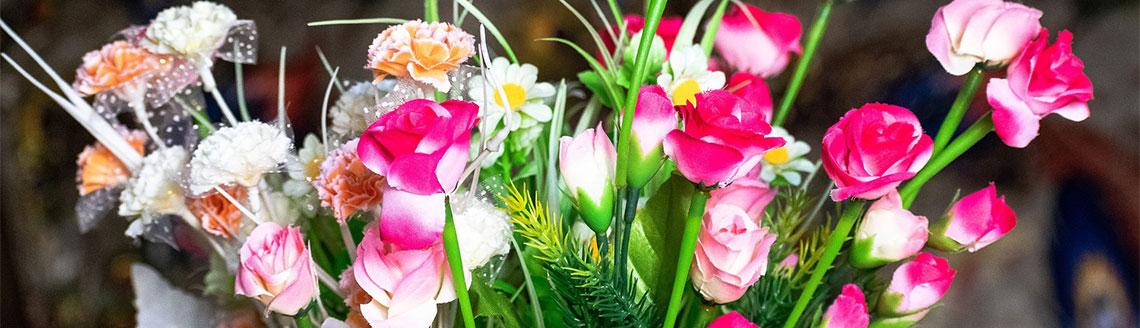
The trailing or upright geranium (more correctly the pelargonium) is the quintessential period window box flower. Reds, soft pinks and whites all work, and their slightly informal habit looks established and homely. Artificial geranium bushes give you that recognisable shape and colour without any deadheading.
Ivy and trailing foliage
Trailing artificial ivy is invaluable for softening the edges of a box and letting greenery cascade down the wall. It instantly makes a display look more natural and lived-in, and it pairs with almost any flower. A length of ivy at each end of the trough frames the planting and grounds it against the brickwork.
Box and clipped greenery
For a more formal, restrained look that suits Georgian frontages especially well, consider artificial box foliage or small topiary shapes. A pair of neat artificial topiary balls or low clipped greenery in a window box gives a tailored, architectural finish that needs no shaping or trimming.
Other suitable choices
- Lavender for a soft, muted, country feel.
- Ferns for shaded windows where a fresh green look is wanted.
- Pansies and primroses for gentle seasonal colour without being garish.
- Trailing fuchsia for a touch of Victorian charm.
Getting the colours right
Bright, clashing colours can look out of place on a period home, where the architecture often does the talking. Muted, considered palettes tend to flatter older properties far more.
A few approaches that work well:
- Tonal greens with white. Crisp, classic and never wrong, this suits both Georgian formality and Victorian elegance.
- Soft reds and deep pinks. Traditional geranium shades that feel rooted in the period.
- Lavender, dusky purple and silvery foliage. Gentle and slightly romantic, ideal for cottage-style Victorian homes.
As a rule, choose two or three colours and repeat them, rather than mixing a little of everything. A restrained palette looks more deliberate and far more in keeping with the age of the house. The most convincing artificial flowers also have subtle variation across their petals rather than one flat colour, which helps the display read as natural from the street.
Assembling your artificial window box
Putting together a faux window box is genuinely easy, and the results last for years. The basic method is much the same whatever plants you choose.
- Line and weight the box. A plastic liner or bag inside the trough keeps it tidy, and a layer of stones or sand in the base adds weight so it sits steadily on a ledge or railing.
- Add a block of dry foam. Florist’s foam cut to fit the trough holds your stems firmly in place. Unlike with fresh flowers, you want it dry, as it simply acts as an anchor.
- Position your centrepiece first. Place any taller plant or topiary shape in the middle to establish your height.
- Build outwards with flowers. Add geraniums or your chosen blooms either side, keeping the arrangement balanced left to right.
- Finish with trailing foliage. Tuck ivy or other trailing stems at the ends and front edge so they cascade naturally.
- Adjust and fluff. Bend the wired stems gently, vary the heights slightly and open out the leaves until it looks relaxed rather than rigid.
A box of this size will typically take somewhere between six and ten flowering bushes plus foliage, though it depends on how full you like the look.
Placement and fixing
How and where you mount your window boxes matters as much as what’s in them. On a period home, the box should feel like a natural part of the frontage.
- Sit boxes on sills or fix them on sturdy brackets. Make sure brackets are secure, especially for upper-floor windows, and avoid damaging original stonework where possible.
- Consider the viewing angle. Window boxes are mostly seen from below and from the street, so build a little height and let the front edge be generous.
- Think about exposure. South-facing windows get the most sun, while sheltered aspects are kinder to any outdoor display over time.
Outdoor use, weather and longevity
It’s worth being realistic about outdoor conditions. Artificial flowers placed outside will always be exposed to the elements, and over time strong sunlight can gradually fade colours, while wind and weather take their toll on any display.
To keep your window boxes looking their best:
- Choose displays intended for outdoor use, and check the product details before buying.
- Position boxes in slightly more sheltered spots where you have the choice.
- In extreme weather, such as severe storms, you may wish to bring arrangements in or move them somewhere more protected.
- Accept that an outdoor display will not stay flawless forever, though good-quality faux planting can look excellent for a long time with minimal attention.
One genuine bonus is that artificial flowers don’t attract insects, since there’s no pollen or nectar, which can be welcome around windows and doorways.
Keeping your window boxes looking smart
Care is refreshingly simple. The main thing is keeping dust, pollen and grime at bay so the colours stay fresh.
- Dust regularly with a soft brush or cloth.
- Rinse gently if outdoor boxes pick up dirt, then let them dry before repositioning.
- Reshape stems after windy spells to restore the arrangement.
- Store seasonal displays carefully if you swap them, keeping them somewhere dry and out of crushing weight so the stems hold their form.
Seasonal variations without the upkeep
One of the pleasures of faux planting is that you can rotate your look without replanting. You might keep a fresh, colourful scheme of geraniums and trailing greenery for spring and summer, then switch to something quieter for the colder months.
For autumn and winter, muted greens, whites and structural foliage tend to suit period homes beautifully. Small artificial conifers, ferns, clipped greenery and a few white blooms read as elegant and seasonal, and avoid the slightly odd effect of bright summer flowers in midwinter. Because everything is artificial, you simply lift out one arrangement and slot in another.
A few buying considerations
When choosing artificial flowers and foliage for a period-home window box, a little care at the buying stage pays off:
- Look for realistic detail. Natural colour variation, lifelike foliage and stems you can gently bend all make a display more convincing.
- Check the intended use. Confirm whether items are designed for outdoor display if that’s where they’ll live.
- Buy enough to fill the box generously. Sparse planting looks artificial in the wrong way, so factor in foliage as well as flowers.
- Stick to your palette. Resist buying a bit of everything, and keep to the restrained scheme you’ve chosen.
Bringing it all together
Styling artificial window boxes for a Georgian or Victorian home really comes down to a few timeless principles: respect the symmetry of the architecture, choose classic plants like geraniums, ivy and box, keep your colours muted and restrained, and resist the urge to overfill. Do that, and you’ll have window boxes that look settled and authentic, framing your windows the way the builders of these lovely old homes intended.
Best of all, you’ll get that polished period charm without the watering can, the deadheading or the disappointment of a winter gap in the planting. A thoughtfully arranged artificial window box is one of the simplest ways to give a traditional home a warm, well-cared-for face to the street, all year round.
 A warm welcome from The Artificial Flowers Company. We offer artificial flower arrangements, silk flowers, hanging baskets, topiary balls, topiary plants and much more - we hope you find what you're looking for!