artificial hanging baskets, topiary balls, hedges and topiary trees
Christmas floral arrangements & centrepieces
Christmas floral arrangements make the table feel dressed before the first plate is laid. A low centrepiece leaves room for conversation, while a taller display can bring colour to a sideboard or entrance table. Look for a shape that suits the setting, with enough space around it for serving dishes and glasses. Artificial flowers and festive foliage let you prepare your Christmas display early and bring it out for each gathering.
Christmas floral arrangement or centrepiece: buy guide
A good Christmas arrangement does one job well: it makes a table, mantelpiece or hallway feel finished without getting in the way. The difference between one that looks right and one that quietly annoys everyone for a fortnight usually comes down to size, shape and where you put it, rather than how expensive it was. This guide covers what to measure, what to look for in quality, what to expect if an arrangement needs a little assembly, and how to use candles safely with artificial foliage.
Artificial or fresh?
Fresh Christmas flowers are lovely but short-lived. Cut pine and fir start dropping needles within a week or two indoors, and flowers such as amaryllis and roses are usually past their best by the time the main event arrives if you buy them in early December. That leaves you either buying twice or living with a tired arrangement on Christmas Day.
An artificial Christmas arrangement can go out at the end of November and still look the same on Twelfth Night. It can sit next to a radiator, it will not leak onto the table, and the same piece comes out again next year. The trade-off is scent: faux fir does not smell of anything. The simplest fix is to tuck a few sprigs of real spruce or eucalyptus into the arrangement a day or two before guests arrive, or to put a pine-scented candle elsewhere in the room. Nobody will be inspecting the needles.
Start with where it is going
Before you look at a single product, decide where the arrangement will live and measure that space. The right centrepiece for a dining table is often the wrong one for a mantelpiece, and vice versa.
Dining table
A Christmas table flower arrangement has to share the table with plates, glasses, serving dishes and people who want to talk to each other. Three measurements matter:
Height. Keep it below eye level when seated, which in practice means no more than about 30cm. Florists use a simple test: sit at the table, rest your elbow on it, and the height of your wrist is the maximum height for the arrangement. Taller pieces only work if they are very narrow at eye level (a slim taper candle, for example) or so tall that guests see underneath them, which is rarely practical at home.
Width. Most UK dining tables are 80–100cm wide. Allow at least 15–20cm either side of the centrepiece for dishes to be passed, which means something around 30–40cm across is about the limit on a standard table.
Length. On a rectangular table, a single centrepiece should take up no more than about a third of the length. On a table over 180cm, two or three smaller arrangements spaced along the middle usually look better than one long piece, and they can be moved to a sideboard when the food comes out.
If your table extends for Christmas, buy for the size it will be on the day, but check the arrangement will not look oversized once the table goes back to normal. Two smaller pieces are more flexible than one large one for exactly this reason.
Round tables suit a round or square arrangement placed dead centre, roughly a quarter to a third of the table's diameter across.
Mantelpiece
Mantels are shallower than they look, often only 15–20cm deep. An arrangement that is round in plan will either hang off the front or have to be pushed back against the wall. Look for pieces described as front-facing, half or flat-backed, which are designed to sit against a wall with all the detail on one side. If the fireplace is used, keep artificial foliage well clear of it; polyester and plastic foliage will melt and can ignite, and rising heat can distort it even without a flame.
Sideboard, console or hall table
This is where taller, fuller arrangements come into their own. Without the sightline problem of a dining table, a 45–60cm piece in an urn or tall vase can make an entrance. Check the depth of the surface as you would a mantel, and if the arrangement is mainly seen from one side, a front-facing design makes better use of the budget than a fully round one.
Coffee table
Low and compact works best here. Anything with candles should be stable enough not to tip if the table is knocked, and the arrangement should leave room for the things a coffee table actually gets used for.
Shapes of Christmas arrangement and where each works
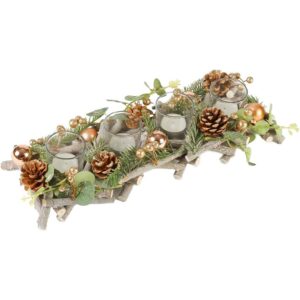
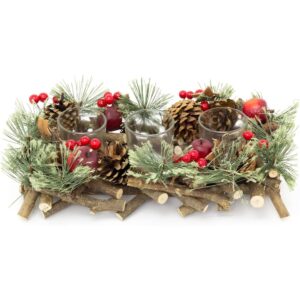
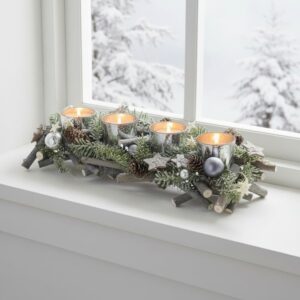
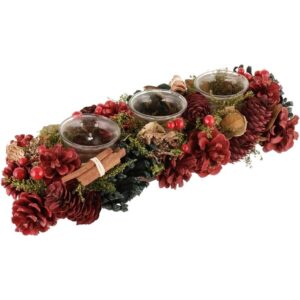
Long and low. A horizontal arrangement of foliage, berries and flowers, often with candle holders set along the length. This is the classic Christmas table centrepiece and the shape most retailers mean by the word. Works on rectangular tables and deep sideboards; too long for most mantels.
Round or posy style in a bowl or vase. Flowers and foliage arranged in a dome. Suits round and square tables, coffee tables and side tables. Check the overall height, as the vase adds to it.
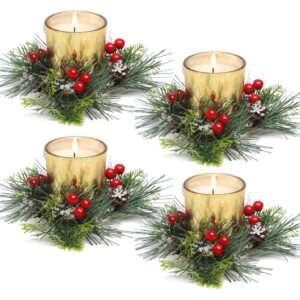
Candle ring or wreath centrepiece. A ring of foliage with space in the middle for a single pillar candle, or four holders around it in the Advent tradition. Compact and symmetrical, so it works well on round tables.
Tall arrangement in an urn or vase. Height and presence for a hall or sideboard. Not for dining tables.
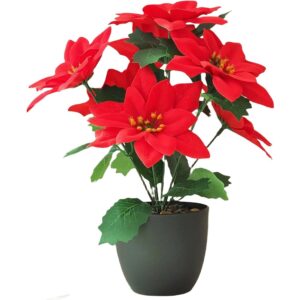
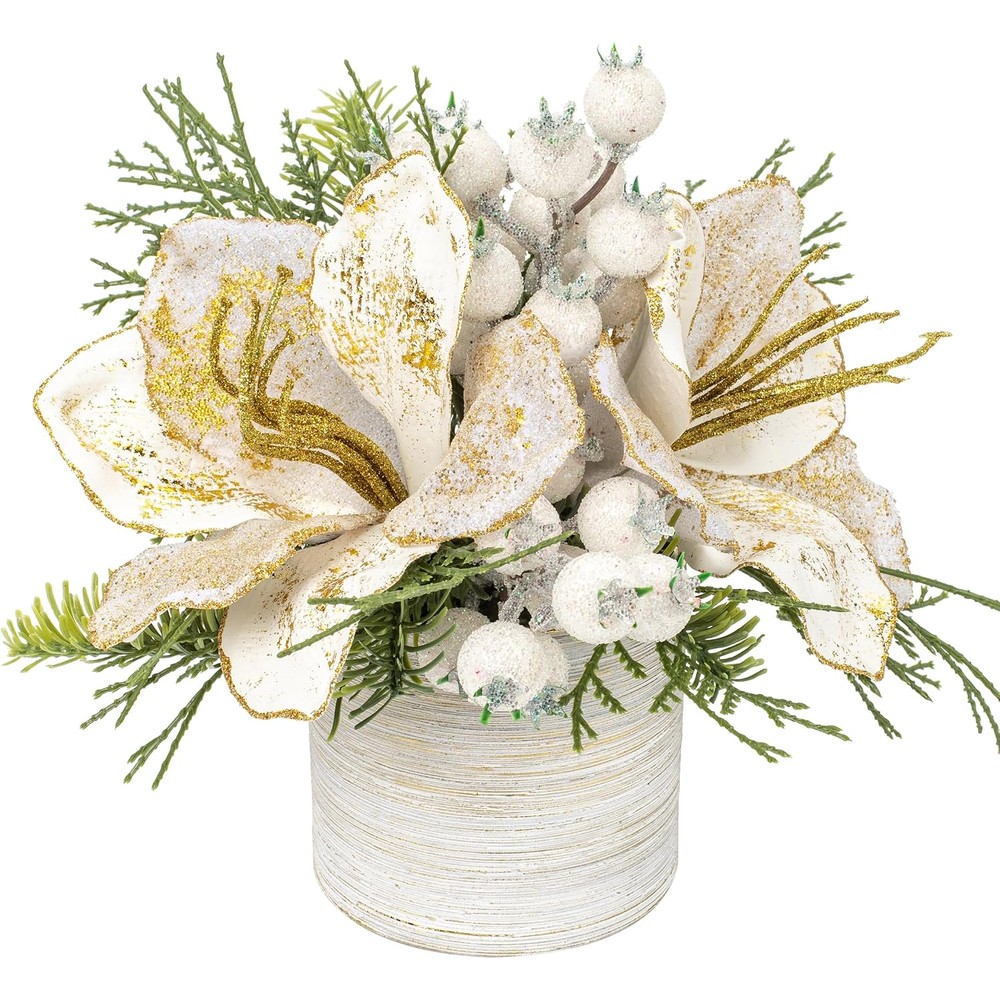
Single statement plant. A faux poinsettia, amaryllis or orchid in a pot. Simple, and useful on windowsills and smaller surfaces where a mixed arrangement would be too busy.
Candles: LED or real candle holders?
Many Christmas floral centrepieces include candles in some form. Some of ours come with LED candles built in; others have ordinary candle holders for you to add your own. Each has its own things to check.
Arrangements with LED candles
Batteries. Small tea-light style LEDs usually take CR2032 coin cells; pillar-style LED candles usually take AA or AAA. Check which type, whether they are included, and how easy the battery compartment is to reach once the candle is sitting in the foliage. You will be changing them at some point.
Timer. A built-in timer (commonly six hours on, eighteen off) means you switch the arrangement on once at the time you want it lit and then leave it alone for the season. Without one, you are reaching into the foliage every evening.
Colour of light. Warm white (roughly 2200–2700K) looks like candlelight. Cool, bluish LEDs look like a torch and flatten the colour of red berries and foliage. A gentle flicker is more convincing than a steady glow.
Candle finish. Real wax or wax-coated LED candles look much better than smooth plastic ones at close range.
LED candles are the safer choice on a dining table, where people are reaching across, and the only sensible choice if the arrangement will be lit when nobody is in the room.
Arrangements with candle holders
Real candles give a warmth that LEDs still do not quite match, but artificial foliage is plastic and fabric and will burn. If you are buying an arrangement with candle holders:
Check the holder size before buying candles. Standard UK dinner (taper) candles have a base of about 22mm; pillar holders vary widely. A candle that rattles in its holder is a tipping risk, and one that has to be forced in can crack the holder. A small blob of candle wax or a candle grip fixes a slightly loose fit.
Keep the flame well above and away from the foliage. Fire services advise keeping any flame at least 30cm from anything that can burn. In a centrepiece that is not always achievable, so use tall tapers rather than short ones, make sure nothing arches over the holder, and extinguish candles before they burn down to within about 5cm of the foliage or holder.
Stability. Pick up the arrangement, or check its weight in the listing. A heavy base or a weighted container matters far more when there is a flame on top of it.
Never leave lit candles unattended, and keep them away from the edges of the table where sleeves and children can reach them.
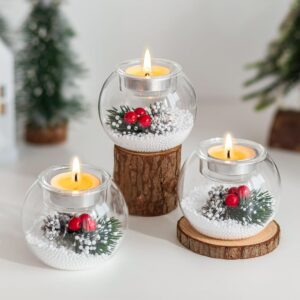
If you like the look of an arrangement with holders but would rather not manage real flames, LED taper and pillar candles are made in standard sizes and will sit in ordinary holders.
What to look for in quality
Christmas arrangements are usually seen at close range across a table, so the details show. Things worth checking in photographs and descriptions:
Foliage material. Moulded PE (polyethylene) pine and fir has rounded, individual needles and looks very close to the real thing. Cheaper PVC needle foliage is cut from flat sheet and looks more like tinsel up close. Many good arrangements mix the two, with PE on the visible tips and PVC filling the body, which is a sensible way to keep the price down.
A mix of textures. The most convincing arrangements combine several foliage types (pine, cedar, eucalyptus, holly, magnolia leaf) with berries, cones and flowers. A single type of foliage repeated looks flat.
Flowers. Common choices are poinsettia, amaryllis, hellebore (Christmas rose), rose, hydrangea and ranunculus. Look for petals with some variation in colour and a soft, matt finish rather than a uniform shine. Real-touch poinsettias and roses are noticeably better than standard polyester ones at this distance.
Berries. Foam berries on wire tend to shed and dent. Harder plastic or coated berries last longer.
Frost, snow and glitter. These finishes shed, particularly in the first season. If the arrangement is going on a tablecloth or a dark wooden table, consider whether you want to be brushing glitter off it. Lightly frosted tips are usually fine; heavy glitter is a commitment.
Container. Opaque containers (ceramic, metal, wood, bark) hide the stems and base. Clear glass shows everything inside, so it only works if the arrangement has been finished properly inside the vase, for example with faux water or a deliberate stem arrangement.
Base weight. Essential with candles, and useful anyway on a table that gets knocked.
Choosing a colour scheme
The arrangement does not have to match the tree, but it does have to sit with what is on the table. Look at your crockery, napkins and tablecloth before choosing, and pick an arrangement that shares at least one colour with them. The usual families are:
Traditional: deep green with red berries, red flowers and gold. Forgiving and warm, and the easiest to pair with most dinner services.
White and frosted: white flowers, silvered or frosted foliage, cones. Elegant, and good with white or grey china. Shows dust and glitter more readily.
Natural: plain greens, cones, bark, dried-look seed heads and cotton, with little or no added colour. Works with rustic and Scandinavian interiors and does not date.
Blush, copper and champagne: softer and more contemporary. Looks best under warm lighting.
Jewel tones: burgundy, plum, teal and gold. Rich and dramatic, and suits darker dining rooms.
Lighting changes everything. Red looks richer and white looks warmer under candlelight and warm LEDs; both look harsher under a cool ceiling light. If you can, check the arrangement in the room where it will be used, in the evening.
Assembly: what to expect
Some artificial Christmas arrangements arrive fully made and only need shaping. Others are partly assembled to keep the box size and postage sensible, and need a little putting together. Typically this means:
Pushing a few larger stems, flower heads or picks into pre-made holes in a foam or plastic base.
Fitting candle holders or LED candles into their sockets.
Attaching a ribbon, bow or decorative pick.
None of this needs tools and it rarely takes more than ten or fifteen minutes. Product descriptions will say if assembly is needed. A few tips make the result look better:
Let it warm up first. Foliage that has been in a cold van is stiff and springs back. Half an hour at room temperature makes it much easier to shape.
Work from the base of each stem outwards. Separate the branches and bend them in different directions and at slightly different angles rather than fanning them out evenly. Real foliage is not symmetrical.
Turn the flower heads. Angle them so they face slightly outwards and in different directions, rather than all pointing straight up. Bend a few stems so the heads sit at different heights.
Step back. Look at it from where people will actually see it, usually seated, and adjust the side that faces the room.
Shake off any loose frost or glitter over a bin or outside before placing it on the table.
Keeping it looking good, and storing it for next year
Over a few weeks indoors, the arrangement will collect a little dust. A soft paintbrush or a hairdryer on its coolest, lowest setting deals with it. Avoid damp cloths on anything frosted or glittered.
When it goes away in January:
Remove the batteries from any LED candles so they do not leak over the year.
Take real candles out and store them flat and cool, separately from the arrangement. Wax softens in a warm loft and will bend or mark the foliage.
Keep the original box if it fits, or use a lidded box with tissue around the flower heads. Do not stack anything on top of it.
Store somewhere dry and not subject to extreme heat. A loft that gets very hot in summer can soften and distort plastic foliage; a damp garage can mark fabric petals. A cupboard indoors is ideal if you have the space.
Next year it will need the same five minutes of shaping it had when it first came out of the box.
Before you buy: a quick checklist
Measured the space it will go in, including depth for mantels and sideboards?
Under 30cm tall if it is for the dining table?
Leaves 15–20cm clear either side on the table?
LED candles: battery type, included or not, timer, warm white?
Candle holders: what size candle do they take, and is the base heavy enough?
Front-facing or fully round, to suit where it sits?
Glitter or frost finish, and are you happy to live with it?
Does it need assembly, and is that clear in the description?
Shares a colour with your tableware?
FAQs:
How tall should a Christmas table centrepiece be?
No more than about 30cm, so that seated guests can see each other over it. A quick check: sit at the table, rest your elbow on it, and the height of your wrist is roughly the maximum. Taller arrangements are better suited to a sideboard, console or hall table.
How wide should a Christmas floral centrepiece be?
Allow at least 15 - 20cm of clear table either side of the arrangement for dishes and glasses. On a typical 80 - 100cm wide dining table that means something around 30 - 40cm across. Lengthways, a single centrepiece should cover no more than about a third of the table; on tables over 180cm, two or three smaller arrangements usually look better than one long one.
Is it safe to use real candles in an artificial Christmas arrangement?
It can be, with care. Artificial foliage is often plastic and fabric and will burn, so use tall candles that keep the flame well above the greenery, make sure nothing arches over the holder, extinguish candles before they burn down to within about 5cm of the foliage, and never leave them unattended. If the arrangement will be lit when nobody is in the room, or there are children reaching across the table, use LED candles instead. LED tapers and pillars are made in standard sizes and will fit ordinary holders.
What size candles fit the holders?
It varies, so check the product description. Standard UK dinner (taper) candles have a base of roughly 22mm; pillar candle holders range more widely. A candle that sits loosely is a tipping risk, so if the fit is slightly slack, a small blob of candle wax or a candle grip will hold it firmly.
What batteries do LED candles in Christmas arrangements take?
Small tea-light style LEDs usually take CR2032 coin cells, and pillar-style LED candles usually take AA or AAA batteries. The listing will say which, and whether they are included. Look for a built-in timer so the arrangement switches itself on at the same time each evening, and remove the batteries before storing the arrangement after Christmas (otherwise they can leak over time and damage your product).
Do artificial Christmas arrangements need assembly?
Some arrive ready to display and only need the foliage shaping after transit. Others are partly assembled to keep the box compact, which usually means pushing a few stems or picks into a pre-made base and fitting the candle holders or LED candles. No tools are needed and it typically takes ten to fifteen minutes. Product descriptions will say if assembly is required.
How do I make an artificial Christmas arrangement look more realistic?
Spend a few minutes shaping it. Let it reach room temperature, separate the branches and bend them at slightly different angles rather than evenly, turn the flower heads so they face in different directions and sit at different heights, and look at it from where people will actually see it. Tucking in a few sprigs of real spruce or eucalyptus adds scent and a little natural irregularity.
Can I put an artificial arrangement on the mantelpiece above a lit fire?
Only if it is well clear of the heat. Rising heat from an open fire or stove can soften and distort plastic foliage even without a flame touching it, and the materials are combustible. On a mantel over a fire that is used regularly, keep the arrangement to the ends or choose a different surface.
Will the arrangement shed glitter or frost?
Frosted and glittered finishes do shed a little, especially in the first season. Shake the arrangement gently over a bin or outdoors before placing it, and avoid damp cloths when dusting. If you would rather avoid the issue entirely, choose an arrangement with plain or lightly frosted foliage.
How do I clean and store a Christmas floral arrangement?
Dust it with a soft brush or a hairdryer on the coolest, lowest setting. For storage, remove any batteries and real candles, put it back in its box or a lidded box with tissue around the flower heads, and keep it somewhere dry that does not get very hot. A cupboard indoors is better than a loft or garage if you have the space.
When should I put a Christmas arrangement out?
Whenever you like. Because artificial arrangements do not fade or drop needles, many people put them out at the end of November or the start of Advent and leave them until Twelfth Night. Fresh arrangements, by contrast, are best bought in the week before they are needed.
Can I use an artificial Christmas arrangement outdoors or in a porch?
Most are designed for indoors. Damp will mark fabric petals and corrode battery contacts, and winter sun can fade colours over time. A covered, dry porch is usually fine for a short period, but check the product description and bring it in if the weather turns.
What is the difference between a Christmas floral arrangement and a centrepiece?
A centrepiece is an arrangement designed to sit in the middle of a table, so it is usually low, often long, and frequently includes candles. "Arrangement" is the broader term and includes taller pieces in vases and urns for sideboards, hallways and mantelpieces. You will also see centrepiece spelt "centerpiece" on American sites; it is the same thing.
We use cookies on our website to give you the most relevant experience by remembering your preferences and repeat visits. By clicking “Accept All”, you consent to the use of ALL the cookies. However, you may visit "Cookie Settings" to provide a controlled consent. View privacy & cookies policy.
This website uses cookies to improve your experience while you navigate through the website. Out of these, the cookies that are categorized as necessary are stored on your browser as they are essential for the working of basic functionalities of the website. We also use third-party cookies that help us analyze and understand how you use this website. These cookies will be stored in your browser only with your consent. You also have the option to opt-out of these cookies. But opting out of some of these cookies may affect your browsing experience.
Necessary cookies are absolutely essential for the website to function properly. These cookies ensure basic functionalities and security features of the website, anonymously.
Cookie
Duration
Description
cookielawinfo-checkbox-advertisement
1 year
The cookie is set by GDPR cookie consent to record the user consent for the cookies in the category "Advertisement".
cookielawinfo-checkbox-analytics
11 months
This cookie is set by GDPR Cookie Consent plugin. The cookie is used to store the user consent for the cookies in the category "Analytics".
cookielawinfo-checkbox-functional
11 months
The cookie is set by GDPR cookie consent to record the user consent for the cookies in the category "Functional".
cookielawinfo-checkbox-necessary
11 months
This cookie is set by GDPR Cookie Consent plugin. The cookies is used to store the user consent for the cookies in the category "Necessary".
cookielawinfo-checkbox-others
11 months
This cookie is set by GDPR Cookie Consent plugin. The cookie is used to store the user consent for the cookies in the category "Other.
cookielawinfo-checkbox-performance
11 months
This cookie is set by GDPR Cookie Consent plugin. The cookie is used to store the user consent for the cookies in the category "Performance".
viewed_cookie_policy
11 months
The cookie is set by the GDPR Cookie Consent plugin and is used to store whether or not user has consented to the use of cookies. It does not store any personal data.
Functional cookies help to perform certain functionalities like sharing the content of the website on social media platforms, collect feedbacks, and other third-party features.
Cookie
Duration
Description
na_id
1 year 1 month
This cookie is set by Addthis.com to enable sharing of links on social media platforms like Facebook and Twitter
na_rn
1 month
This cookie is used to recognize the visitor upon re-entry. This cookie allows to collect information on user behaviour and allows sharing function provided by Addthis.com
na_sc_e
1 month
This cookie is used to recognize the visitor upon re-entry. This cookie allows to collect information on user behaviour and allows sharing function provided by Addthis.com
na_sr
1 month
This cookie is set by Addthis.com. This cookie is used for sharing of links on social media platforms.
na_srp
1 minute
This cookie is used to recognize the visitor upon re-entry. This cookie allows to collect information on user behaviour and allows sharing function provided by Addthis.com
na_tc
1 year 1 month
This cookie is set by the provider Addthis. This cookie is used for social media sharing tracking service.
ouid
1 year 1 month
The cookie is set by Addthis which enables the content of the website to be shared across different networking and social sharing websites.
Performance cookies are used to understand and analyze the key performance indexes of the website which helps in delivering a better user experience for the visitors.
Cookie
Duration
Description
_gat
1 minute
This cookies is installed by Google Universal Analytics to throttle the request rate to limit the colllection of data on high traffic sites.
d
3 months
This cookie tracks anonymous information on how visitors use the website.
YSC
session
This cookies is set by Youtube and is used to track the views of embedded videos.
Analytical cookies are used to understand how visitors interact with the website. These cookies help provide information on metrics the number of visitors, bounce rate, traffic source, etc.
Cookie
Duration
Description
__gads
1 year 24 days
This cookie is set by Google and stored under the name dounleclick.com. This cookie is used to track how many times users see a particular advert which helps in measuring the success of the campaign and calculate the revenue generated by the campaign. These cookies can only be read from the domain that it is set on so it will not track any data while browsing through another sites.
_ga
2 years
This cookie is installed by Google Analytics. The cookie is used to calculate visitor, session, campaign data and keep track of site usage for the site's analytics report. The cookies store information anonymously and assign a randomly generated number to identify unique visitors.
_gid
1 day
This cookie is installed by Google Analytics. The cookie is used to store information of how visitors use a website and helps in creating an analytics report of how the website is doing. The data collected including the number visitors, the source where they have come from, and the pages visted in an anonymous form.
Advertisement cookies are used to provide visitors with relevant ads and marketing campaigns. These cookies track visitors across websites and collect information to provide customized ads.
Cookie
Duration
Description
DSID
1 hour
This cookie is setup by doubleclick.net. This cookie is used by Google to make advertising more engaging to users and are stored under doubleclick.net. It contains an encrypted unique ID.
IDE
1 year 24 days
Used by Google DoubleClick and stores information about how the user uses the website and any other advertisement before visiting the website. This is used to present users with ads that are relevant to them according to the user profile.
test_cookie
15 minutes
This cookie is set by doubleclick.net. The purpose of the cookie is to determine if the user's browser supports cookies.
uid
1 year 1 month
This cookie is used to measure the number and behavior of the visitors to the website anonymously. The data includes the number of visits, average duration of the visit on the website, pages visited, etc. for the purpose of better understanding user preferences for targeted advertisments.
uuid
3 months
To optimize ad relevance by collecting visitor data from multiple websites such as what pages have been loaded.
VISITOR_INFO1_LIVE
5 months 27 days
This cookie is set by Youtube. Used to track the information of the embedded YouTube videos on a website.









 A warm welcome from The Artificial Flowers Company. We offer artificial flower arrangements, silk flowers, hanging baskets, topiary balls, topiary plants and much more - we hope you find what you're looking for!
