artificial hanging baskets, topiary balls, hedges and topiary trees
Artificial hedges & screening
Artificial hedges and screening offer a quick way to add greenery, improve privacy or cover an unattractive fence or wall. Choose from realistic artificial hedge panels and foliage screening that stay green throughout the year without trimming, watering or waiting for plants to grow.
Artificial hedges have so many possibilities in the garden - use hedging to cover up an unsightly wall or panel, put it underneath your greenery where the light is preventing it from growing as well as it should, or create stylish features - without limits.
Artificial hedges are so much easier to look after than real hedges - once you've put them up, there's no clipping or maintenance to do. Contrast this with a typical boxwood hedge where you'll spend every other weekend clipping and trimming to keep it in check!
Good quality artificial hedges are UV fade resistant so they won't fade in the sunlight and will stay looking attractive for a long period of time. They are extremely versatile - the mats can be cut to size and easily clipped together for coverage all around the garden - even on curved surfaces.
Artificial hedge buying guide
You might have heard of artificial grass, flowers, hanging baskets, topiary or plants - but artificial hedges are a relatively new idea and there are few companies currently making them. Like the other fake products though, artificial hedges are growing in popularity. This is because they have so many benefits! While a regular hedge needs trimming, shaping, feeding and watering, an artificial hedge looks fabulous all of the time - with absolutely zero effort.
Uses for an artificial hedge
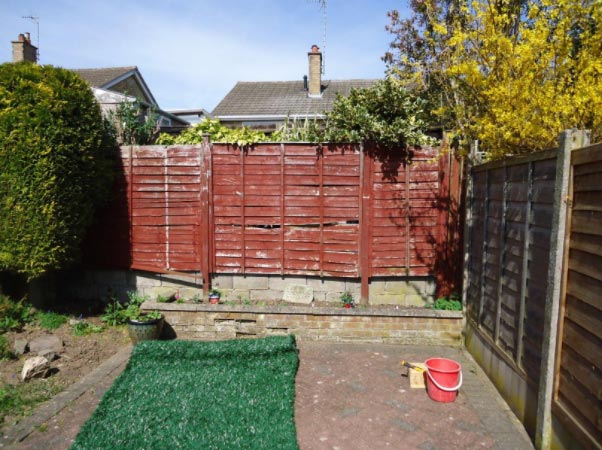
Above: before artificial hedging is installed
Above: After artificial hedging is installed
There are so many different uses for artificial hedging. My personal favourite is to cover ugly areas of the garden. This might be an unsightly wall, a rotten fence or sparse patches on your existing foliage. Artificial hedges can also help you to create features in the garden. You might create a hedge along the edges of a decking area - and you'll enjoy year round perfect greenery with no effort at all.
Types of artificial hedging
The most popular type of hedge panel is box hedging or boxwood. It has a dark green leafy look and appears very realistic. You can also get ivy leaf and fir hedging. Look carefully at the pictures - make sure you see at least one close up before you order. In my opinion, the fir hedging can sometimes look a little like an artificial Christmas tree. It's cheaper than boxwood and suitable for large spaces where people won't be looking up close. It can also help fill in sparse areas - so you could for example put it behind some existing trees that aren't doing too well. The boxwood is the best solution in most cases - especially if people will be getting within a metre.
You can also find panels with mixed plants which create a nice area of greenery, combining grass, fern, moss and ivy.
What is artificial hedging made from?
Most artificial hedges are made from polyethylene. You should always ensure they are UV fade resistant - otherwise your hedge will literally fade with the sunlight.
Measuring up
Check the size of the hedging you want to purchase - most comes as a 50 x 50 square panel so four tiles will cover one square metre. Typically they come in packs of 10 or 12 so you'll be covering between 2.5 and 3 square metres per pack.
Installing the hedging
Most artificial hedging comes as square panels that look a bit like flooring. You clip them together to make larger areas. You can also buy much larger sections of hedging - these are often a bit cheaper and may come as a roll.
How you install the hedging depends on what you're creating. If for example you're edging some decking, you'll need to build a frame to attach the hedging too. Remember that it will look unrealistic to have hedging growing straight up from the ground - it looks better if you create planters, raised beds or something that would 'house' and conceal the trunks and roots, if the hedging were actually real.
We hope the above provides a useful guide when purchasing an artificial hedge.
We use cookies on our website to give you the most relevant experience by remembering your preferences and repeat visits. By clicking “Accept All”, you consent to the use of ALL the cookies. However, you may visit "Cookie Settings" to provide a controlled consent. View privacy & cookies policy.
This website uses cookies to improve your experience while you navigate through the website. Out of these, the cookies that are categorized as necessary are stored on your browser as they are essential for the working of basic functionalities of the website. We also use third-party cookies that help us analyze and understand how you use this website. These cookies will be stored in your browser only with your consent. You also have the option to opt-out of these cookies. But opting out of some of these cookies may affect your browsing experience.
Necessary cookies are absolutely essential for the website to function properly. These cookies ensure basic functionalities and security features of the website, anonymously.
Cookie
Duration
Description
cookielawinfo-checkbox-advertisement
1 year
The cookie is set by GDPR cookie consent to record the user consent for the cookies in the category "Advertisement".
cookielawinfo-checkbox-analytics
11 months
This cookie is set by GDPR Cookie Consent plugin. The cookie is used to store the user consent for the cookies in the category "Analytics".
cookielawinfo-checkbox-functional
11 months
The cookie is set by GDPR cookie consent to record the user consent for the cookies in the category "Functional".
cookielawinfo-checkbox-necessary
11 months
This cookie is set by GDPR Cookie Consent plugin. The cookies is used to store the user consent for the cookies in the category "Necessary".
cookielawinfo-checkbox-others
11 months
This cookie is set by GDPR Cookie Consent plugin. The cookie is used to store the user consent for the cookies in the category "Other.
cookielawinfo-checkbox-performance
11 months
This cookie is set by GDPR Cookie Consent plugin. The cookie is used to store the user consent for the cookies in the category "Performance".
viewed_cookie_policy
11 months
The cookie is set by the GDPR Cookie Consent plugin and is used to store whether or not user has consented to the use of cookies. It does not store any personal data.
Functional cookies help to perform certain functionalities like sharing the content of the website on social media platforms, collect feedbacks, and other third-party features.
Cookie
Duration
Description
na_id
1 year 1 month
This cookie is set by Addthis.com to enable sharing of links on social media platforms like Facebook and Twitter
na_rn
1 month
This cookie is used to recognize the visitor upon re-entry. This cookie allows to collect information on user behaviour and allows sharing function provided by Addthis.com
na_sc_e
1 month
This cookie is used to recognize the visitor upon re-entry. This cookie allows to collect information on user behaviour and allows sharing function provided by Addthis.com
na_sr
1 month
This cookie is set by Addthis.com. This cookie is used for sharing of links on social media platforms.
na_srp
1 minute
This cookie is used to recognize the visitor upon re-entry. This cookie allows to collect information on user behaviour and allows sharing function provided by Addthis.com
na_tc
1 year 1 month
This cookie is set by the provider Addthis. This cookie is used for social media sharing tracking service.
ouid
1 year 1 month
The cookie is set by Addthis which enables the content of the website to be shared across different networking and social sharing websites.
Performance cookies are used to understand and analyze the key performance indexes of the website which helps in delivering a better user experience for the visitors.
Cookie
Duration
Description
_gat
1 minute
This cookies is installed by Google Universal Analytics to throttle the request rate to limit the colllection of data on high traffic sites.
d
3 months
This cookie tracks anonymous information on how visitors use the website.
YSC
session
This cookies is set by Youtube and is used to track the views of embedded videos.
Analytical cookies are used to understand how visitors interact with the website. These cookies help provide information on metrics the number of visitors, bounce rate, traffic source, etc.
Cookie
Duration
Description
__gads
1 year 24 days
This cookie is set by Google and stored under the name dounleclick.com. This cookie is used to track how many times users see a particular advert which helps in measuring the success of the campaign and calculate the revenue generated by the campaign. These cookies can only be read from the domain that it is set on so it will not track any data while browsing through another sites.
_ga
2 years
This cookie is installed by Google Analytics. The cookie is used to calculate visitor, session, campaign data and keep track of site usage for the site's analytics report. The cookies store information anonymously and assign a randomly generated number to identify unique visitors.
_gid
1 day
This cookie is installed by Google Analytics. The cookie is used to store information of how visitors use a website and helps in creating an analytics report of how the website is doing. The data collected including the number visitors, the source where they have come from, and the pages visted in an anonymous form.
Advertisement cookies are used to provide visitors with relevant ads and marketing campaigns. These cookies track visitors across websites and collect information to provide customized ads.
Cookie
Duration
Description
DSID
1 hour
This cookie is setup by doubleclick.net. This cookie is used by Google to make advertising more engaging to users and are stored under doubleclick.net. It contains an encrypted unique ID.
IDE
1 year 24 days
Used by Google DoubleClick and stores information about how the user uses the website and any other advertisement before visiting the website. This is used to present users with ads that are relevant to them according to the user profile.
test_cookie
15 minutes
This cookie is set by doubleclick.net. The purpose of the cookie is to determine if the user's browser supports cookies.
uid
1 year 1 month
This cookie is used to measure the number and behavior of the visitors to the website anonymously. The data includes the number of visits, average duration of the visit on the website, pages visited, etc. for the purpose of better understanding user preferences for targeted advertisments.
uuid
3 months
To optimize ad relevance by collecting visitor data from multiple websites such as what pages have been loaded.
VISITOR_INFO1_LIVE
5 months 27 days
This cookie is set by Youtube. Used to track the information of the embedded YouTube videos on a website.



 A warm welcome from The Artificial Flowers Company. We offer artificial flower arrangements, silk flowers, hanging baskets, topiary balls, topiary plants and much more - we hope you find what you're looking for!