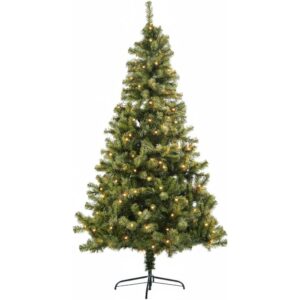
Artificial Christmas trees
Showing 67–67 of 67 resultsSorted by latest
The Artificial Flowers Company
artificial hanging baskets, topiary balls, hedges and topiary trees
Showing 67–67 of 67 resultsSorted by latest
A good artificial Christmas tree is a once-a-decade purchase. Buy well and it comes out of the loft every December for fifteen or twenty years, looking the same as it did the first time. Buy badly and you're back online the following November, trying to work out why the "7ft" tree hit the ceiling, why the branches drooped under the baubles, or why half the lights gave up on Boxing Day.
This guide explains everything that actually matters when you're choosing: how to size a tree for a British room, what the different shapes are for, what the foliage is made of and why it matters, how to read a tip count, what to check on a pre-lit tree, how the thing goes together and comes apart again, and how to look after it. There's a section on each type of tree we sell, with honest advice on who it suits, and a checklist at the end.
Start here. Most people know roughly what they want before they've thought about materials or tip counts, and the type of tree narrows everything else down.
The default: a conical green tree, unlit, in a classic fir or spruce silhouette, for you to dress however you like. If you have a collection of decorations and lights you love, or you enjoy the ritual of doing the lights, this is the tree. It's also the most forgiving to buy, because there's nothing electrical to go wrong. Everything in this guide applies to it.
The same tree with lights already woven through the branches, connected section by section, with a single plug. Best for anyone who dreads the lights, has a tall tree that's awkward to reach round, or wants the tree up and glowing in fifteen minutes. Watch out for low light counts (some budget pre-lit trees carry fewer lights than you'd use yourself), cool white lights when you wanted warm, and guarantees that cover the tree for years but the lights for months. The lights are the part most likely to fail, so a well-made pre-lit tree still looks good as an unlit tree if they eventually do. See our pre-lit Christmas trees.
Full height, narrow footprint. A slim tree is usually 70–90cm wide at a 6ft height, against 100–120cm for a full tree; a pencil tree is narrower again, often 40–60cm. Best for flats, hallways, alcoves, bay windows, the gap between the sofa and the wall, and anyone who wants a tall tree without giving up a third of the room. They also make excellent second trees for a dining room or landing. Watch out for sparse budget versions – a slim tree needs a good tip count to avoid looking like a bottle brush – and for the fact that short branches hold fewer and smaller decorations. See our slim and pencil Christmas trees.
Green trees with a white coating to look as though snow has settled on them. "Frosted" trees have a light dusting on the branch tips; "snowy" or "flocked" trees have a heavier covering – sometimes a drift on every branch. Best for a Scandi, pale or minimalist scheme, or anyone who likes the tree to do the work so the decorations can be few. A flocked tree looks finished with lights and a handful of baubles. Watch out for shedding: the flock does come off, especially during assembly and on heavily coated trees, and it's harder to vacuum than fallen needles. Heavy flock also makes branches thicker, so hooks need to be larger and heavy baubles may slide. Never put a flocked tree outside. See our snowy and flocked Christmas trees.
Anything from 30cm to about 4ft (120cm), often in a pot, hessian sack or weighted base, and frequently battery-lit. Best for hall tables, sideboards, offices and reception desks, children's bedrooms, small flats, and as a second or third tree. Watch out for the floor: a 3ft or 4ft tree standing on the floor of a normal room looks lost. Put it on a table, a chest, a crate or a plant stand and it looks intentional. Battery-lit trees go through batteries faster than you'd expect – a timer function is worth having. See our small and tabletop Christmas trees.
Trees designed to pass as real at close range, modelled on actual species – Nordmann fir, Norway spruce, Fraser fir, Scots pine – with moulded PE needles cast from real branches, varied shades of green, visible brown branch structure and sometimes pine cones. Best for anyone who has always had a real tree and wants to switch without it looking like a compromise, and for rooms where the tree is seen up close. Watch out for density: the most realistic trees are often slightly sparser than the bushiest budget ones, because real trees are. That's a feature, but if you want a tree so full you can't see the trunk, a mixed PE/PVC tree will suit you better. See our realistic Christmas trees.
Trees built to live on a porch, doorstep, patio or balcony through a British December: UV-stabilised foliage that won't fade, fittings that won't rust, and – if pre-lit – low-voltage lights with a weatherproof transformer. Best for flanking a front door, greeting guests, or a tree in the garden you can see from the kitchen. Watch out for ordinary indoor trees described loosely as "indoor/outdoor". An indoor tree's steel hinges will rust and its lights are not safe in rain. Also check weight and anchoring: a light tree in an exposed spot will be on its side by Christmas Eve. A covered porch extends the life of any outdoor tree considerably. See our outdoor Christmas trees.
More returns come down to size than anything else. Three measurements matter, and most people only check one.
A standard UK ceiling is about 2.4m (just under 8ft); older houses are often higher, newer flats and loft conversions often lower. Measure yours. You want at least 15cm clear above the tree, and more if you're adding a topper – a star adds 15–25cm, an angel sometimes 30cm. Tree heights are nominal: a "6ft" tree may be anywhere from 180cm to 185cm, and almost always includes the stand.
| Tree height | Approximate height | Suits a ceiling of | Notes |
|---|---|---|---|
| 4ft | 120cm | Any | Best raised on a table or stand; looks small on the floor |
| 5ft | 150cm | Any | Good for smaller rooms, children's rooms, flats with low ceilings |
| 6ft | 180cm | 2.2m and up | The most popular UK size. Fits almost every living room with room for a topper |
| 7ft | 210cm | 2.4m and up | Fills a standard room generously. Leaves 15–30cm for a topper on a 2.4m ceiling |
| 7.5ft | 225cm | 2.5m and up | Tight on a 2.4m ceiling; a topper probably won't fit |
| 8ft | 240cm | 2.7m and up | Period homes, hallways with high ceilings, double-height spaces |
| 9ft and over | 270cm+ | 3m and up | Large period rooms, stairwells, commercial spaces. Check weight and who's assembling it |
This is the measurement people forget. A full-shaped tree is roughly two-thirds as wide as it is tall at the base, so a 6ft tree is typically 100–120cm across and a 7ft tree 120–140cm. Measure the floor space you've got, remembering that the tree should sit a little away from the wall so the back branches aren't crushed, and that you'll want to walk past it for a month. If the width is the problem, don't go shorter – go slimmer. A 7ft slim tree in a 90cm gap looks far better than a 5ft full tree squashed into the same space.
Draw the footprint on the floor with masking tape, or cut a circle of newspaper to the base diameter. It takes two minutes and it's the single best way to avoid a mistake.
Beyond simply fitting, a tree should suit the room. A tree that touches the ceiling looks cramped even if it technically fits; a 5ft tree in a large room with a 3m ceiling looks like an afterthought. As a rule, the top of the tree sitting roughly where a tall person's reach ends – 2m or so – looks right in a normal room, and you can go taller as the ceiling rises.
"Shape" covers two separate things: the overall outline of the tree, and which way the branch tips point.
On an upswept tree, the branch tips angle upwards – the most common style on artificial trees. It looks full, it's easy to hang decorations on because the tips act as hooks, and baubles sit snugly. On a downswept tree, the tips angle gently down and out, as they do on a real fir. It looks more natural and decorations hang more freely, but heavy ones can slide towards the ends. Neither is better; it's a matter of what you're used to. Trees modelled on specific species tend to be downswept; traditional trees tend to be upswept.
This is the thing that determines how real the tree looks, how long it lasts and, more than anything else, what it costs. There are two main materials and most good trees use both.
Thin sheets of PVC are cut into fringes and twisted around a wire to make a branch tip, like a bottle brush. This is how artificial trees have been made for decades. Done cheaply, PVC foliage is flat, shiny and uniform – the familiar "fake tree" look. Done well, with needles of varied length, a matte finish and two or three shades of green, it looks surprisingly good and has real advantages: it's bushy, it hides the pole, it supports heavy ornaments, and it's inexpensive. Several of the trees that win UK group tests are all-PVC. Some makers describe their soft, wide PVC as "cashmere" and their stiff, wiry PVC as "pine needle" – the latter is scratchy to handle (gloves are often supplied) but very convincing.
PE needles are injection-moulded in three dimensions, often from moulds taken from real branches. Each tip is a solid, rounded sprig with individual needles rather than a flat fringe, and it looks and feels far more like the real thing. PE is also more resistant to fading. The drawbacks are cost – PE tips are much more expensive to make – and that a tree made only of PE can look a little open near the trunk, because the tips don't fluff out the way PVC does. All-PE trees are the top of the market and are what most people mean by "realistic".
The sensible middle: PE tips on the outer ends of the branches, where you see them, and PVC tips further in, where they fill gaps and hide the pole. A good mixed tree gives you most of the realism at a fraction of the cost, with the bulk to carry a full load of decorations. If you're unsure what to buy, buy this. Check the proportion – anything from "PE tips" (a few, for show) to 70% PE is described as "mixed", and the price will tell you which end you're at.
Tinsel and fibre optic trees are their own thing – fun, kitsch and fast, but not trying to look real. Feather, paper and wooden trees are decorative objects rather than Christmas trees in the usual sense. All have their place; just know which you're buying.
The "tip count" is the number of individual branch tips on the tree – not the number of branches. Retailers quote it as a proxy for fullness, and within a single material it's a fair guide: a 6ft all-PVC tree with 400 tips will be noticeably thinner than one with 900.
But tip count on its own can mislead, for three reasons:
As a rough benchmark for a 6ft tree: under 500 tips is budget territory; 700–1,000 is good quality; 1,500 and over is very full. Scale up by roughly a third for each extra foot of height. Use the number to compare like with like, then trust the close-up photographs.
Not all green is equal. Budget trees tend towards a single, bright, slightly yellow green. Better trees mix two or three tones – darker green outer tips, lighter new-growth tips, sometimes a blue-grey cast for a spruce or a silvery underside for a Fraser fir – and the depth that gives is one of the biggest contributors to realism. If your room is dark or the tree will carry a lot of lights, a mid-green reads as natural; if you want the tree to look lush under daylight, a deeper green works. Very dark trees can need more lights and decorations to lift them.
Covered above under types. The short version: frosted is a light dusting and sheds very little; snowy or flocked is a heavy covering, looks dramatic, and sheds. Both suit pale, Nordic and minimal schemes and need fewer decorations. Both are indoor only.
White, black, silver, pink, red and other fashion colours make no attempt at realism and shouldn't be judged on it. A white tree is a blank canvas that makes coloured baubles and lights pop; a black tree with gold is dramatic; a pink tree is a joy in a child's bedroom. Buy them as decoration, in the knowledge that trends move, and that a white tree yellows faster than a green one fades if stored somewhere warm or sunny.
The branches are permanently attached to the central pole with metal hinges and fold flat for storage. The tree arrives in two to four sections; you slot them together, the branches drop into place and you shape the tips. Assembly takes ten minutes before fluffing. Almost all mid-range and premium trees are hinged. The trade-off is bulk: a hinged tree never packs down as small as a hook-on one, and the sections are heavier.
Each branch is separate and hooks into a slot on the pole; the branches are usually colour-coded by row. Assembly takes longer – thirty minutes or more for a 6ft tree – but each branch is in your hand as you shape it, which some people find easier, and the whole thing packs into a much smaller box. Hook-on construction is common on budget trees and on some very large ones where hinged sections would be too heavy to lift.
Foliage and often lights are fixed to a frame that collapses like an umbrella. Up in a minute, down in a minute, stores flat. Very good for anyone who finds assembly physically difficult, or for a second tree. The limitation is the uniform shape.
A 6ft hinged tree with mixed foliage typically weighs 10–15kg; a 7ft tree 15–25kg; a dense 8ft tree can top 30kg. That's worth knowing if you live alone, have stairs, or store the tree in a loft. More sections mean lighter pieces and an easier job. Check that sections are clearly marked and that pre-lit sections connect simply – ideally through the pole, so the only visible cable is the one to the wall.
Most trees come with a folding metal stand that the bottom pole section drops into and is secured by a thumbscrew. It's fine for most trees up to 7ft. Look for a plastic stand on a cheap tree as a warning sign – they crack and they don't hold a heavy tree steady. Very tall or heavy trees should have a wide, substantial stand, sometimes with a weighted base. A tree skirt, basket or collar hides the stand and the cables; allow for its diameter when planning floor space.
Pre-lit trees are now the majority of what's sold in the UK, and for good reason: they turn the most tedious job of the season into plugging something in. But it's worth thinking through, because the lights are the one part of an artificial tree that will eventually fail, and they're fixed to the branches.
Choose pre-lit if you want speed, you have a tall tree, you like the lights deep in the branches rather than draped on the outside (something pre-lit trees do well and hand-stringing does badly), or you'd otherwise buy new lights anyway.
Choose unlit if you already have lights you love, you like to change colour or style from year to year, you want the longest possible life from the tree, or you're buying a very realistic tree and don't want cables competing with the foliage.
If you go pre-lit, five things to check:
Our pre-lit Christmas tree guide goes into light types, connection systems and fault-finding in more detail.
Only you can decide how much that matters – a tree covered in thirty years of family decorations hardly needs to – but if it does, these are the cues that separate a convincing tree from a plastic one. Most of them are visible in a good close-up photograph.
A useful test: look at the listing photo and imagine the tree without decorations or lights. If it still looks like a tree, it's a good one.
Artificial trees are much less of a fire risk than a drying-out real tree, but they are plastic. Look for "fire retardant" or "fire resistant" in the specification – it means the foliage has been treated to resist ignition and self-extinguish, and most reputable trees carry it. Keep any tree well clear of open fires, stoves and radiators (heat will also warp foliage and bleach colour), and don't drape anything over lights.
Pre-lit trees and light sets should carry a UKCA or CE mark and come with a UK three-pin plug or a transformer. Low-voltage LED sets running from a transformer are the norm and are very safe. Switch lights off when you go out or to bed – a timer makes that automatic. Don't daisy-chain more sets than the instructions allow, and don't run cables under rugs. For outdoor trees, the transformer and any connections need to be IP44-rated at minimum and the transformer itself kept dry; use a weatherproof extension and ideally an RCD-protected socket.
Artificial foliage isn't toxic, but PVC needles that shed can be swallowed, and glass baubles and wires are a hazard in any tree. Practical steps: choose a slim or parasol tree so there's less at ground level, make sure the stand is wide and the tree is upright and stable, tether a tall tree to the wall or a curtain pole with fishing line if you have a climber (cat or child), put unbreakable decorations on the lower third, and keep cables tucked away. Flocked trees are best avoided with pets that chew.
Every artificial tree looks flat, squashed and faintly tragic when it comes out of the box. This is normal, and the difference between that tree and the one in the photo is thirty to sixty minutes of shaping – "fluffing", in the trade. Do it once properly and it takes a fraction of the time in later years.
How you store an artificial tree has more effect on how long it lasts than anything else you do.
If you're still deciding, a fair comparison:
| Artificial tree | Real cut tree | |
|---|---|---|
| Cost | £50–£300 once; nothing in later years | £40–£90 every year for a 6ft Nordmann fir |
| Effort | Assemble and shape (30–60 min); store afterwards | Buy, transport, saw base, fit stand, water daily, sweep needles, dispose of |
| Appearance | Consistent year to year; realism depends on quality | Real, with scent – but drops needles and dries out over a month |
| Allergies and pets | No pollen, sap or mould spores | Can trigger hay-fever-like symptoms; sap and needles are an irritant to pets |
| Fire risk | Low if fire retardant and kept from heat | Low when fresh, rising sharply as it dries |
| Environment | Roughly 40kg CO2e to make a 2m tree (Carbon Trust); breaks even with real trees after about 10 years' use | Around 3.5kg CO2e if chipped or burnt; 16kg if landfilled |
| End of life | Mixed plastic and metal – not kerbside recyclable. Donate or sell on | Council collections chip it for compost |
The honest environmental answer is that an artificial tree is better only if you keep it. The Carbon Trust puts the break-even at around ten Christmases against a real tree that's disposed of well – and the average artificial tree in the UK is thrown away after far fewer. So if you're going artificial, buy one good enough that you won't want to replace it, store it properly, and when you do eventually move it on, pass it to someone rather than binning it.
For a 6ft tree, as a rough guide to the UK market:
Add roughly 25–40% for each foot of height above 6ft, and 15–30% for pre-lit over unlit. Slim trees are usually a little cheaper than full trees of the same height; flocked trees a little more.
Christmas tree stock in the UK is at its best from September to the end of October. Popular sizes – 6ft and 7ft pre-lit, in particular – start selling out from mid-November, and by the second week of December the choice is what's left. If you know what you want, buy early. If you're not fussy and happy to gamble, the sales in the last days of December and early January are the cheapest time to buy a tree for next year, though the range is thin.
Whatever you do, assemble the tree as soon as it arrives rather than leaving it in the box until December. If anything is missing or broken, you want to know while there's time to sort it out.

For most UK living rooms with a standard 2.4m ceiling, a 6ft (180cm) tree is the safe choice - it leaves plenty of room for a topper. A 7ft (210cm) tree fits a 2.4m ceiling but with only 15 - 30cm to spare, so choose a low topper. Anything over 7ft needs higher ceilings. Always check the width too: a full 6ft tree is typically 100 - 120cm across at the base. If that's too wide for your space, choose a slim or pencil tree rather than a shorter one.
Almost always, yes. Trees are measured from the floor (bottom of the stand) to the topmost tip. Heights are nominal, so a "6ft" tree might be 180 - 185cm. If you plan to use a different stand or raise the tree on a crate or table, add that to the total.
A full-shaped 6ft tree is usually 100 - 120cm in diameter at the base. A slim 6ft tree is around 70 - 90cm, and a pencil tree 40 - 60cm. A 7ft full tree is typically 120 - 140cm wide. The width is listed in the product specification - measure your floor space and allow a little extra so the tree doesn't press against the wall.
PVC foliage is made from thin sheets cut into fringes and twisted around wire, like a bottle brush. It's bushy, inexpensive and hides the central pole well, but can look flat and shiny on cheaper trees. PE (polyethylene) foliage is injection-moulded in three dimensions, often from casts of real branches, so each tip looks like a real sprig of needles. It's far more realistic and fade-resistant but costs more. Most good trees use a mix: PE tips on the outside for realism, PVC inside for fullness.
For a 6ft tree, under 500 tips is budget, 700 - 1,000 is good quality and 1,500 or more is very full. Add roughly a third for each extra foot of height. But compare like with like: PE tips are much bigger than PVC tips, so an all-PE tree with 800 tips can look fuller than a PVC tree with 1,200. Look at close-up photos as well as the number – long, wide tips fill a tree, short stubby ones don't.
If you dislike putting lights on, have a tall tree or want it up quickly, yes – and pre-lit trees get the lights deep into the branches in a way that's hard to do by hand. The trade-offs are that the lights are the part most likely to fail, and some budget pre-lit trees are lightly lit. Check the light count against the look you want (200–300 is a traditional glow on a 6ft tree, 500+ is the fully-lit look), check whether the lights are warm or cool white, and check how long the guarantee covers the lights. A well-made tree still works as an unlit tree if the lights eventually go.
It depends on the look you're after, and there's no wrong answer. A single 200-light string is the traditional look and plenty for a tree that's carrying lots of decorations. Light retailers generally suggest 300 - 400 as a minimum for a 6ft tree. 500 or more gives a fully-lit, glowing tree where the lights do most of the work. Pre-lit trees are more efficient because the lights sit inside the branches rather than on the surface. Be wary of cluster and micro-LED counts - 1,000 tiny bulbs is not comparable to 1,000 standard LEDs.
Hinged branches are permanently fixed to the central pole and fold down for storage; the tree comes in two to four sections that slot together, and assembly takes about ten minutes before shaping. Hook-on branches are separate, usually colour-coded, and hook into slots on the pole one at a time. They take longer to assemble but pack into a smaller box and are lighter to lift. Most mid-range and premium trees are hinged; hook-on is more common on budget trees and very large ones.
Both are full-height trees with a reduced width. A slim tree is roughly three-quarters the width of a full tree – around 70–90cm at 6ft – and still reads as a traditional tree. A pencil tree is much narrower, often under 60cm, giving a tall column shape. Slim trees suit most rooms where space is tight; pencil trees suit hallways, alcoves and either side of a fireplace or door.
Yes, to some degree. Lightly frosted trees shed very little. Heavily flocked trees lose some of their coating every time they're assembled, decorated and taken down, and the fine powder is harder to vacuum than fallen needles. Shedding reduces after the first year. Flocked trees are indoor only, and heavy flock makes branches thicker, so use larger hooks and keep heavy baubles near the pole.
Only if it's specifically designed for outdoor use. An ordinary indoor tree will fade in daylight, its steel hinges will rust and its lights are not safe in rain. Outdoor trees use UV-stabilised foliage, rust-proof fittings and, if pre-lit, low-voltage lights with a weatherproof (IP44 or better) transformer that still needs to be kept dry. Weight or anchor the tree against wind, and position it under cover if you can – a porch extends its life considerably.
Shape it properly. Working from the bottom section up and from the pole outwards, separate each branch's tips and point them in three directions – up, out and down. Bend the inner tips towards the pole to hide the trunk and cables, and don't make every branch identical. Stand back regularly to check for gaps. The first time this takes 30 - 60 minutes on a 6ft tree; it's much quicker in later years. If it's pre-lit, switch the lights on while you shape it so you can spread them evenly.
A good quality tree, stored properly, will last fifteen to twenty years or more; many families have trees far older. Budget trees may start to look thin or shed after a few years. On pre-lit trees, the lights usually fail before the tree does – typically after five to ten years – but the tree can then be used with your own lights. The Carbon Trust estimates an artificial tree needs around ten years' use to have a lower carbon footprint than buying a real tree each year.
Only if you keep them. The Carbon Trust estimates a 2m artificial tree represents around 40kg of CO₂ equivalent to produce, compared with about 3.5kg for a real tree that's chipped or burnt afterwards (or 16kg if it goes to landfill). That means an artificial tree needs to be used for roughly ten Christmases to break even. If you buy a tree you'll keep for a decade or more, store it well and pass it on rather than throwing it away, it's a reasonable choice. If you're likely to replace it after a few years, a real tree from a local grower is greener.
Dust it, then take it apart from the top, folding hinged branches gently against the pole. Label the sections if they aren't colour-coded. Use a storage bag rather than the original box – the box was packed by machine and you won't get the tree back in without damaging it. Store somewhere cool and dry: a cupboard or under a bed is ideal, an insulated loft is fine, a damp garage or shed risks rusted hinges and corroded light contacts. Don't stack anything heavy on top.
Far less than a drying real tree, but they are plastic. Look for "fire retardant" or "fire resistant" in the specification, keep the tree well away from open fires, stoves and radiators, use LED lights (they run cool), switch lights off when you're out or asleep, and don't overload sockets or daisy-chain more light sets than the instructions allow.
The foliage isn't usually toxic, but shed PVC needles, glass baubles and cables can all cause harm if chewed or swallowed. A slim or parasol-style tree puts less at ground level; a wide, stable stand and a discreet tether to the wall stop a climbing cat bringing it down; unbreakable decorations on the lower branches and cables tucked away cover the rest. Avoid heavily flocked trees with pets that chew.
September and October for the widest choice – popular sizes, especially 6ft and 7ft pre-lit trees, start selling out from mid-November. The cheapest time is the post-Christmas sales in late December and January, if you're happy to buy for the following year from a reduced range. Whenever you buy, assemble the tree as soon as it arrives so there's time to resolve any problems.
For a 6ft tree, £60 - £150 buys a decent mass-market tree with hinged branches and a metal stand - good enough if it will be covered in decorations. £150 - £300 is where realistic, long-lasting trees start: mostly moulded PE foliage, modelled on real species, with five- to ten-year guarantees. £300 - £500 buys premium pre-lit trees, usually 7ft and over. Think about cost per year rather than up-front price: a £200 tree kept for fifteen Christmases works out at about £13 a year, well under the price of a single real tree.
Yes. The tree is unaffected – you can leave the dead lights in place (they're usually barely visible once the tree is dressed) and add your own, or carefully snip the cables off section by section. Before you do, check the simple fixes: a loose connector between sections, a blown fuse in the plug, or a single failed bulb on older strings.

Copyright © 2026
As an Amazon Associate I earn from qualifying purchases. (Product prices and availability are accurate as of the date/time indicated and are subject to change. Any price and availability information displayed on the supplier's website at the time of purchase will apply to the purchase of this product).