artificial hanging baskets, topiary balls, hedges and topiary trees
Artificial bonsai trees
An artificial bonsai tree gives you the sculptural shape of a miniature tree without the patient pruning. Place one on a desk, sideboard or shelf where its branching outline can be appreciated up close. It’s a lovely way to add a small patch of greenery when space is limited.
A real bonsai is one of the hardest houseplants to keep alive. It needs daily attention to watering, the right light, regular pruning and wiring, and most species sulk indoors. An artificial bonsai gives you the same sculptural shape – the twisting trunk, the layered pads of foliage, the shallow ceramic pot – with none of that. It will look exactly the same in five years as it does the day it arrives.
That said, there's a wide gap between a convincing artificial bonsai and one that looks like a plastic ornament. This guide explains what to look for, how to pick the right size and style for the spot you have in mind, and how to set it up and look after it once it arrives.
The short version
Measure the spot first. Listed height usually includes the pot, and many pine and juniper bonsai are wider than they are tall.
Under 25cm suits a desk, shelf or bedside table. 30–45cm is the sweet spot for a sideboard or console. 50cm and over is a statement piece for a low cabinet, plant stand or floor.
Pine, juniper and podocarpus give you the classic Japanese look. Ficus and money tree look more like a leafy houseplant. Olive suits Mediterranean and Scandi interiors. Red, purple and pink trees are decorative rather than realistic – lovely, but choose them knowingly.
Look for matte foliage in more than one shade of green, a textured trunk with some movement, bendable branches, a proper ceramic pot and a tidy base of moss or pebbles with no foam showing.
Keep it out of direct sun and away from radiators. Dust it every few weeks and it will last for years.
Getting the size right
Size is where most people go wrong, and it's rarely the tree's fault. Two things catch buyers out.
First, the listed height almost always includes the pot. A "23cm" bonsai is 23cm from the bottom of the pot to the top of the canopy, not 23cm of tree sitting in a pot. If you're picturing it on a shelf with a fixed gap above, that matters.
Second, bonsai spread sideways. Real bonsai are trained to grow wide, low pads of foliage, and good artificial ones copy that. A 50cm tall pine bonsai can easily be 55–60cm across. Always check the width and depth as well as the height, and allow some breathing room around it – a bonsai jammed between a lamp and a stack of books loses its outline, which is the whole point.
As a rough guide:
Overall height
Where it works
Notes
Under 20cm
Desk, floating shelf, bedside table, bathroom shelf, windowsill (out of direct sun)
Small trees read as "ornament" from across a room, so put them where they'll be seen up close. Detail matters more here, not less.
20–30cm
Desk centrepiece, bookshelf, sideboard grouped with other objects, hall table, coffee table
The most versatile size. Big enough to have presence, small enough to move around when you change your mind.
30–45cm
Sideboard or console as the main focal point, dining table centrepiece, reception desk, mantelpiece
Check the spread. At this height a pine or juniper may be 40–50cm wide. On a dining table, make sure people can still see each other over it.
45–60cm
Low cabinet, plant stand, hearth, large console, floor in a small alcove
These are statement pieces. They want space around them and a plain background so the silhouette shows.
60cm and over
Floor-standing, beside a sofa or in an entrance hall
Think of these as small artificial trees in a bonsai style. Pot stability becomes important – look for a heavy base.
A simple trick: cut a piece of paper or card to the tree's width and depth and put it where you're planning to display it. It takes a minute and saves a return.
Types of artificial bonsai
Artificial bonsai are modelled on the species most often used for real bonsai, and each has a distinct character. Choosing the right one is mostly about matching that character to your room.
Pine bonsai
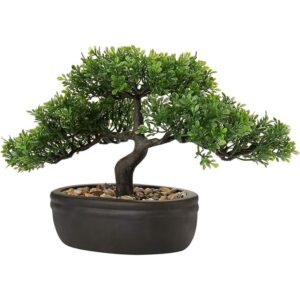
The most recognisable bonsai of all. Pine bonsai (modelled on Japanese black or white pine) have dark green needles arranged in distinct, cloud-like tiers, usually on a thick, gnarled trunk. They look mature and deliberate, and they suit calm, pared-back interiors – Japanese-inspired rooms, neutral living rooms, hallways. Because the foliage is in separated pads, the tree's structure stays visible, which is a big part of why they look convincing. They are also the type most likely to be wider than tall, so check the footprint.
Juniper bonsai
Junipers are the classic beginner's real bonsai, so an artificial one looks entirely plausible indoors. The foliage is finer and more feathery than pine, often in a slightly softer green, and the trunks tend to twist dramatically. Many artificial junipers copy the bleached, stripped-bark "deadwood" features (called jin and shari) that are prized on real specimens. A good all-rounder if you want something that looks like a genuine bonsai rather than a decorative plant.
Podocarpus bonsai
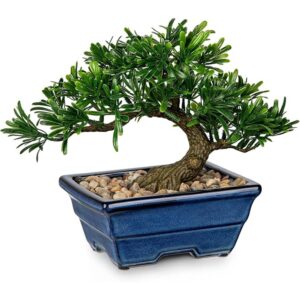
Podocarpus – sometimes called Buddhist pine or yew pine – has longer, flat, glossy needles that sit in loose clusters rather than tight pads. It's the species most associated with Chinese penjing, the older tradition from which Japanese bonsai developed, and it has a slightly more relaxed, leafy look than pine or juniper. Artificial podocarpus often come in taller, more upright forms and in decorative pots, which makes them good for a hall table or a spot that needs a bit of height without much width.
Ficus bonsai
Ficus is the easiest real bonsai to keep indoors, so a faux one looks right at home on a desk or shelf. Expect broad, glossy oval leaves rather than needles, a dense rounded canopy and often a thick trunk with exposed, bulbous roots (the "ginseng ficus" look). It reads more as a leafy houseplant than a traditional bonsai, which suits modern and contemporary interiors. The dense foliage does collect dust a little faster than open pine or juniper pads.
Money tree bonsai
Modelled on Pachira aquatica, a money tree has a braided or plaited trunk topped with hand-shaped leaves of five or so leaflets. It's associated with good fortune and is a traditional gift for a new home or business, which makes it a popular choice for offices, reception areas and housewarming presents. Visually it's the most "houseplant" of the bonsai styles – fresh, bright green and upright.
Olive bonsai
Small silvery-green leaves on a pale, gnarled trunk. Olive bonsai bring a Mediterranean feel and look wonderful against white walls, limewash, rattan and pale wood – they fit Scandi, coastal and farmhouse interiors as well as anything Japanese-inspired. They're usually a touch more open and airy than a ficus.
Maple, cherry blossom and coloured bonsai
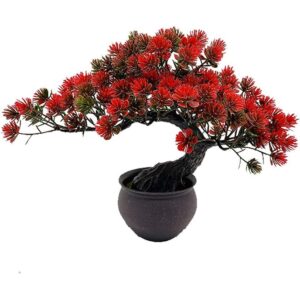
Red, orange, pink and purple artificial bonsai are modelled on Japanese maple in autumn colour or on flowering trees like cherry and plum blossom. Be honest with yourself about what you're buying: real maples and cherries are outdoor trees that only hold that colour for a few weeks a year, so a red tree on an indoor sideboard isn't trying to fool anyone. That's fine – these are decorative pieces that add a splash of colour, and they work especially well where the alternative would be a vase of artificial flowers. If realism is your priority, stick to the greens.
Bonsai shapes and what they mean
Real bonsai are trained into recognised styles, each imitating how a tree grows in a particular setting. Artificial bonsai borrow the same vocabulary, and knowing a few of them helps you choose a shape that suits the space – and spot the ones that have been designed with care.
Formal upright – a straight, tapering trunk with branches getting shorter towards the top. Tidy, symmetrical and calm. Suits formal rooms and centred positions.
Informal upright – the trunk curves gently on its way up, with the top of the tree finishing roughly above the base. This is the most common and most natural-looking style, and the easiest to live with.
Slanting – the whole trunk leans to one side, as if shaped by wind or reaching for light. Looks best placed to one end of a surface, leaning into the space rather than off the edge.
Cascade and semi-cascade – the trunk rises and then falls below the rim of the pot, like a tree clinging to a cliff. These need to sit on the edge of a shelf or a stand so the cascade has somewhere to hang. Striking, but not for a crowded sideboard.
Literati – a tall, slender, often contorted trunk with just a little foliage at the top. Minimal and elegant; suits narrow spaces and modern interiors.
Windswept – all the branches and foliage sweep in one direction. Dramatic, and like slanting styles it has a natural "front" and a direction, so think about which way it will face.
Forest or group planting – several trunks of different heights in one shallow tray, like a miniature woodland. Wider and lower than a single tree, and good as a table centrepiece.
A well-made artificial bonsai will commit clearly to one of these. If a tree looks like a straight stick with a symmetrical ball of leaves on top, it hasn't been designed with bonsai in mind – it's a small artificial plant with "bonsai" in the title.
What makes an artificial bonsai look real
You'll rarely be able to handle an artificial bonsai before buying, so you need to read the photos and description carefully. These are the things that separate the convincing from the obviously fake.
Foliage: finish and colour
Shine is the giveaway. Real pine and juniper needles are matte; real ficus and olive leaves have at most a soft sheen. Foliage that glints under a lamp looks plastic no matter how good the shape is. Look for a matte or lightly satin finish, and for more than one shade of green – newer growth lighter at the tips, older growth darker underneath, perhaps a hint of brown or grey near the trunk. A single flat shade of bright green is the hallmark of a cheap tree.
Material names help a little. Moulded polyethylene (PE) foliage can carry fine detail – veins, slightly curled edges, varied leaf sizes – and tends to look better than thin PVC. Fabric or "silk" leaves are soft but fade faster. In practice, zoomed-in photos tell you more than the materials list, so look for close-ups rather than relying on the styled room shot.
Trunk and branches
The trunk carries a bonsai. It should have bark texture, taper from base to top, and some movement – a bend, a lean, a twist. Smooth, uniform, perfectly cylindrical trunks look like dowel. Better trees have moulded resin or plastic trunks with convincing bark, sometimes with the pale deadwood details mentioned above; a few use real wood. Check where the branches meet the trunk – a visible plastic collar, a blob of glue or a sudden colour change breaks the illusion.
Branches with wire inside are a real advantage. They let you spread the foliage out after shipping, adjust the shape to the space and tidy the tree if it gets knocked. Rigid branches give you no second chances.
The base: moss, pebbles and what they hide
Almost every artificial bonsai is set into a block of foam, plaster or cement inside the pot, and the top is dressed to hide it. The quality of that dressing matters enormously. Look for darker, textured artificial moss, small natural-coloured pebbles or a faux soil finish that reaches right to the edge of the pot. Bright lime-green moss, or a visible rim of white foam around the trunk, cheapens the whole tree. If the listing photos don't show the base, that's usually because it isn't worth showing.
The pot
Real bonsai are displayed in shallow, unglazed or softly glazed ceramic pots, typically in muted colours – brown, grey, blue, cream, off-white – with small feet that lift them off the surface. An artificial bonsai in a pot like that borrows some of the credibility. A lightweight plastic pot moulded to look like ceramic rarely convinces, and it's prone to tipping. Pot weight is also a practical matter: a tree that sits on a desk or anywhere a cat might brush past needs a base heavy enough to stay put.
Density and proportion
More foliage is not better. One of the most common mistakes is buying the fullest-looking tree, only to find it looks like a green blob. Real bonsai have space between the foliage pads so you can see the branch structure – "room for a bird to fly through", as the saying goes. A tree that shows its bones looks more expensive and more real. Equally, the pot should be in proportion: as a rule of thumb, the pot's width is around two-thirds of the tree's height or spread, whichever is greater. An oversized pot makes the tree look like a seedling.
Pots, bases and what's under the tree
Because artificial bonsai are set into their pots, you can't usually lift the tree out and repot it as you would a houseplant. That makes the pot choice at the point of purchase more important than with other artificial plants.
Ceramic is the default and the best-looking. Glazed finishes in blue, green, cream or white suit brighter, more decorative schemes; unglazed or matte grey and brown suit minimal and Japanese-inspired rooms.
Cement and stone-effect pots are heavier, very stable and lean more modern and industrial.
Plastic pots are light and cheap. They're acceptable on a very small tree you'll see from a distance, but avoid them for anything you'll look at closely.
If you love a tree but not its pot, you have two options. You can sit the whole thing inside a larger cachepot and dress the top with fresh pebbles or moss so the original pot disappears. Or, if the tree is set in foam, you can sometimes ease the foam block out of the pot and transfer it, but this risks damaging the dressing and isn't always possible with cement bases. Buying a tree whose pot you like from the start is far easier.
Where to put it
Artificial bonsai are more forgiving than real ones, but a few spots are better than others.
Desks and home offices are ideal. A small juniper, pine or ficus softens a screen-and-paperwork setup, and the no-watering, no-light requirement means it will survive your holidays.
Sideboards, consoles and hall tables suit 30–45cm trees. Give the tree one end of the surface rather than the centre, and pair it with one or two other objects of different heights.
Shelves and alcoves work for small trees, as long as the overall height fits with the canopy spread out. Shelves also protect the tree from knocks.
Bathrooms are a good use for a small artificial bonsai – steam does no harm, and real plants often struggle without a window. Dust it slightly more often, as humidity makes dust stick.
Bedrooms suit calmer styles – an informal upright pine or an olive on a chest of drawers.
Windowsills are fine on a north- or east-facing window. Avoid south- and west-facing sills, where direct afternoon sun will fade foliage over time unless the tree is specifically UV-resistant.
Near radiators, stoves and fireplaces – keep some distance. Sustained heat can soften and warp plastic foliage and loosen glued joints.
Kitchens – fine, but away from the hob. Airborne grease settles on foliage and is much harder to clean off than dust.
Outdoors – most artificial bonsai are designed for indoor use only. Unless the listing explicitly says UV-resistant and suitable for outdoor use, assume it will fade and the pot may crack in frost. Even UV-treated trees last longer under cover.
Styling tips
Give it a plain backdrop. A bonsai's value is its silhouette. Against a busy wallpaper or a crowded bookcase the outline disappears. Against a plain wall, a mirror or a window it comes alive.
Raise it slightly. Real bonsai are always shown on a stand (a dai) or a slab. A simple wooden board, a slate tile or a shallow tray under your tree does the same job and makes it look intentional.
Find the front. Every bonsai has a best side – usually the one where the trunk's movement is clearest and the lowest branch comes towards you. Turn it until it looks right, then leave it.
One is often enough. A single well-placed bonsai carries more weight than a cluster. If you do group, use odd numbers and vary the heights.
Pair with natural materials. Stone, unfinished wood, linen, paper and ceramics all flatter a bonsai. Chrome and high gloss fight it.
Mix with other faux greenery sparingly. A bonsai next to a trailing artificial pothos or a small fern looks like a considered collection. A bonsai next to five other artificial plants looks like a shop display.
Setting it up when it arrives
Artificial bonsai are packed with the foliage pressed flat to fit the box, and most people's first reaction on opening one is disappointment. Don't judge it yet. Ten minutes of shaping makes an enormous difference.
Lift the tree out by the trunk or pot, never by the foliage, and check nothing has come loose in transit.
Starting from the trunk and working outwards, gently separate the main branches. If they're wired, bend them so the foliage pads sit in distinct, roughly horizontal layers with gaps between them.
Fan each pad out sideways rather than upwards. Bonsai foliage grows outwards in flat clouds; branches pointing straight up look wrong.
Vary the angles slightly. Perfectly even spacing looks artificial. A pad that's a little lower on one side than the other looks like a tree.
Step back a couple of metres and look at the outline. Most bonsai want a loosely triangular silhouette, widest at the bottom, narrowing to a single top.
Any kinks in the foliage from packing usually relax on their own within a day or two in a warm room. A hairdryer on a cool, low setting speeds this up.
Check the base dressing. If moss or pebbles have shifted, press them back; if you want a tidier finish, a handful of fresh small pebbles costs very little.
Keeping it looking good
An artificial bonsai needs almost nothing, but "almost nothing" isn't quite "nothing". Dust is the enemy – it dulls the colour and is what eventually makes faux plants look tired.
Every few weeks: a soft brush (a clean make-up or paint brush is perfect), a feather duster or a hairdryer on the cool setting. Work from the top down.
Every few months: wipe broad-leaved types like ficus, olive and money tree with a slightly damp microfibre cloth. For needle types, a soft brush dipped in water and shaken nearly dry gets between the needles.
Don't soak it. The foam or plaster base will absorb water and may go mouldy or crumble. Never run the tree under a tap or stand it in the shower.
Avoid cleaning sprays and polishes. Silicone-based products leave a shine that looks wrong on foliage and attracts more dust. Plain water or a very mild soap solution is enough.
Reshape occasionally. If the tree gets knocked or the branches drift, a minute's adjustment restores it. Wired branches can be reshaped indefinitely.
Keep it out of direct sun. This is the single biggest factor in how long the colour lasts.
Looked after like this, a decent artificial bonsai will look good for many years. Cheaper trees in bright rooms may start to fade or yellow after two or three.
Artificial, real or preserved?
If you're on the fence, it's worth knowing what each option involves.
Artificial bonsai
Real bonsai
Preserved bonsai
What it is
Moulded foliage on a shaped trunk, set in a pot
A living tree kept small by pruning and root restriction
Real foliage treated with glycerine to hold its colour, usually on a driftwood or real trunk
Care
Dusting
Daily watering checks, light, pruning, wiring, repotting, pest control, winter dormancy for outdoor species
Dusting; keep out of sun and high humidity
Light needed
None
Bright; most species need to live outdoors
None (direct sun fades it)
Lifespan
Many years
Decades, if cared for; weeks, if not
Several years; foliage gradually dries and becomes brittle
Realism
Good at normal viewing distance; varies by quality
Real
Very realistic, slightly muted colour
Typical cost
Low to mid
Low for a starter tree, very high for a mature specimen
Mid to high
Pets and children
Not toxic, but small pebbles can be a choking hazard
Some species toxic if eaten
Not for chewing
If you'd enjoy the hobby, a real juniper or ficus bonsai is a wonderful thing. If you want the look in a room without the right light, or you travel, or you've killed houseplants before, an artificial one is the honest choice. Preserved bonsai sit in between – beautiful, but fragile and not cheap.
What to expect to pay
Prices vary by size, pot and maker, but as a rough guide:
Under £20 buys a small tree, usually under 25cm, with simpler foliage and often a plastic or thin ceramic pot. Fine for a shelf or bathroom where it's seen in passing. Check the base dressing in the photos.
£20–£50 is where the range gets good: 20–40cm trees with proper ceramic pots, multi-toned foliage, textured trunks and wired branches. Most people will be happiest here.
£50–£100 buys larger trees (40–60cm), heavier pots, more detailed trunks and more elaborate shaping – cascades, literati forms, trees with deadwood detail.
Over £100 is floor-standing territory, or highly detailed designer pieces.
Spend according to viewing distance. A tree on your desk, 50cm from your face all day, deserves more of the budget than one on top of a wardrobe.
Buying one as a gift
Artificial bonsai make unusually good presents, because they solve a problem a real plant creates – nobody has to keep it alive. Some pointers:
Money trees are the traditional choice for a new home, new job or new business, thanks to their association with prosperity.
Pine and juniper suit someone who likes Japanese design, calm interiors or has mentioned wanting a "proper" bonsai but never got round to it.
Small trees (under 25cm) are safest when you don't know the recipient's space. They'll fit on a desk or shelf anywhere.
Ficus and olive suit the houseplant lover who's run out of windowsill.
For an office or a colleague's desk, choose a heavier pot – it'll survive being moved around.
Checklist before you buy
Have I measured the space, including width and depth, not just height?
Does the listed height include the pot?
Have I seen close-up photos of the foliage, trunk and base, not just the room shot?
Is the foliage matte, with more than one shade of green?
Does the trunk have texture and movement?
Are the branches wired so I can shape them?
Is the pot ceramic or stone, and heavy enough for where it's going?
Is the base finished with moss, pebbles or soil-effect, with no foam visible?
Is it going anywhere near direct sun, a radiator or outdoors? If so, is it suitable?
Does the shape (upright, slanting, cascade) actually suit the spot?
FAQs
Do artificial bonsai trees look real?
Good ones do, at normal viewing distance. The things that make the difference are matte foliage in varied shades of green, a textured trunk with some bend or lean, visible space between the foliage pads, a proper ceramic pot and a tidy base dressing. From a metre away a well-made artificial pine or juniper is hard to tell from a real one. Up close, the leaves will always feel like what they are – which is also true of real bonsai, since few people have handled one. Place the tree where its outline is seen first and its leaves second.
What size artificial bonsai should I get?
Under 20cm for a desk, shelf or bedside table; 20–30cm for a desk centrepiece or a bookshelf; 30–45cm for a sideboard, console or dining table; 45cm and over for a statement piece on a low cabinet or the floor. Remember that the listed height normally includes the pot, and that pine and juniper bonsai can be wider than they are tall, so check all three dimensions.
Which type of artificial bonsai is most realistic?
Pine, juniper and podocarpus, because the real versions are instantly recognisable as bonsai and because their needle foliage sits in separated pads that show the branch structure. Ficus and olive are also convincing, but they read more as a leafy houseplant than a classical bonsai. Coloured trees – red, purple, pink – are decorative first and realistic second.
Why are some artificial bonsai red or purple?
They're modelled on Japanese maple in autumn colour, or on flowering trees like cherry and plum blossom. Real maples and cherries are outdoor trees that only look that way for a few weeks a year, so a coloured artificial bonsai is best thought of as a long-lasting alternative to a vase of flowers rather than an imitation of a living bonsai. They're lovely in a room that needs a lift of colour.
What's the difference between a pine, juniper and podocarpus bonsai?
Pine has short, stiff, dark green needles in tight cloud-like tiers on a thick trunk. Juniper has finer, feathery, scale-like foliage, often a slightly softer green, usually on a twisting trunk and frequently with pale deadwood details. Podocarpus has longer, flatter, glossier needles in looser clusters and tends to be taller and more upright. All three give the classic Japanese look; pine is the most formal, juniper the most dramatic, podocarpus the most relaxed.
What is a money tree bonsai?
A money tree is modelled on <em>Pachira aquatica</em>, a tropical tree with a braided trunk and hand-shaped leaves. It's associated with luck and prosperity, which makes it a traditional gift for new homes and businesses, and it's a particular favourite for offices and reception desks. Visually it looks more like a bright, leafy houseplant than a traditional pine or juniper bonsai.
Can I put an artificial bonsai tree outside?
Usually not. Most artificial bonsai are made for indoor use and will fade in sunlight; the foam base will absorb rain and a ceramic pot can crack in frost. Some trees are sold specifically as UV-resistant and suitable for outdoors – if that's what you need, look for it stated clearly in the listing, and even then a covered porch or balcony will give it a much longer life than open ground.
Will an artificial bonsai fade?
In direct sunlight, eventually, yes – greens drift towards yellow and reds towards pink. Out of direct sun, a good quality tree will hold its colour for many years. The simplest protection is to keep it off south- and west-facing windowsills and away from conservatory glass.
How do I clean an artificial bonsai?
Dust it every few weeks with a soft brush, a feather duster or a hairdryer on the cool setting, working from the top down. Every few months, wipe broad leaves with a slightly damp microfibre cloth, or for needle foliage use a soft brush dipped in water and shaken nearly dry. Don't soak the tree or run it under a tap – the foam or plaster in the pot will absorb water. Avoid polishes and silicone sprays, which leave an unnatural shine and attract dust.
How do I make a cheap artificial bonsai look more expensive?
Four quick fixes. Spread and shape the branches properly so the foliage sits in distinct horizontal layers with gaps between them. Replace bright green moss or bare foam with dark moss or small natural pebbles. Sit the pot on a simple wooden board, slate or tray to act as a stand. And give it a plain background so the silhouette shows. If the pot itself is the problem, drop the whole thing into a better cachepot and dress the top.
Why does my artificial bonsai look flat or squashed when it arrives?
It's been packed with the foliage pressed down to fit the box. This is normal. Spend ten minutes separating the branches, fanning each pad out sideways and setting them at slightly different heights and angles. Kinks in the foliage usually relax within a day or two in a warm room; a hairdryer on cool helps. Judge the tree after shaping, not before.
Can I change the pot on an artificial bonsai?
Sometimes. The tree is set into a block of foam, plaster or cement inside the pot. If it's foam, you can often ease the block out and transfer it to a new pot, then re-dress the top with moss or pebbles. If it's cement or plaster, it's usually fixed. The easier route is to place the whole tree inside a larger decorative pot and hide the original with a layer of pebbles - or simply to choose a tree whose pot you like from the outset.
Are artificial bonsai safe around pets and children?
The foliage and trunk aren't toxic, but they aren't designed for chewing either, and the small pebbles used to dress the base can be a choking hazard. Keep trees with loose pebbles out of reach of toddlers and curious pets, and choose a heavier pot for anywhere a cat is likely to investigate. Compared with a real bonsai – several common species are toxic if eaten – an artificial one is the safer option.
Is it bad luck or bad feng shui to have a fake bonsai?
No. Feng shui practitioners generally say artificial plants aren't bad luck; a living plant is preferred if you're specifically after its energy, but an artificial one is considered perfectly good décor, especially in rooms where a real plant couldn't survive. The usual advice is to keep it clean and dusted, to choose one that looks as lifelike as possible, and to avoid leaving it in a dark, neglected corner. Money trees in particular are widely given as good-luck gifts.
How long does an artificial bonsai tree last?
Kept out of direct sun and dusted occasionally, a good quality artificial bonsai will look as it did on day one for many years. Cheaper trees, or trees in very bright rooms, may begin to fade or yellow after two or three years. There's nothing to wear out mechanically – the only real enemies are sunlight, heat and grime.
Where is the best place to put an artificial bonsai in the house?
Anywhere you'll see it often and where it has a plain background: a desk, a sideboard, a hall table, a bathroom shelf or a bedroom chest of drawers are all good. Keep it out of direct sun and away from radiators and the hob. Shelves and alcoves also protect it from knocks. Bathrooms are an underrated spot – steam does it no harm, and they're exactly where a real plant would struggle.
Are artificial bonsai trees worth buying?
If you want the look of a bonsai in a space without the light, time or temperament to keep a real one alive, yes. A real bonsai is a demanding hobby; most indoor ones die within a year. An artificial one costs a fraction of a mature real specimen, needs no care beyond dusting and will look the same for years. The key is to buy a good one – matte varied foliage, a textured trunk, a decent pot and a tidy base – and to spend a few minutes shaping it when it arrives.
What does "bonsai" actually mean?
Bonsai is Japanese for "planted in a container" (bon, tray or pot; sai, planting). It refers to the art of growing and training a tree in a pot so that it looks like a mature tree in miniature. It developed from the older Chinese tradition of penjing. The word is both singular and plural – one bonsai, several bonsai.
We use cookies on our website to give you the most relevant experience by remembering your preferences and repeat visits. By clicking “Accept All”, you consent to the use of ALL the cookies. However, you may visit "Cookie Settings" to provide a controlled consent. View privacy & cookies policy.
This website uses cookies to improve your experience while you navigate through the website. Out of these, the cookies that are categorized as necessary are stored on your browser as they are essential for the working of basic functionalities of the website. We also use third-party cookies that help us analyze and understand how you use this website. These cookies will be stored in your browser only with your consent. You also have the option to opt-out of these cookies. But opting out of some of these cookies may affect your browsing experience.
Necessary cookies are absolutely essential for the website to function properly. These cookies ensure basic functionalities and security features of the website, anonymously.
Cookie
Duration
Description
cookielawinfo-checkbox-advertisement
1 year
The cookie is set by GDPR cookie consent to record the user consent for the cookies in the category "Advertisement".
cookielawinfo-checkbox-analytics
11 months
This cookie is set by GDPR Cookie Consent plugin. The cookie is used to store the user consent for the cookies in the category "Analytics".
cookielawinfo-checkbox-functional
11 months
The cookie is set by GDPR cookie consent to record the user consent for the cookies in the category "Functional".
cookielawinfo-checkbox-necessary
11 months
This cookie is set by GDPR Cookie Consent plugin. The cookies is used to store the user consent for the cookies in the category "Necessary".
cookielawinfo-checkbox-others
11 months
This cookie is set by GDPR Cookie Consent plugin. The cookie is used to store the user consent for the cookies in the category "Other.
cookielawinfo-checkbox-performance
11 months
This cookie is set by GDPR Cookie Consent plugin. The cookie is used to store the user consent for the cookies in the category "Performance".
viewed_cookie_policy
11 months
The cookie is set by the GDPR Cookie Consent plugin and is used to store whether or not user has consented to the use of cookies. It does not store any personal data.
Functional cookies help to perform certain functionalities like sharing the content of the website on social media platforms, collect feedbacks, and other third-party features.
Cookie
Duration
Description
na_id
1 year 1 month
This cookie is set by Addthis.com to enable sharing of links on social media platforms like Facebook and Twitter
na_rn
1 month
This cookie is used to recognize the visitor upon re-entry. This cookie allows to collect information on user behaviour and allows sharing function provided by Addthis.com
na_sc_e
1 month
This cookie is used to recognize the visitor upon re-entry. This cookie allows to collect information on user behaviour and allows sharing function provided by Addthis.com
na_sr
1 month
This cookie is set by Addthis.com. This cookie is used for sharing of links on social media platforms.
na_srp
1 minute
This cookie is used to recognize the visitor upon re-entry. This cookie allows to collect information on user behaviour and allows sharing function provided by Addthis.com
na_tc
1 year 1 month
This cookie is set by the provider Addthis. This cookie is used for social media sharing tracking service.
ouid
1 year 1 month
The cookie is set by Addthis which enables the content of the website to be shared across different networking and social sharing websites.
Performance cookies are used to understand and analyze the key performance indexes of the website which helps in delivering a better user experience for the visitors.
Cookie
Duration
Description
_gat
1 minute
This cookies is installed by Google Universal Analytics to throttle the request rate to limit the colllection of data on high traffic sites.
d
3 months
This cookie tracks anonymous information on how visitors use the website.
YSC
session
This cookies is set by Youtube and is used to track the views of embedded videos.
Analytical cookies are used to understand how visitors interact with the website. These cookies help provide information on metrics the number of visitors, bounce rate, traffic source, etc.
Cookie
Duration
Description
__gads
1 year 24 days
This cookie is set by Google and stored under the name dounleclick.com. This cookie is used to track how many times users see a particular advert which helps in measuring the success of the campaign and calculate the revenue generated by the campaign. These cookies can only be read from the domain that it is set on so it will not track any data while browsing through another sites.
_ga
2 years
This cookie is installed by Google Analytics. The cookie is used to calculate visitor, session, campaign data and keep track of site usage for the site's analytics report. The cookies store information anonymously and assign a randomly generated number to identify unique visitors.
_gid
1 day
This cookie is installed by Google Analytics. The cookie is used to store information of how visitors use a website and helps in creating an analytics report of how the website is doing. The data collected including the number visitors, the source where they have come from, and the pages visted in an anonymous form.
Advertisement cookies are used to provide visitors with relevant ads and marketing campaigns. These cookies track visitors across websites and collect information to provide customized ads.
Cookie
Duration
Description
DSID
1 hour
This cookie is setup by doubleclick.net. This cookie is used by Google to make advertising more engaging to users and are stored under doubleclick.net. It contains an encrypted unique ID.
IDE
1 year 24 days
Used by Google DoubleClick and stores information about how the user uses the website and any other advertisement before visiting the website. This is used to present users with ads that are relevant to them according to the user profile.
test_cookie
15 minutes
This cookie is set by doubleclick.net. The purpose of the cookie is to determine if the user's browser supports cookies.
uid
1 year 1 month
This cookie is used to measure the number and behavior of the visitors to the website anonymously. The data includes the number of visits, average duration of the visit on the website, pages visited, etc. for the purpose of better understanding user preferences for targeted advertisments.
uuid
3 months
To optimize ad relevance by collecting visitor data from multiple websites such as what pages have been loaded.
VISITOR_INFO1_LIVE
5 months 27 days
This cookie is set by Youtube. Used to track the information of the embedded YouTube videos on a website.




 A warm welcome from The Artificial Flowers Company. We offer artificial flower arrangements, silk flowers, hanging baskets, topiary balls, topiary plants and much more - we hope you find what you're looking for!
