artificial hanging baskets, topiary balls, hedges and topiary trees
Artificial trees
Artificial trees give you the impact of a larger plant without the watering, pruning or growing space a real tree needs. Our realistic faux trees are ideal for adding permanent greenery to entrances, patios, conservatories and other indoor or outdoor spaces. See also: Artificial topiary trees.
A tree changes a room in a way no smaller plant can. It fills the empty corner, draws the eye up, softens a bare wall and makes a space feel finished. The trouble is that most of the trees we'd like indoors, olives above all, were never meant to live there and quietly die over a British winter. A good artificial tree solves that, but "good" covers a wide range, and the difference between a tree that reads as real from across the room and one that announces itself from the hallway comes down to a few things you can check before you buy. This guide covers which species convince, how to get the height right, what to look for in the trunk and leaves, how to pot, shape and position a tree, and what changes when it's going outside.
1. Why an artificial tree?
People buy artificial trees for the places real ones can't go: the corner with no window, the north-facing hallway, the landing, the office, the restaurant with no one to water, the home with cats. They buy them because they want a finished look today rather than in five years, because they travel, because they've killed three fiddle leaf figs already, or simply because they want a 180cm olive tree in a room where a real one would be bare by March. A good artificial tree is a one-off purchase that looks the same in February as in July and needs a dust every month or so.
2. Real vs artificial: the honest comparison
Real trees in pots are wonderful where they suit the conditions, and most of the species people want indoors don't. Olives need six hours of direct sun a day and sharp drainage; Britain offers roughly 1,000–1,500 hours of sun a year against 2,500 or more around the Mediterranean, and indoor olives routinely lose a third to half their leaves in the first year. Fiddle leaf figs sulk at the slightest draught. Palms brown at the tips in dry, heated rooms. Even specialist nurseries selling mature olives say plainly that they're outdoor plants and don't recommend them indoors.
Real tree indoors
Quality artificial tree
Purchase (olive, 170–180cm)
£45–£80 for a young, thin tree; £300–£450 for a mature one with a thick trunk
£60–£250 for most; £400–£600 for premium 2m+ trees in planters
Looks on day one
Often sparse; years to fill out
Full and finished
Light
Full sun essential; fails in a dark corner
Any light level, including none
Watering and feeding
Weekly, more in summer; feed spring and summer
None
Leaf drop and mess
Yes, especially indoors and after moving
None
Pests and disease
Scale, spider mite, root rot
None
Typical indoor life
1–3 years before it's replaced or moved outside
7–10 years indoors; 3–5 outdoors in sun
Grows, changes, smells of leaf
Yes
No
The last row is the real trade. An artificial tree isn't alive and won't ever be. What it does is look right in the spot where a living tree would have died, which is most British interiors.
3. Which tree? Species compared
Species choice does more for realism than price does. The rule of thumb: small, matt, irregular leaves are easy to fake convincingly; large, glossy, uniform leaves need a top-grade finish to convince. The trunk gives a tree away faster than the foliage, so the species with naturally interesting trunks have a head start.
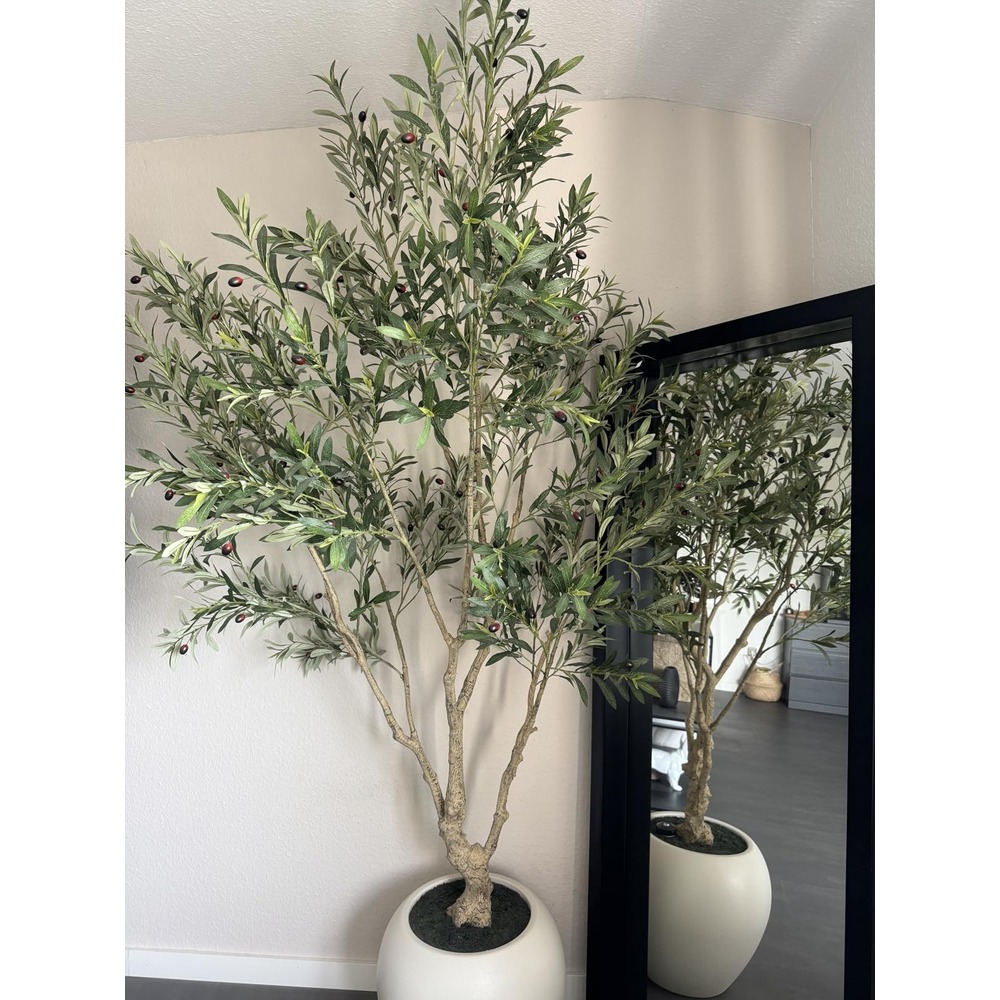
Olive. The bestseller, and for good reason: small two-tone leaves (grey-green above, silvery beneath) hide manufacturing flaws, the gnarled trunk is often real wood, and the Mediterranean look suits almost every interior. Choose one with sparse, muted olives or none at all; heavy fruiting looks like a Christmas decoration. Indoors, or a covered spot, unless the listing says UV-stabilised.
Bay (laurel). Larger, glossier leaves than olive on a clear stem, traditionally a pair either side of a front door. The real plant is actually hardy in Britain, so the artificial case rests on the finished shape, the lack of clipping and the fact that nobody has to water it. Usually sold UV-stabilised for outdoors.
Cypress, cedar and other conifers. Columnar height without the spread of a canopy; the Italianate look. Needle foliage is forgiving at a distance and the best versions blend two or three greens. Cheaper ones read as a Christmas tree up close, so check the photos. Most are made for outdoors.
Palms. The classic indoor tree. Areca has fine, feathery, upright fronds and is the easiest to fake well; kentia has broader, arching, darker fronds and a more elegant silhouette; phoenix (date palm) has stiff, spiky fronds and a chunky trunk and suits conservatories and poolside; traveller and cycas are the architectural choices. Look for fronds with a slight droop and colour variation along the stem, and a trunk with fibre texture rather than a smooth tube. Some palms are UV-stabilised for outdoors; most aren't.
Ficus and fiddle leaf fig. Fiddle leaf figs have been the designer's tree for a decade. Their huge violin-shaped leaves are hard to fake: the good ones have deep veining, a matt surface and leaves at varied angles; the cheap ones look stamped out. Smaller-leaved ficus (benjamina, "weeping fig") is far easier to get right and often more convincing. Indoors only.
Eucalyptus. Round, blue-grey leaves on slender stems; soft, airy and very forgiving. Suits Scandinavian and coastal interiors. Indoors.
Blossom and cherry. Bare branches with pink or white flowers. Beautiful as a statement, but seasonal by nature, so a blossom tree in October looks odd. Many people use them for a few months and store them. Indoors.
Birch, maple and other deciduous trees. Rarer, usually with real wood or very good resin trunks and silk leaves. Lovely in atriums and large rooms; the leaves are fabric so they're indoors only.
Bamboo. Tall, narrow, works in a slim space beside a doorway or in a run along a wall. Real canes with artificial leaves are the most convincing. Indoors or covered.
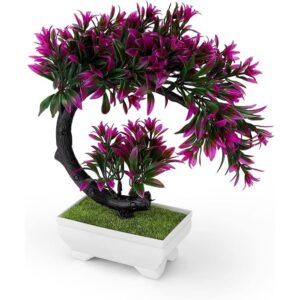
Bonsai. A different proposition: a tabletop sculpture rather than a room-filler, 30–60cm, often with a resin trunk and a ceramic dish. The best mimic a specific style (olive, juniper, maple, black pine) rather than a generic "bonsai", and come with moss and gravel dressing. The real thing is one of the most demanding plants there is, which is the whole argument for the artificial one.
If you're buying two or more trees for one room, stick to one species. A room with an olive, a palm and a fiddle leaf fig looks like a showroom.
4. Getting the height right
Nearly every disappointed review of an artificial tree is about size, in both directions: the "statement" tree that turned out to be shelf-sized, and the 240cm olive that arrived in three boxes and brushed the ceiling. Photos are shot to flatter. Get a tape measure out.
Ceiling first. For a standard UK ceiling of 2.3–2.4m, a tree of 150–180cm (including its pot) occupies roughly 65–70% of the height and looks intentional. Leave at least 15–20cm of clear air above the canopy; a tree that touches the ceiling looks cramped and a tree with a metre of space above it looks lost. Trees of 200cm and over need a stairwell, a vaulted room, a double-height hall or a commercial space.
Does the stated height include the pot? Usually it includes the starter pot but never your decorative planter, which adds 10–40cm. Some sellers quote the height of a tree they've stretched to the maximum; others quote it as shaped. Look for a "height as shown" figure.
Spread matters as much as height. An olive at 180cm might be 50cm across or 130cm across. A corner tree can carry a wide canopy; a tree beside a sofa or in a hallway needs a narrower one. Check the spread, then mark it on the floor.
Size to the room, not the gap. A good rule: 65–90cm suits a sideboard, console or desk; 120–125cm suits beside a chair, at the end of a kitchen island or in a hallway; 150–180cm fills a corner or flanks a fireplace; 200cm and over is for atriums and receptions. If you're torn between two sizes, go larger, as long as the ceiling allows.
Planter proportion. The visible planter should be about 20–25% of the tree's total height. A 180cm tree wants a planter around 35–45cm tall; a tiny pot under a big tree looks top-heavy and tips.
5. Trunk, leaves and fruit: how to judge quality
You can't touch it online, so study the close-ups and the specification:
The trunk. This is where realism lives or dies. The best trees use a real wood trunk (natural timber, sometimes several pieces bound together) or a high-density resin cast from real bark. A smooth, uniform, glossy brown pole reads as plastic from across the room. Look for irregularity, texture, a slight lean or twist, and a trunk colour that varies.
Leaf count. Better listings state it. As a guide, a convincing 120cm olive has 600–900 leaves, a 150–160cm one 1,000–1,300, and a premium 180cm tree 2,000–3,000. Fewer than that and you'll see through the canopy to the wires. Treat the number as a comparison between trees rather than a precise measure, since sellers count differently.
Leaf finish. Matt, not shiny; two tones at least (olives should be grey-green above and silvery below); veins visible; some leaves slightly curled or turned. Flat colour and high gloss are the giveaways.
Branches. Wired, so each one can be bent 30–45 degrees and stays where you put it. Rigid branches sit however they left the factory. Branches should emerge at varied heights and angles; a tree with branches in neat tiers looks like a bottle brush.
Fruit. On olives, less is more. Real trees carry fruit on perhaps 5–10% of their branches, in small clusters, in muted green-to-black shades. A tree studded with glossy black olives everywhere looks like a decoration. If you're unsure, buy without.
The base. A weighted plastic starter pot (usually 15–25cm across) with cement or weighted foam, finished with moss or soil over the top. Exposed white foam or a visible blob of cement means someone has cut corners.
Named materials. "PE leaves", "real wood trunk", "wired branches", "UV-stabilised" are claims you can hold a seller to. "Lifelike", "premium" and "realistic" are not.
6. Materials, indoor fading and UV
Most artificial tree foliage is polyethylene (PE), moulded from real leaves, sometimes blended with polyester fabric for softness. PVC is cheaper and shinier and ages faster. Palms and conifers are often PE throughout; blossom, birch and maple use fabric leaves.
Indoors, light and heat still matter. Sunlight through glass carries enough UV to pale standard foliage over a few years, and a south-facing window or a conservatory will do it faster. Give a tree in bright light a quarter turn every few weeks so one side doesn't take it all. Heat is the other enemy: PE leaves can warp or go tacky above about 30°C, so keep trees away from radiators, hobs, wood burners and sunny glass. Harsh LED downlights also amplify any plastic sheen, so a tree 1–2m from a spotlight looks better than one directly under it.
Outdoors, only UV-stabilised will do. A standard indoor tree put outside turns bluish, then chalky, then brittle within a season. Outdoor-rated trees have UV inhibitors mixed into the plastic before moulding, and sellers typically guarantee them against fading for a year. If a listing doesn't say "UV-stabilised" or "UV-resistant" and name the material, it's an indoor tree, however handsome. Most olive trees sold in the UK, including most of ours, are indoor trees; most bay, cypress and conifer trees are outdoor ones; palms are split. See section 11.
7. Pots and planters
Trees are photographed in handsome planters and, with a few exceptions that say so clearly, the planter isn't included. You'll get a plain plastic starter pot designed to drop inside something decorative. That's a feature: it lets you match the pot to the room. But budget for it, because a 180cm tree in a 20cm black plastic pot looks exactly as temporary as it is.
Size. Opening 5–10cm wider than the starter pot, deep enough that the starter pot sits below the rim, and tall enough to meet the 20–25% proportion above. The starter pot dimensions should be in the listing.
Weight. Artificial trees are light and top-heavy. Choose a planter with some heft (ceramic, stone, concrete, fibreclay) or a lighter one you'll ballast. Wide and squat beats tall and narrow for stability.
Style. Terracotta and stone for Mediterranean olives and bay; matt ceramic or fibreclay for modern rooms; woven baskets with a liner for a softer look; concrete for industrial spaces. The fancier the tree, the plainer the pot should be.
Finish. Sit the starter pot on a layer of gravel, pack sand or gravel round it until nothing moves (2–5kg is typical), then dress the surface with moss, bark, pebbles or slate so no plastic shows. This ten minutes is what makes a tree look planted rather than placed.
Outdoors, the planter also needs drainage holes and to be frost-proof. See section 11.
8. Delivery, assembly and the first hour
A few things nobody tells you until the courier has gone:
Big trees come in pieces. Anything over about 150cm usually arrives with the trunk in two or three sections that slot or screw together, sometimes in two boxes. That's normal, and it means a 240cm tree can be carried up a narrow stair. Assemble it in the room it's going to live in; a built tree won't go round a landing.
Check it before you build it. Count the sections against the instructions, look for snapped branches or cracked trunk joints, and photograph any damage before you throw the box away.
Everything is compressed. The tree will look flat, sparse and lopsided straight out of the box. Don't judge it yet. If it's arrived in cold weather, leave it in a warm room for a few hours so the plastic relaxes before you shape it.
It may smell. New PE and fresh adhesives can give off a plastic smell for a day or two. Stand the tree somewhere ventilated and it passes.
It may lean. If the trunk isn't vertical once assembled, check the sections are fully seated and any screws tight. If it still leans, pack a folded card or a thin wooden shim between trunk and starter pot on the low side, or add ballast on the opposite side of the planter. A slight lean, deliberately, can look more natural than dead vertical; a 10-degree list does not.
9. Shaping: the fifteen minutes that matter most
This is the step that decides whether your tree looks real, and it's the step most people skip. Work from the bottom up:
Separate every branch. Pull them away from the trunk and from each other so none are touching or parallel.
Bend for asymmetry. Push outer branches 15–20cm outwards, tuck some inwards, lift some and lower others so the canopy isn't a flat fan or a neat ball. Real trees are never symmetrical.
Angle the leaves. Twist stems so leaves face different directions and catch light differently; a tree with every leaf facing forward looks printed.
Leave gaps. Expose 10–15% of the trunk and inner branches. Mature trees don't have uniform coverage, and seeing some trunk is what reads as "grown".
Lean towards the light. Real plants grow towards the window. Bend the canopy very slightly that way.
Step back three metres. Look for flat spots, bald patches and anything too regular. Then look from where you'll actually see it most: the sofa, the doorway, the desk.
Wipe it. A microfibre cloth over the leaves removes factory dust and release agents, which are what give new trees a shine.
Revisit the shape every few months; branches drift and a two-minute tweak keeps the tree looking tended.
10. Where to put it
Position the tree where a real one could plausibly live: near a window, beside French doors, in a bright hall. The eye accepts an olive by a window without question and queries one in a windowless cupboard-sized loo. Then:
Give it space. A tree jammed into a corner with branches crushed against two walls looks stored, not styled. Pull it 10–20cm out and let the canopy breathe.
Anchor it to furniture. A tree beside a sofa, behind a reading chair or framing a fireplace reads as part of the room. A tree alone in the middle of a wall reads as an object.
Keep it away from heat and harsh light as above: radiators, hobs, wood burners, strong downlights and all-day direct sun.
Think about traffic. Hallways and landings are classic spots but the tree will be brushed past daily; choose a narrower spread and a heavier planter.
Pair with real plants. A single living plant on the windowsill near an artificial tree lends it credibility, and nobody checks which is which.
11. Outdoor artificial trees
Bay trees, cypresses, cedars and some palms and olives are made for outside, and either side of a front door is where many artificial trees end up. The rules change:
UV-stabilised only, with the material named. Check the listing, and check it again for "sheltered spot" wording: some UV products are described for a porch rather than full exposure.
Weight is not optional. A 150cm tree in a light pot is a sail. Stand the starter pot in a heavy outdoor planter, fill the bottom third with gravel or bricks, pack sand round the starter pot, and top-dress. For exposed sites, set the starter pot in a little quick-dry concrete or expanding foam, or bolt the planter down. Our guides to weighing down a hanging basket and windy coastal gardens apply just as well to trees.
Drainage. The planter needs holes and ideally pot feet, so rain runs through rather than freezing in the base and cracking the pot. Check the gap around the starter pot after heavy rain and tip out any standing water.
Wood trunks and water. Natural wood trunks rot if their base sits in water. Keep them on gravel above the waterline.
Storms. No tree is storm-proof. When gales are forecast, lay tall trees on their side or bring them into a porch or garage. Check anchors and joints afterwards.
Winter. UV trees can stay out all year. Brush heavy snow off the canopy so its weight doesn't bend branches, avoid bending or moving trees in freezing weather when plastic is brittle, and check that the planter is frost-proof (terracotta often isn't).
Theft. A pair of good trees on an open driveway is a target. A chain around the trunk base to a ground bolt, hidden under gravel, solves it and the wind problem together.
12. Pets, children and stability
Artificial trees remove the poisoning risk of real ones (several popular indoor trees, including sago palm and some ficus, are toxic to cats and dogs) and they don't shed leaves or soil for toddlers to eat. The risk they do carry is tipping. A top-heavy tree in a light pot can be pulled over by a cat climbing it or a child grabbing a branch. Ballast the planter generously, use a wide base, and in family homes consider a strap or a discreet hook from the trunk to the wall behind, as you would for a bookcase. Small decorative fruit and loose leaves are chewing hazards for puppies and kittens, so choose fruitless trees where that's a concern.
13. Cleaning and care
Dust is the one thing that reliably gives a good artificial tree away. Every few weeks, run a feather duster or a hairdryer on cool over the canopy from the top down. Twice a year, wipe leaves with a cloth barely dampened with cool water, and for sturdy PE trees, a quick lukewarm shower in the bath followed by a shake and a dry on a towel. No detergent, furniture polish, hairspray (sticky, and attracts more dust) or hot water, and never soak a tree with fabric leaves or a real wood trunk. Outdoors, brush off debris and rinse gently with a hose from the top down once or twice a year; no pressure washers. Full method in how to clean outdoor artificial flowers.
14. Artificial trees for businesses
Receptions, hotel lobbies, restaurants, salons, offices and show homes are where artificial trees make the most obvious sense: a specimen tree that would cost thousands to keep alive under skylights looks the same every day for a one-off cost. Three extras:
Fire safety. Fire certification for decorative foliage isn't a legal requirement in most premises, but insurers may expect it and your fire risk assessment may require it. Spray-applied treatments can achieve BS 5867 Part 2 Type B, which satisfies most decorative uses. Large installations, feature walls and anything on an escape route need inherently fire-retardant foliage certified to EN 13501-1 Class B, which no spray can achieve. Ask the supplier for the certificate for the specific product.
Anchor and inspect. Public spaces mean knocks and climbing children. Ballast heavily, fix tall trees to a wall or floor where possible, and put a quarterly check and dust in the diary.
Buy better at eye level. A tree beside a reception desk is seen at arm's length by everyone who walks in. Spend on the trunk and leaf quality there; economise on trees seen from a distance.
15. How long will it last?
Indoors and out of direct sun, a quality artificial tree should look good for seven to ten years with monthly dusting and an occasional reshape; many last longer. In a sunny window or conservatory, expect visible paling of standard foliage in two to four years. Outdoors, UV-stabilised trees hold their colour for three to five years in full sun and longer in shade; greens outlast anything else. When a tree finally tires, you rarely need to replace the whole thing: turn the faded side to the wall, move it to a darker spot, or on a wood-trunked tree, replace the foliage sections and keep the trunk.
16. Buyer's checklist
Before you click "buy":
Have you measured the ceiling and allowed 15–20cm above the canopy, and measured the floor space for the spread?
Does the stated height include the starter pot, and have you added your planter's height?
Is the trunk real wood or textured resin, not a smooth pole?
Is a leaf count given, and does it match the size (roughly 1,000+ for a 150cm olive)?
Are the leaves matt and two-toned in the close-ups? Are the branches wired?
If it's an olive, is the fruit sparse, or can you buy without?
Indoors or outdoors? If outdoors, is it UV-stabilised with the material named?
Is the planter included? If not, have you budgeted for one 5–10cm wider than the starter pot and about a quarter of the tree's height?
Do you have 2–5kg of gravel or sand for ballast, and something to dress the top?
Will it go up your stairs in sections, and do you have fifteen minutes to shape it?
Is the spot away from radiators, hobs, downlights and all-day sun?
Pets or small children? Have you planned for tip-over and chosen a fruitless tree?
Business premises? Has anyone specified a fire rating?
We hope this helps you choose a tree you'll still be pleased with in a decade. If you have a question we haven't covered, get in touch and we'll be glad to help.
FAQs
How tall should an artificial tree be for a normal room?
For a standard UK ceiling of 2.3 - 2.4m, a tree of 150 - 180cm including its pot looks balanced, filling about two-thirds of the height with 15 - 20cm of clear air above. Choose 120cm for beside a chair or in a hallway, 65 - 90cm for a sideboard or console, and 200cm or more only for stairwells, vaulted rooms and commercial spaces.
Does the height include the pot?
Usually the stated height includes the plastic starter pot but never a decorative planter, which adds 10 - 40cm. Some sellers quote the tree stretched to its maximum; look for a "height as shown" figure, and check the spread too, since an olive at 180cm can be anywhere from 50cm to 130cm across.
Can I put an artificial olive tree outside?
Only if it's UV-stabilised, and most olive trees sold in the UK aren't. Standard indoor foliage turns bluish, chalky and brittle within a season outdoors. Bay, cypress, cedar and some palms are usually made for outside. Check the listing names the material and says UV-stabilised; if it doesn't, it's an indoor tree or one for a covered porch.
What makes an artificial tree look realistic?
The trunk first: real wood or textured resin, never a smooth brown pole. Then matt, two-tone leaves with visible veins, wired branches you can bend, a leaf count suited to the size (around 1,000 or more for a 150cm olive), and sparse fruit if any. After that, fifteen minutes of asymmetric shaping and a proper planter do more than anything else.
Do artificial trees come with a pot?
Usually not. Most arrive in a weighted plastic starter pot designed to drop inside a planter of your choice. Pick one 5 - 10cm wider than the starter pot and about 20 - 25% of the tree's height, weight it with gravel or sand, and dress the surface with moss, bark or pebbles so no plastic shows.
How do I stop my artificial tree leaning or tipping over?
Make sure trunk sections are fully seated and screws tight. If it still leans, pack a thin shim between trunk and starter pot on the low side, or add ballast on the opposite side of the planter. For tipping, use a wide, heavy planter packed with 2 - 5kg of gravel or sand; in homes with cats or toddlers, a discreet strap to the wall behind adds safety.
My artificial tree arrived flat and sparse. Is it faulty?
Almost certainly not. Every tree is compressed for shipping and looks thin out of the box. Leave it in a warm room for a few hours, then separate every branch, bend them to varied heights and angles, twist leaves to face different directions and leave 10 - 15% of the trunk visible. Judge it only after shaping.
Do artificial trees fade indoors?
Slowly. Sun through glass carries enough UV to pale standard foliage over a few years, faster in a south-facing window or conservatory. Heat above about 30°C from radiators, hobs or sunny glass can warp PE leaves. Keep trees out of all-day direct sun and away from heat, and give a tree in bright light a quarter turn every few weeks.
How do I clean an artificial tree?
Dust every few weeks with a feather duster or a hairdryer on cool, working from the top down. Twice a year, wipe leaves with a barely damp cloth, or give a sturdy PE tree a quick lukewarm shower and let it dry. Avoid detergent, polish, hairspray and hot water, and never soak fabric leaves or a real wood trunk.
Are artificial trees fire-rated for offices and hotels?
Not by default. Fire certification isn't a legal requirement in most premises but insurers and fire risk assessments may require it. Spray treatment can achieve BS 5867 Part 2 Type B for decorative use; large installations and escape routes need inherently fire-retardant foliage certified to EN 13501-1 Class B. Ask the supplier for the certificate for the specific tree.
We use cookies on our website to give you the most relevant experience by remembering your preferences and repeat visits. By clicking “Accept All”, you consent to the use of ALL the cookies. However, you may visit "Cookie Settings" to provide a controlled consent. View privacy & cookies policy.
This website uses cookies to improve your experience while you navigate through the website. Out of these, the cookies that are categorized as necessary are stored on your browser as they are essential for the working of basic functionalities of the website. We also use third-party cookies that help us analyze and understand how you use this website. These cookies will be stored in your browser only with your consent. You also have the option to opt-out of these cookies. But opting out of some of these cookies may affect your browsing experience.
Necessary cookies are absolutely essential for the website to function properly. These cookies ensure basic functionalities and security features of the website, anonymously.
Cookie
Duration
Description
cookielawinfo-checkbox-advertisement
1 year
The cookie is set by GDPR cookie consent to record the user consent for the cookies in the category "Advertisement".
cookielawinfo-checkbox-analytics
11 months
This cookie is set by GDPR Cookie Consent plugin. The cookie is used to store the user consent for the cookies in the category "Analytics".
cookielawinfo-checkbox-functional
11 months
The cookie is set by GDPR cookie consent to record the user consent for the cookies in the category "Functional".
cookielawinfo-checkbox-necessary
11 months
This cookie is set by GDPR Cookie Consent plugin. The cookies is used to store the user consent for the cookies in the category "Necessary".
cookielawinfo-checkbox-others
11 months
This cookie is set by GDPR Cookie Consent plugin. The cookie is used to store the user consent for the cookies in the category "Other.
cookielawinfo-checkbox-performance
11 months
This cookie is set by GDPR Cookie Consent plugin. The cookie is used to store the user consent for the cookies in the category "Performance".
viewed_cookie_policy
11 months
The cookie is set by the GDPR Cookie Consent plugin and is used to store whether or not user has consented to the use of cookies. It does not store any personal data.
Functional cookies help to perform certain functionalities like sharing the content of the website on social media platforms, collect feedbacks, and other third-party features.
Cookie
Duration
Description
na_id
1 year 1 month
This cookie is set by Addthis.com to enable sharing of links on social media platforms like Facebook and Twitter
na_rn
1 month
This cookie is used to recognize the visitor upon re-entry. This cookie allows to collect information on user behaviour and allows sharing function provided by Addthis.com
na_sc_e
1 month
This cookie is used to recognize the visitor upon re-entry. This cookie allows to collect information on user behaviour and allows sharing function provided by Addthis.com
na_sr
1 month
This cookie is set by Addthis.com. This cookie is used for sharing of links on social media platforms.
na_srp
1 minute
This cookie is used to recognize the visitor upon re-entry. This cookie allows to collect information on user behaviour and allows sharing function provided by Addthis.com
na_tc
1 year 1 month
This cookie is set by the provider Addthis. This cookie is used for social media sharing tracking service.
ouid
1 year 1 month
The cookie is set by Addthis which enables the content of the website to be shared across different networking and social sharing websites.
Performance cookies are used to understand and analyze the key performance indexes of the website which helps in delivering a better user experience for the visitors.
Cookie
Duration
Description
_gat
1 minute
This cookies is installed by Google Universal Analytics to throttle the request rate to limit the colllection of data on high traffic sites.
d
3 months
This cookie tracks anonymous information on how visitors use the website.
YSC
session
This cookies is set by Youtube and is used to track the views of embedded videos.
Analytical cookies are used to understand how visitors interact with the website. These cookies help provide information on metrics the number of visitors, bounce rate, traffic source, etc.
Cookie
Duration
Description
__gads
1 year 24 days
This cookie is set by Google and stored under the name dounleclick.com. This cookie is used to track how many times users see a particular advert which helps in measuring the success of the campaign and calculate the revenue generated by the campaign. These cookies can only be read from the domain that it is set on so it will not track any data while browsing through another sites.
_ga
2 years
This cookie is installed by Google Analytics. The cookie is used to calculate visitor, session, campaign data and keep track of site usage for the site's analytics report. The cookies store information anonymously and assign a randomly generated number to identify unique visitors.
_gid
1 day
This cookie is installed by Google Analytics. The cookie is used to store information of how visitors use a website and helps in creating an analytics report of how the website is doing. The data collected including the number visitors, the source where they have come from, and the pages visted in an anonymous form.
Advertisement cookies are used to provide visitors with relevant ads and marketing campaigns. These cookies track visitors across websites and collect information to provide customized ads.
Cookie
Duration
Description
DSID
1 hour
This cookie is setup by doubleclick.net. This cookie is used by Google to make advertising more engaging to users and are stored under doubleclick.net. It contains an encrypted unique ID.
IDE
1 year 24 days
Used by Google DoubleClick and stores information about how the user uses the website and any other advertisement before visiting the website. This is used to present users with ads that are relevant to them according to the user profile.
test_cookie
15 minutes
This cookie is set by doubleclick.net. The purpose of the cookie is to determine if the user's browser supports cookies.
uid
1 year 1 month
This cookie is used to measure the number and behavior of the visitors to the website anonymously. The data includes the number of visits, average duration of the visit on the website, pages visited, etc. for the purpose of better understanding user preferences for targeted advertisments.
uuid
3 months
To optimize ad relevance by collecting visitor data from multiple websites such as what pages have been loaded.
VISITOR_INFO1_LIVE
5 months 27 days
This cookie is set by Youtube. Used to track the information of the embedded YouTube videos on a website.
 A warm welcome from The Artificial Flowers Company. We offer artificial flower arrangements, silk flowers, hanging baskets, topiary balls, topiary plants and much more - we hope you find what you're looking for!
