artificial hanging baskets, topiary balls, hedges and topiary trees
Artificial topiary
Artificial topiary gives you the neat, clipped look of traditional topiary without the pruning and upkeep. Browse realistic artificial topiary trees and balls for doorways, patios, gardens and other areas where you want structured, year-round greenery.
Topiary is the art of clipping evergreens into ornamental shapes, and a pair of clipped balls or trees either side of a front door is one of the oldest tricks in the book for making a house look cared for. The trouble is that real topiary takes skill, time and, increasingly, luck. This guide explains why so many people are switching to artificial, what the different shapes are for, how to get the size and pot right, and how to keep your topiary upright, secure and looking freshly clipped for years.
1. Why topiary at all?
Topiary gives a garden structure. Flowers come and go, but a clipped ball or cone looks the same in January as it does in July, which is why designers use it as the "bones" of a planting scheme. At an entrance it frames the door and draws the eye; on a patio it adds height and formality; in a border it gives loose planting something to lean against. A pair of matching trees flanking a doorway has been the classic statement of a well-kept house since the Romans, and it works just as well on a modern semi as on a Georgian townhouse.
2. Why artificial? Box blight, caterpillars and cost
Traditional topiary is grown from box (Buxus sempervirens), and box in Britain is in trouble. Two problems have arrived in the last fifteen years:
Box tree caterpillar. The box tree moth first appeared in the UK in 2007 and is now, in the RHS's words, a "common resident" across England, Wales, Scotland and Ireland, with more than 5,000 sightings reported every year. Its caterpillars can strip a plant bare in days.
Box blight. A fungal disease that browns and drops leaves in patches. Spores survive in the soil for up to six years, so it comes back every wet summer.
Between them, these two have killed an estimated four million box plants in the UK since 2008. The RHS is now trialling alternatives to box at Wisley and openly advising gardeners to reconsider growing it. Some leading nurseries have stopped selling box altogether.
Even without disease, real topiary is a commitment. Potted box needs watering all year, including winter, feeding in spring, clipping once or twice a year with sharp shears (never in frost or hot sun), snow brushed off, fleece in hard frosts and regular checks for caterpillars from spring onwards. Get the clipping wrong and you wait a season for it to grow out.
Real topiary
Quality artificial topiary
Single 40cm box ball
£60–£85
£20–£60
Matched pair of balls
From £245
£40–£120
Pair of standard (lollipop) trees, 90–120cm
£325–£1,000+
£60–£200
Pair of spirals, 120–150cm
£280–£2,600
£150–£250
Clipping
Once or twice a year, sharp tools, right weather
Never
Watering (in pots)
Regularly, all year round
Never
Pests and disease
Box blight and box tree caterpillar, increasingly unavoidable
None
Shape on day one
Often small and thin; years to fill out
Full and finished
Expected life
Decades if it survives; one bad summer if it doesn't
3–5 seasons in full sun; longer in shelter
Real topiary does have its charms: it grows, it smells of box on a warm evening, and a fifty-year-old yew cone is a thing of beauty. But for a doorway, a patio or a shopfront where you want a finished look today with no upkeep and no risk of coming home to a stripped plant, artificial is the sensible choice.
3. Balls, trees, spirals and cones: the shapes explained
Topiary balls are the most versatile shape. Hang them from a bracket as an evergreen alternative to a hanging basket, sit them in pots either side of a door, tuck them into a border or window box, or line them along a path. Most are boxwood-style foliage; you'll also find long-leaf "grass" balls with a softer, shaggier look.
Flower balls are topiary balls with blooms worked through or covering the foliage: roses, lavender, heather and others. They're a hanging basket and a topiary in one, and because they're a single shape rather than a mixed planting, they look neat and deliberate all year.
Standards or lollipop trees have a clear stem with a ball on top. Double- and triple-ball versions stack two or three balls of decreasing size. These are the classic front-door tree.
Cones and pyramids have vertical presence without the spread of a ball, so they suit narrow porches and paths. They read as formal and architectural.
Spirals are the showpiece shape: a cone clipped into a corkscrew. They draw the eye and suit taller frontages, but note that real spirals are hugely expensive, so a good artificial spiral is one of the biggest savings you can make.
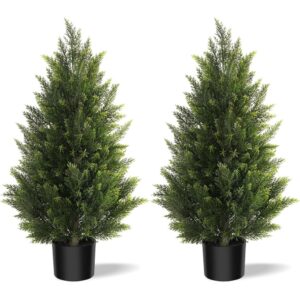
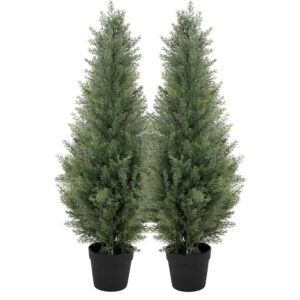
Cypress, cedar and bay trees are looser, more natural forms. A cypress or cedar column gives height with a softer outline; a bay tree has larger, glossier leaves and a gentler silhouette. Both are traditional either side of a door.
Choose balls if you have wall brackets to fill, want to sit something in an existing pot or bed, need a window box or wall-top feature, or want colour from a flower ball. They're lighter, cheaper and easier to store.
Choose trees if you want the classic flanked-doorway look, need height on a patio or terrace, or want a feature that reads as architecture rather than decoration. Trees need a heavier pot and more care over wind, but they make a bigger statement.
Many people combine the two: a pair of trees at the door and a couple of hanging balls on the wall brackets either side, all in the same foliage so it reads as one scheme.
5. Materials: what "UV-resistant" really means
Nearly every outdoor topiary is labelled UV-resistant, but the term hides two very different products:
UV-coated foliage. The protection is sprayed onto the surface after manufacture. It works for a season or so in full sun before the leaves start to pale and, on poor examples, take on a bluish or bleached tint. Fine in a porch or on a shaded wall.
UV-stabilised polyethylene (PE). The UV inhibitors are mixed into the plastic itself, so protection doesn't wear off. Good PE boxwood has a slightly waxy, matt feel like real box, flexes without cracking and holds its colour for several seasons in full sun.
Cheaper topiary often uses PVC, which is stiffer, shinier and more likely to fade, harden and crack in strong sun. It's acceptable for a shaded spot or indoor use, but not for a south-facing doorstep.
Our rule of thumb: if the listing names the material (PE, polyethylene, "UV-stabilised"), it's been made with the outdoors in mind. If it just says "UV-resistant" with nothing else, treat it as a sheltered-spot product. On trees, also check the trunk: natural wood looks best but will rot if left standing in water, while a resin or metal-cored trunk is maintenance-free.
6. Getting the size and proportion right
Photos are deceptive and topiary is unforgiving of the wrong scale: too small looks tentative, and you'll notice it every time you walk in. A few rules borrowed from the real-topiary trade:
Hanging balls: 30–40cm diameter suits most wall brackets. Below 30cm a ball looks lost on a standard bracket; 40cm is a substantial ball that needs a bracket to match.
Balls at ground level or in pots: at least 40cm to read as a deliberate feature rather than a pot of foliage. 50cm and above is a statement.
Trees at a door: the head of a standard tree should reach roughly door-handle height, about 90–110cm from the ground once it's in its pot. A 3ft (90cm) tree in a pot suits a small porch or cottage door; 4ft (120cm) suits most standard front doors; 5ft (150cm) and above suits tall or double-height frontages. If you're torn between two sizes, go larger.
Proportion to the entrance: the diameter of a ball or the base of a cone should be around 20–30% of the total entrance width. A 2.5m entrance suits 50–75cm; a narrow terrace doorway suits 40–50cm.
Spacing pairs: 120–140cm apart, centre to centre, leaves comfortable clearance either side of a standard door.
Always check whether a stated height includes the pot. Most listings quote the tree only.
7. Pots and planters
Topiary trees are almost always photographed in handsome pots, and those pots rarely come with the tree. You'll usually get a plain plastic starter pot designed to be dropped inside something decorative. A few of our sets do include planters, and we say so clearly, but assume you'll be choosing your own unless the listing says otherwise. That's no bad thing: it lets you match the pot to your house.
When choosing a pot:
Go heavy and wide. Stone, concrete, glazed ceramic or a weighted fibreclay planter with a broad base resists tipping far better than a tall, narrow, lightweight one. For a 120cm tree, aim for 40–50cm across.
Think about water. A pot with no drainage will fill with rain and become a bucket, which rots wooden trunks and breeds algae. Either use a pot with drainage, or drill a hole, and make sure the starter pot sits above any water that collects.
Dress the top. Fill around the starter pot with gravel or sand (which also adds weight, see below) and finish with decorative gravel, slate chippings or bark so no plastic is visible. This single step is what makes artificial topiary look planted.
8. Assembly and fluffing
Most trees arrive in one or two pieces: the trunk plugs or screws into the base, and on taller trees the stem may come in two sections. Balls are either supplied whole or as two halves that clip together; the clips on cheaper balls can be fiddly and misaligned, which is one reason we favour ready-assembled balls.
Everything arrives compressed from the box, and the difference between "obviously fake" and "is that real?" is ten or fifteen minutes of fluffing:
Work round the piece, pulling each leaf cluster outwards and slightly upwards.
Turn stems to cover any visible frame or bald patches. Many balls come with spare tufts for exactly this.
Leave the piece in a warm room for a day if it's arrived misshapen in cold weather; the plastic relaxes and reshapes far more easily.
Step back three metres and look for flat spots. Real box is never perfectly round, but it's never dented either.
9. Pairs and pack sizes
Most people want two, and the single most common ordering mistake is buying one when you thought you were buying a pair. Check the pack size before you order. Better-quality balls and trees are often sold singly, which is fine, but make sure you order enough.
Pairs at a door should match exactly in height, head size and foliage colour. That's easy with artificial (real topiary nurseries charge a premium for grown-together matched pairs), but if you're adding to an existing piece later, buy the same product rather than something "close" from a different range.
10. Hanging balls: chains and brackets
Most hanging balls come with a chain attached. On the cheapest balls this is thin, unprotected metal that rusts within a season and streaks the wall. Look for a galvanised chain (steel dipped in a protective zinc coating) or a powder-coated one; either will stay bright for years.
Brackets are rarely included. Choose powder-coated steel or stainless steel rather than painted mild steel, size it to the ball (a 40cm ball needs a bracket with real reach so it doesn't rub the wall), fix it into solid brick or a timber stud with fixings rated well above the weight, and hang the chain from a closed hook or carabiner rather than an open S-hook. Give it a firm tug twice a year and after any storm.
11. Wind: weighting and securing
Artificial topiary weighs a fraction of the real thing. A 120cm tree in a lightweight pot is top-heavy and will be on its side after the first autumn gale. Weighting is not optional:
Trees in pots. Fill the bottom third of the decorative pot with gravel, pebbles or a couple of bricks, sit the starter pot on top, then pack sand or soil around it to lock it in place before dressing the surface. The heavier the fill, the more stable the tree. Most tree listings, including ours, will tell you to do this; it's the most important instruction in the box.
Permanent or exposed sites. For a coastal garden, a rooftop terrace or a shopfront, set the starter pot into the outer planter with expanding foam or a light pour of concrete, then cover with gravel. Alternatively bolt the outer planter to the ground through its drainage hole.
Balls in pots or beds. Tie the ball's chain or an internal wire to a brick or sandbag buried in the pot, or push two tent pegs into the ground beside it and fix with cable ties hidden in the foliage. A ball that's merely resting on soil will roll away.
Hanging balls. Keep the chain short so the wind has less leverage, use a closed hook, and choose the sheltered side of the doorway if you can. Our guide to weighing down an artificial hanging basket applies just as well to a hanging ball.
Check everything after strong winds. If a tree is still wobbly, add more weight; there's no such thing as too stable.
12. Theft: keeping your topiary where you put it
A good pair of artificial trees on an open driveway or outside a pub is an easy target. The method that works: pass a length of chain or heavy wire around the base of the trunk inside the outer planter, fix it to a bolt set into the ground (or into a concrete fill in the pot), and cover the whole arrangement with gravel so nothing is visible. Concreting the starter pot into a heavy outer planter achieves the same thing for anywhere that isn't too public. Neither takes more than half an hour and both also solve the wind problem.
13. Storms, winter and storage
No topiary, real or artificial, is storm-proof. Sustained gale-force wind will damage foliage however well anchored the base is, so when a named storm is forecast, move trees into a porch or garage and lift hanging balls down. It takes a minute.
Good-quality outdoor topiary can stay out all winter, and most people leave it up because year-round structure is the whole point. It will last longer, though, if you keep a few things in mind: frost makes cheaper plastic brittle, so avoid fluffing or moving pieces in freezing weather; make sure pots drain so trunks don't stand in ice; and if you do store anything, let it dry fully first and keep it out of direct sun.
14. Keeping it looking freshly clipped
Boxwood-style foliage collects dust, pollen and cobwebs, and near roads a grey film. A clean once or twice a year keeps it looking new:
Brush loose debris off with a soft brush or a cool hairdryer.
Wipe leaves with a damp cloth and a drop of washing-up liquid for grime.
Rinse with a gentle hose from the top down. Avoid pressure washers, hot water and solvents, which can strip UV coatings and loosen glued leaves.
Let it dry, then fluff any clusters the water has flattened.
Artificial topiary is a natural fit for pubs, restaurants, hotels, salons and offices: a smart, formal entrance with no watering rota, no bare patches and no risk of a diseased plant greeting your customers. A few extra considerations:
Anchor and secure as described above. Public sites need the concrete-or-bolt approach, not just gravel.
Pavements. Pots on the footway need to leave clear passage, and hanging balls over a public pavement should follow the same height rules as hanging baskets (generally 2.25m clearance in England; a legal requirement in Scotland). See the business section of our hanging baskets guide.
Indoors. Foliage used inside commercial premises may need to be fire-retardant rated to satisfy your fire risk assessment. Ask before you buy.
Consent. Listed buildings and conservation areas may need permission for fixed brackets; freestanding pots usually don't.
16. How long will it last?
Realistically, a quality UV-stabilised PE topiary in full UK sun should look good for three to five seasons with a rinse a year and a little fluffing. UV-coated or PVC foliage in full sun may start to pale within a season, though it will last far longer under a porch or on a north-facing wall. Green foliage outlasts flower colours, so a plain boxwood ball will outlive a rose ball hung in the same spot.
When a piece does start to tire, you often don't need to replace it. Rotate the tree so the faded side faces the wall, swap the most exposed hanging ball with one from a shadier spot, or replace one faded ball on a multi-ball tree.
17. Buyer's checklist
Before you click "buy":
Is the foliage material named (PE / polyethylene / UV-stabilised)? If it only says "UV-resistant", is the spot sheltered enough?
Is it rated for outdoor use, or indoor only?
Does the stated height include the pot? Will the head of a tree reach door-handle height?
Is a ball at least 30cm for a bracket, or 40cm for the ground?
Is the pot included? If not, have you budgeted for a heavy, wide one with drainage?
Single or pair? Have you ordered enough?
Ready-assembled, or two halves to clip together?
On hanging balls: galvanised chain, and do you have a suitable bracket and a closed hook?
Do you have gravel and sand to weight the pot, and a plan for storms?
If it's on a driveway or outside a business, how will you secure it against theft?
We hope this helps you find the right topiary for your home or business. If you have a question we haven't covered, get in touch and we'll be glad to help.
FAQs
Why choose artificial topiary over real box?
Real box in Britain now faces two near-unavoidable problems: box tree caterpillar, which the RHS classes as a common resident across the UK, and box blight, a fungus that persists in soil for years. Together they've killed millions of UK box plants. Artificial topiary gives you the finished, clipped look from day one with no watering, clipping, pests or disease.
What size artificial topiary do I need for my front door?
For a standard tree, the head should reach roughly door-handle height, around 90 - 110cm from the ground once potted. A 3ft (90cm) tree suits a small porch, 4ft (120cm) suits most front doors and 5ft (150cm) suits tall frontages. For balls, choose 30 - 40cm for wall brackets and at least 40cm for pots or the ground.
Do artificial topiary trees come with pots?
Usually not. Most trees are photographed in decorative pots but supplied in a plain plastic starter pot to drop inside a planter of your choice. Some sets do include planters; the listing will say so. Choose a heavy, wide pot with drainage and weight it with gravel and sand.
How do I stop my artificial topiary blowing over?
Fill the bottom third of the pot with gravel or bricks, sit the tree's starter pot on top and pack sand around it before dressing the surface. In very exposed or public spots, fix the starter pot with expanding foam or concrete, or bolt the planter to the ground. Hanging balls should have a short chain and a closed hook. Bring everything under cover when a storm is forecast.
Does artificial topiary fade in the sun?
All artificial foliage fades eventually, but the rate depends on the material. UV-stabilised polyethylene (PE) has protection built into the plastic and typically holds its colour for three to five seasons in full sun. UV-coated or PVC foliage can pale within a season in a south-facing spot, though it lasts far longer in shade.
Can I leave artificial topiary outside all year?
Yes, good-quality outdoor-rated topiary is designed to stay out year-round, which is the point of evergreen structure. Make sure pots drain so trunks don't stand in water, avoid handling the foliage in freezing weather when plastic is brittle, and move pieces to shelter during gales.
Do artificial topiary balls need assembling?
Some are supplied whole, others as two halves that clip together. Either way, expect ten to fifteen minutes of fluffing to pull the compressed foliage out, cover the frame and remove flat spots. Leaving a misshapen ball in a warm room for a day makes it much easier to reshape.
How do I stop my topiary being stolen?
Pass a chain or heavy wire around the base of the trunk inside the outer planter, fix it to a bolt set into the ground or into concrete in the pot, and cover everything with gravel. Concreting the starter pot into a heavy planter works well for most home driveways.
How do I clean artificial topiary?
Brush off loose debris with a soft brush, wipe leaves with a damp cloth and a drop of washing-up liquid, and rinse gently with a hose from the top down. Avoid pressure washers, hot water and solvents. Let it dry, then fluff any flattened clusters.
Is artificial topiary cheaper than real?
Considerably. A real 40cm box ball costs £60 - £85 and matched real pairs start at around £245 for balls, £325 for lollipop standards and £370 for spirals, plus years of clipping and watering. Artificial equivalents cost £20 - £60 per ball and £60 - £250 per pair of trees, with no running costs.
We use cookies on our website to give you the most relevant experience by remembering your preferences and repeat visits. By clicking “Accept All”, you consent to the use of ALL the cookies. However, you may visit "Cookie Settings" to provide a controlled consent. View privacy & cookies policy.
This website uses cookies to improve your experience while you navigate through the website. Out of these, the cookies that are categorized as necessary are stored on your browser as they are essential for the working of basic functionalities of the website. We also use third-party cookies that help us analyze and understand how you use this website. These cookies will be stored in your browser only with your consent. You also have the option to opt-out of these cookies. But opting out of some of these cookies may affect your browsing experience.
Necessary cookies are absolutely essential for the website to function properly. These cookies ensure basic functionalities and security features of the website, anonymously.
Cookie
Duration
Description
cookielawinfo-checkbox-advertisement
1 year
The cookie is set by GDPR cookie consent to record the user consent for the cookies in the category "Advertisement".
cookielawinfo-checkbox-analytics
11 months
This cookie is set by GDPR Cookie Consent plugin. The cookie is used to store the user consent for the cookies in the category "Analytics".
cookielawinfo-checkbox-functional
11 months
The cookie is set by GDPR cookie consent to record the user consent for the cookies in the category "Functional".
cookielawinfo-checkbox-necessary
11 months
This cookie is set by GDPR Cookie Consent plugin. The cookies is used to store the user consent for the cookies in the category "Necessary".
cookielawinfo-checkbox-others
11 months
This cookie is set by GDPR Cookie Consent plugin. The cookie is used to store the user consent for the cookies in the category "Other.
cookielawinfo-checkbox-performance
11 months
This cookie is set by GDPR Cookie Consent plugin. The cookie is used to store the user consent for the cookies in the category "Performance".
viewed_cookie_policy
11 months
The cookie is set by the GDPR Cookie Consent plugin and is used to store whether or not user has consented to the use of cookies. It does not store any personal data.
Functional cookies help to perform certain functionalities like sharing the content of the website on social media platforms, collect feedbacks, and other third-party features.
Cookie
Duration
Description
na_id
1 year 1 month
This cookie is set by Addthis.com to enable sharing of links on social media platforms like Facebook and Twitter
na_rn
1 month
This cookie is used to recognize the visitor upon re-entry. This cookie allows to collect information on user behaviour and allows sharing function provided by Addthis.com
na_sc_e
1 month
This cookie is used to recognize the visitor upon re-entry. This cookie allows to collect information on user behaviour and allows sharing function provided by Addthis.com
na_sr
1 month
This cookie is set by Addthis.com. This cookie is used for sharing of links on social media platforms.
na_srp
1 minute
This cookie is used to recognize the visitor upon re-entry. This cookie allows to collect information on user behaviour and allows sharing function provided by Addthis.com
na_tc
1 year 1 month
This cookie is set by the provider Addthis. This cookie is used for social media sharing tracking service.
ouid
1 year 1 month
The cookie is set by Addthis which enables the content of the website to be shared across different networking and social sharing websites.
Performance cookies are used to understand and analyze the key performance indexes of the website which helps in delivering a better user experience for the visitors.
Cookie
Duration
Description
_gat
1 minute
This cookies is installed by Google Universal Analytics to throttle the request rate to limit the colllection of data on high traffic sites.
d
3 months
This cookie tracks anonymous information on how visitors use the website.
YSC
session
This cookies is set by Youtube and is used to track the views of embedded videos.
Analytical cookies are used to understand how visitors interact with the website. These cookies help provide information on metrics the number of visitors, bounce rate, traffic source, etc.
Cookie
Duration
Description
__gads
1 year 24 days
This cookie is set by Google and stored under the name dounleclick.com. This cookie is used to track how many times users see a particular advert which helps in measuring the success of the campaign and calculate the revenue generated by the campaign. These cookies can only be read from the domain that it is set on so it will not track any data while browsing through another sites.
_ga
2 years
This cookie is installed by Google Analytics. The cookie is used to calculate visitor, session, campaign data and keep track of site usage for the site's analytics report. The cookies store information anonymously and assign a randomly generated number to identify unique visitors.
_gid
1 day
This cookie is installed by Google Analytics. The cookie is used to store information of how visitors use a website and helps in creating an analytics report of how the website is doing. The data collected including the number visitors, the source where they have come from, and the pages visted in an anonymous form.
Advertisement cookies are used to provide visitors with relevant ads and marketing campaigns. These cookies track visitors across websites and collect information to provide customized ads.
Cookie
Duration
Description
DSID
1 hour
This cookie is setup by doubleclick.net. This cookie is used by Google to make advertising more engaging to users and are stored under doubleclick.net. It contains an encrypted unique ID.
IDE
1 year 24 days
Used by Google DoubleClick and stores information about how the user uses the website and any other advertisement before visiting the website. This is used to present users with ads that are relevant to them according to the user profile.
test_cookie
15 minutes
This cookie is set by doubleclick.net. The purpose of the cookie is to determine if the user's browser supports cookies.
uid
1 year 1 month
This cookie is used to measure the number and behavior of the visitors to the website anonymously. The data includes the number of visits, average duration of the visit on the website, pages visited, etc. for the purpose of better understanding user preferences for targeted advertisments.
uuid
3 months
To optimize ad relevance by collecting visitor data from multiple websites such as what pages have been loaded.
VISITOR_INFO1_LIVE
5 months 27 days
This cookie is set by Youtube. Used to track the information of the embedded YouTube videos on a website.



 A warm welcome from The Artificial Flowers Company. We offer artificial flower arrangements, silk flowers, hanging baskets, topiary balls, topiary plants and much more - we hope you find what you're looking for!
