artificial hanging baskets, topiary balls, hedges and topiary trees
Artificial hanging baskets
Enjoy colourful hanging baskets throughout the year without worrying about watering, deadheading or wilting flowers. Our artificial hanging baskets combine realistic faux flowers and foliage in ready-made displays for walls, porches, fences and garden buildings.
Artificial hanging baskets: the complete buying guide
Last updated: September 2026
Not all artificial hanging baskets are the same. Some will still look freshly planted after five summers; others will be faded, bare and swinging from a rusty chain by the second. This guide covers everything we've learned about choosing, hanging and looking after artificial baskets, so you get one that suits your home or business and lasts.
1. Why hanging baskets at all?
If you're not already a hanging basket convert, you might be wondering why bother. After all, artificial hanging baskets may be low maintenance, but no hanging baskets is, well, no maintenance!
Hanging baskets add colour and style to outdoor spaces, whether that's the front of the house, the back garden or the entrance to your business. They bring colour up to eye level and above, where it's difficult to place pots and planters, they lift dull walls and fences, and the more extravagant baskets give an entrance a genuinely lavish flourish. A pair either side of a front door is one of the quickest ways to make a house look cared for.
2. Real vs artificial: cost and effort compared
The biggest advantage of artificial baskets is obvious: no watering, feeding, deadheading or replanting. But it's worth putting numbers on it, because the running cost of real baskets surprises most people.
Around £60–£65 for basket, liner, bracket, compost, feed and a dozen plants
£30–£105, one-off
Each following year
Around £35 for fresh plants and compost, per basket
£0
Ready-planted from a garden centre
£35–£60 per basket, per season
Not applicable
Winter replant
£18–£30 per basket
Not needed (swap a few stems if you like)
Watering
Daily in summer, twice a day in a heatwave, 3–5 litres each time
None
Holiday cover
Needed
Not needed
Expected life
One season, then start again
3–5 seasons in full sun; longer in a sheltered spot
Put simply, a pair of real baskets by your front door costs roughly £100–£200 a year plus a daily watering commitment. A pair of good artificial baskets is a one-off purchase that you rinse a couple of times a year.
Real plants do have one advantage: they change and grow through the season. If you enjoy that, and you have the time, nobody will talk you out of it. Artificial baskets are for everyone who wants the look without the routine.
3. Materials: what "UV-resistant" really means
Nearly every outdoor basket is labelled UV-resistant, but there are two very different kinds and the difference matters more than anything else on this page.
Silk and polyester flowers with a UV coating. The UV protection is a surface treatment applied after manufacture. It works well for a season or so, then gradually breaks down in direct sun and the colours start to wash out. These look the most realistic up close, so they're the right choice for a covered porch, a north- or east-facing wall, or anywhere that doesn't get baking afternoon sun.
Polyethylene (PE) and PE-blend plants. Here the UV stability is built into the material itself rather than coated on, so colour lasts for several seasons of full sun. Look for "PE", "polyethylene" or "PE blend" in the description. Many of the best baskets combine the two: durable plastic stems and leaves with silk-polyester petals for realism.
Our rule of thumb: if a listing names the material, it's been made with the outdoors in mind. If it just says "UV-resistant" and nothing else, treat it as a sheltered-spot basket. And remember that flower colours fade before greens, so a foliage-heavy basket will always outlast a flower-heavy one in the sunniest positions.
Finally, some baskets are sold for indoor use only. They're not UV treated at all and won't survive a British summer outside, however good they look on the day they arrive.
4. Where will it hang?
Before you choose a basket, look at the spot. South- and west-facing positions get the harshest sun and the most fading; north- and east-facing walls are far kinder. A porch, a recessed doorway or the lee side of the house will shelter a basket from both sun and wind and can easily double its life.
If you have a choice, hang your most colourful, flower-heavy baskets where they get part shade and save the hottest, sunniest positions for greenery-led designs. It's also worth thinking about the view: a basket seen mostly from below (over a door, on a lamp post) needs colour and trailing foliage on its underside, while one seen from the side or above can be all about the top display.
5. Size, drop and weight
Artificial hanging baskets come in a wide range of sizes and photos can be deceiving, so always check the measurements before you order. Three numbers matter:
Basket diameter. For a nice, full basket outside a front door you want at least 30cm across the basket itself, not including the flowers. A 25cm basket looks fine on a narrow porch but will look lost on a wide frontage.
Total drop. This is the distance from the top of the chain or hook to the lowest trailing stem, typically around 60cm for a standard basket. Measure from your bracket to make sure the basket won't brush heads in a doorway or block a window.
Weight. Artificial baskets are light, usually 1 – 2kg, compared with 8 – 12kg for a real basket full of wet compost. That's good news for your brackets but does mean they move more in wind (see section 10).
A couple of practical notes: pairs either side of a door should match in size as well as colour, and cone or half-baskets suit narrow spaces where a full round basket would stick out too far.
6. Basket, ball, cone or trailing?
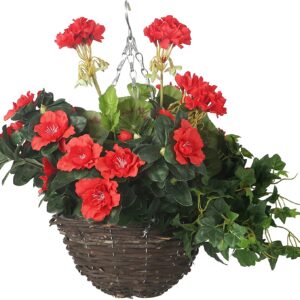
Top-planted baskets have the artificial flowers arranged in the top only. This gives a neat, traditional look, though on cheaper baskets it can look rather bare from below.
Ball baskets have flowers and foliage flowing in every direction, not just out of the top, with small holes for stems on the underside. You get all-round colour, which is ideal for baskets seen from below or from several angles.
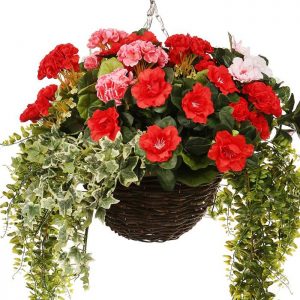
Trailing baskets have a display on top and foliage or flowers spilling over the edge. Done well, these are the most realistic of all and very hard to tell from the real thing at normal viewing distance.
Cones, hearts and half-baskets are a matter of personal preference. A cone has a modern feel and sits close to the wall; a half-basket is perfect for a narrow passageway. Either may have flowers in the top only or foliage trailing down the sides.
7. Ready-made or arrange-it-yourself?
Some baskets arrive fully finished and ready to hang. Others come as a kit: a metal basket with chain, a coco liner, a foam or grass core and loose stems for you to arrange. Kits take five or ten minutes and let you tailor the look to your taste, but the result depends on you rather than the factory.
If you go the DIY route, the difference between "obviously fake" and "wow, is that real?" comes down to a few habits:
Bend and fluff every wired stem before you judge it. Nothing looks good straight out of the box.
Tall stems in the centre, bushy fillers around them, trailers over the rim.
Push a few trailing pieces through the sides of the basket, not just over the edge, so it looks grown rather than placed.
Vary the angles. Real plants lean towards the light; they don't stand in rows.
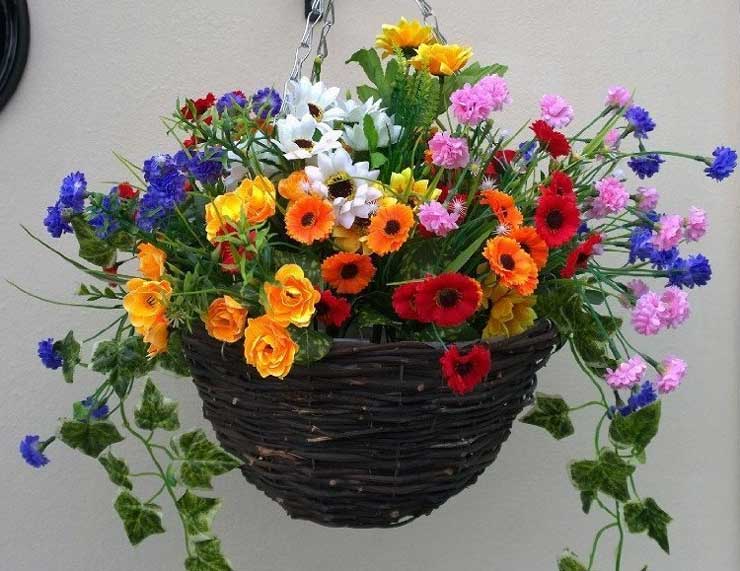
Artificial hanging baskets come in every colour you can think of and your choice will come down to personal taste. Colours can be true to life or bright and bold, and both have their place: a muted, mixed basket blends into a cottage frontage, while a single strong colour makes a statement at a shop or pub entrance.
In our opinion, silk flowers look the most realistic, but the best plastic alternatives are not far behind. Foliage varies a great deal, and it's usually the foliage rather than the flowers that gives an artificial basket away, so check a product's close-up photos of the leaves before you buy.
Remember, too, that people rarely stick their faces into a hanging basket. The effect is appreciated from at least half a metre away, usually more. You might be able to tell the plants are artificial if you stroke them or inspect them closely, but your visitors won't be doing that.
9. Chains, hooks and brackets
Most baskets come with a chain already attached. On the cheapest baskets this can be plastic or thin, unprotected metal that rusts within a season and stains the wall below. The best chains are galvanised (dipped in a protective zinc coating over steel) or powder-coated, and will give you years of use without rust.
Just as important is what the chain hangs from:
Use a closed hook, carabiner or locking bracket rather than an open S-hook. Open hooks are the most common reason baskets end up on the ground.
Fix brackets into solid brick, stone or a timber stud, never into render or mortar alone, and use fixings rated for well above the basket's weight.
Give every bracket and hook a firm tug once or twice a year and after any storm.
10. Wind: weighing down and securing
Because artificial baskets weigh a fraction of a real one, they swing, spin and lift in wind far more readily. In an exposed spot that can mean flattened flowers, a twisted chain or a basket on the pavement after the first autumn gale. A few simple measures make all the difference:
Add discreet weight to the base. A handful of pebbles, a sealed bag of sand or a heavier coco-lined metal frame will settle the basket without showing.
Keep the hanging drop short. The closer the basket sits to its bracket, the less leverage the wind has on it.
Use a closed hook or locking bracket, as above.
Make sure the core is firmly seated. The foam or grass insert should sit tight in the liner so it can't lift out even if the basket stays put.
Choose the sheltered side of the house or a recessed doorway where you can.
No hanging basket, real or artificial, is storm-proof. When gales are forecast, lift your baskets down for a day or two, exactly as you would with any other garden feature. It protects the flowers, the chain and your brackets, and it takes thirty seconds.
Over winter, good-quality outdoor baskets can stay up, and many customers keep them out all year. They will, however, last longer with a winter rest: frost can make cheaper plastic stems brittle, and weeks of wet, shady weather can leave a green film on liners. If you do bring them in:
Make sure they're completely dry first. Never store a wet basket in a bag or a damp shed.
Store them out of direct sunlight; a garage or shed shelf is ideal.
Before rehanging in spring, check the chain, hook, ties and any loose stems, and give everything a fluff.
12. Keeping them looking fresh
Outdoor baskets pick up pollen, dust, cobwebs and, near roads, a grey film of grime. A quick clean once or twice a year keeps them looking newly planted:
Take the basket down and give it a dry shake first.
Use a soft brush or a cool hairdryer for pollen and dust.
Wipe leaves and petals with a damp cloth and a drop of washing-up liquid for road film.
Rinse gently with a hose from the top down only. Never submerge the basket or spray water into the foam core.
Avoid hot water, solvents and pressure washers, all of which can lift the UV coating.
Let it dry fully before rehanging, then fluff the stems back into shape.
Artificial baskets are a natural fit for shops, pubs, cafés, salons and offices: no staff time spent watering, no bare patches mid-season, and no drips. If your baskets will hang over a public pavement, there are a few rules to be aware of:
Height. Councils in England generally recommend that anything projecting over a footway from a private building is at least 2.25m above the pavement and 0.5m back from the kerb; the Highways Act gives them power to remove lower projections. In Scotland it's an offence to hang anything lower than 2.25m or within 50cm of the carriageway.
Lamp columns and street furniture. Baskets on council lamp posts need the council's consent, usually with a weight limit and a minimum clearance.
Planning. Permission may be needed in conservation areas or on listed buildings, so check with your local authority before drilling into a period frontage.
Insurance. Councils recommend that businesses hanging baskets over the public highway have public liability cover. Check that yours includes it.
One advantage councils specifically mention: dripping water from real baskets makes pavements slippery and encourages algae. Artificial baskets don't drip, which is one less thing to worry about at a busy entrance.
14. How long will it last?
Realistically, a quality PE or PE-blend basket in full UK sun should look good for three to five seasons with a rinse or two a year and, ideally, a winter rest indoors. Coated silk or polyester in full sun may start to fade noticeably within a season, though it will last far longer under a porch or on a shaded wall. Greens outlast flower colours, and a basket that's been weighed down and secured properly will outlast one that spends every windy day spinning on its chain.
When a basket does start to tire, you rarely need to replace the whole thing. Swapping the most faded stems for fresh ones, or refreshing the liner, brings it back for a fraction of the cost.
15. Buyer's checklist
Before you click "buy", run through this list:
Is the material named (PE, PE blend, or silk-polyester on plastic stems)? If it just says "UV-resistant", is the spot sheltered enough?
Is the basket at least 30cm in diameter, and do you know the total hanging drop?
Is the weight listed, and will your bracket carry it with plenty of margin?
Is the chain galvanised or coated metal rather than plastic?
Does it have a coco liner and a firm foam or grass core?
Is the trailing length stated, not just "trailing"?
Are there close-up photos of the foliage, not just the flowers?
Is it pre-arranged or a kit, and are you happy with either?
Is it rated for outdoor use, or indoor only?
Do you have a closed hook, somewhere sheltered to hang it, and somewhere dry to store it when a storm is forecast?
We hope this guide helps you find the perfect basket for your home or business. If you have a question we haven't answered, get in touch and we'll be happy to help.
FAQs
Do artificial hanging baskets fade in the sun?
All artificial flowers fade eventually, but the rate depends on the material. Coated silk or polyester can fade noticeably within a season in full sun, while polyethylene (PE) plants have UV stability built into the material and typically hold their colour for three to five seasons. Flower colours fade before greens, so foliage-heavy baskets last longest in sunny spots.
Can I leave artificial hanging baskets out all year?
Good-quality outdoor-rated baskets can stay up all year, and many people leave them out. They'll last longer, though, if you bring them into a dry shed or garage over winter, out of direct sunlight, and always take them down when gales are forecast.
How do I stop my artificial hanging basket blowing around?
Add a little discreet weight to the base (pebbles or a sealed bag of sand), keep the hanging drop short so the wind has less leverage, and use a closed hook or locking bracket rather than an open S-hook. In very exposed spots, choose the sheltered side of the house and take baskets down in storms.
What size artificial hanging basket do I need?
For a full-looking basket beside a front door, choose a basket at least 30cm in diameter, measured across the basket itself rather than the flowers. Also check the total hanging drop, usually around 60cm, so it won't brush heads in a doorway.
Can I arrange the flowers in an artificial hanging basket myself?
Yes. Many baskets come as a kit with a coco liner, a foam core and loose stems for you to arrange, which takes five to ten minutes. Bend and fluff each stem, put tall stems in the centre, bushy ones around them and trailers over the rim. You can also swap a few stems each season for a fresh look.
How do I clean an artificial hanging basket?
Take it down, shake off loose debris, then use a soft brush or cool hairdryer for pollen and a damp cloth with a drop of washing-up liquid for grime. Rinse gently with a hose from the top down, never into the foam core, and let it dry fully before rehanging.
Are artificial hanging baskets cheaper than real ones?
Over more than one season, yes. A real 16-inch basket costs around £50 in its first year and £35 a year after that in plants, compost and food, plus daily watering in summer. A quality artificial basket is a one-off £30 - £105 and lasts several seasons with no running costs.
What should I look for in the chain?
Choose a galvanised or powder-coated metal chain. Plastic or untreated metal chains on the cheapest baskets can snap or rust within a season and stain the wall below. Hang the chain from a closed hook or locking bracket fixed into solid brick or a timber stud.
Can I hang baskets outside my shop over the pavement?
Usually, but check the rules. English councils generally recommend at least 2.25m clearance above the footway and 0.5m back from the kerb; in Scotland anything lower is an offence. Baskets on lamp posts need council consent, planning permission may apply on listed buildings or in conservation areas, and you should have public liability insurance.
Do artificial hanging baskets look real?
From normal viewing distance, a good-quality basket is very hard to tell from the real thing. Silk flowers look the most realistic up close, PE plants are not far behind, and foliage quality matters more than the flowers, so check close-up photos of the leaves before you buy.
We use cookies on our website to give you the most relevant experience by remembering your preferences and repeat visits. By clicking “Accept All”, you consent to the use of ALL the cookies. However, you may visit "Cookie Settings" to provide a controlled consent. View privacy & cookies policy.
This website uses cookies to improve your experience while you navigate through the website. Out of these, the cookies that are categorized as necessary are stored on your browser as they are essential for the working of basic functionalities of the website. We also use third-party cookies that help us analyze and understand how you use this website. These cookies will be stored in your browser only with your consent. You also have the option to opt-out of these cookies. But opting out of some of these cookies may affect your browsing experience.
Necessary cookies are absolutely essential for the website to function properly. These cookies ensure basic functionalities and security features of the website, anonymously.
Cookie
Duration
Description
cookielawinfo-checkbox-advertisement
1 year
The cookie is set by GDPR cookie consent to record the user consent for the cookies in the category "Advertisement".
cookielawinfo-checkbox-analytics
11 months
This cookie is set by GDPR Cookie Consent plugin. The cookie is used to store the user consent for the cookies in the category "Analytics".
cookielawinfo-checkbox-functional
11 months
The cookie is set by GDPR cookie consent to record the user consent for the cookies in the category "Functional".
cookielawinfo-checkbox-necessary
11 months
This cookie is set by GDPR Cookie Consent plugin. The cookies is used to store the user consent for the cookies in the category "Necessary".
cookielawinfo-checkbox-others
11 months
This cookie is set by GDPR Cookie Consent plugin. The cookie is used to store the user consent for the cookies in the category "Other.
cookielawinfo-checkbox-performance
11 months
This cookie is set by GDPR Cookie Consent plugin. The cookie is used to store the user consent for the cookies in the category "Performance".
viewed_cookie_policy
11 months
The cookie is set by the GDPR Cookie Consent plugin and is used to store whether or not user has consented to the use of cookies. It does not store any personal data.
Functional cookies help to perform certain functionalities like sharing the content of the website on social media platforms, collect feedbacks, and other third-party features.
Cookie
Duration
Description
na_id
1 year 1 month
This cookie is set by Addthis.com to enable sharing of links on social media platforms like Facebook and Twitter
na_rn
1 month
This cookie is used to recognize the visitor upon re-entry. This cookie allows to collect information on user behaviour and allows sharing function provided by Addthis.com
na_sc_e
1 month
This cookie is used to recognize the visitor upon re-entry. This cookie allows to collect information on user behaviour and allows sharing function provided by Addthis.com
na_sr
1 month
This cookie is set by Addthis.com. This cookie is used for sharing of links on social media platforms.
na_srp
1 minute
This cookie is used to recognize the visitor upon re-entry. This cookie allows to collect information on user behaviour and allows sharing function provided by Addthis.com
na_tc
1 year 1 month
This cookie is set by the provider Addthis. This cookie is used for social media sharing tracking service.
ouid
1 year 1 month
The cookie is set by Addthis which enables the content of the website to be shared across different networking and social sharing websites.
Performance cookies are used to understand and analyze the key performance indexes of the website which helps in delivering a better user experience for the visitors.
Cookie
Duration
Description
_gat
1 minute
This cookies is installed by Google Universal Analytics to throttle the request rate to limit the colllection of data on high traffic sites.
d
3 months
This cookie tracks anonymous information on how visitors use the website.
YSC
session
This cookies is set by Youtube and is used to track the views of embedded videos.
Analytical cookies are used to understand how visitors interact with the website. These cookies help provide information on metrics the number of visitors, bounce rate, traffic source, etc.
Cookie
Duration
Description
__gads
1 year 24 days
This cookie is set by Google and stored under the name dounleclick.com. This cookie is used to track how many times users see a particular advert which helps in measuring the success of the campaign and calculate the revenue generated by the campaign. These cookies can only be read from the domain that it is set on so it will not track any data while browsing through another sites.
_ga
2 years
This cookie is installed by Google Analytics. The cookie is used to calculate visitor, session, campaign data and keep track of site usage for the site's analytics report. The cookies store information anonymously and assign a randomly generated number to identify unique visitors.
_gid
1 day
This cookie is installed by Google Analytics. The cookie is used to store information of how visitors use a website and helps in creating an analytics report of how the website is doing. The data collected including the number visitors, the source where they have come from, and the pages visted in an anonymous form.
Advertisement cookies are used to provide visitors with relevant ads and marketing campaigns. These cookies track visitors across websites and collect information to provide customized ads.
Cookie
Duration
Description
DSID
1 hour
This cookie is setup by doubleclick.net. This cookie is used by Google to make advertising more engaging to users and are stored under doubleclick.net. It contains an encrypted unique ID.
IDE
1 year 24 days
Used by Google DoubleClick and stores information about how the user uses the website and any other advertisement before visiting the website. This is used to present users with ads that are relevant to them according to the user profile.
test_cookie
15 minutes
This cookie is set by doubleclick.net. The purpose of the cookie is to determine if the user's browser supports cookies.
uid
1 year 1 month
This cookie is used to measure the number and behavior of the visitors to the website anonymously. The data includes the number of visits, average duration of the visit on the website, pages visited, etc. for the purpose of better understanding user preferences for targeted advertisments.
uuid
3 months
To optimize ad relevance by collecting visitor data from multiple websites such as what pages have been loaded.
VISITOR_INFO1_LIVE
5 months 27 days
This cookie is set by Youtube. Used to track the information of the embedded YouTube videos on a website.
 A warm welcome from The Artificial Flowers Company. We offer artificial flower arrangements, silk flowers, hanging baskets, topiary balls, topiary plants and much more - we hope you find what you're looking for!