artificial hanging baskets, topiary balls, hedges and topiary trees
Artificial Christmas garlands
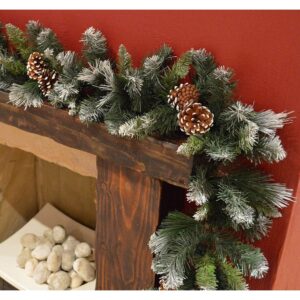
A garland draws the Christmas decorations through a room, softening a mantelpiece, winding along a banister or running down the centre of a table. Artificial Christmas garlands give you a base to enjoy as it is or dress with ribbons, flowers and favourite ornaments. Measure the whole route before choosing a length, including any gentle swags, and leave room around doorways and handrails for everyday use.
An artificial Christmas garland is one of the few decorations you can buy once and use for a decade, so it is worth spending ten minutes getting the length, fullness and style right. This guide covers how to measure for a mantelpiece, staircase, doorway or table, what actually makes a faux garland look realistic, whether a pre-lit garland is worth it, what to check before hanging one outdoors, and how to hang and store it without damaging your woodwork or the garland itself.
Getting the length right
Most artificial Christmas garlands sold in the UK are 180cm (6ft), 200cm or 270cm (9ft). Lengths are measured along the straight wire core, so a garland that is draped, swagged or wrapped around a banister covers much less distance than its stated length. Under-buying is the most common mistake; a garland that is slightly too long can be tucked back on itself or allowed to pool at the bottom of the stairs, but one that is too short has no fix other than buying another.
Run a piece of string along the exact route you want the garland to take, including any swags and drops, then measure the string. If that is too much faff, the following rules of thumb work for most homes.
Where
How to work out the length
Typical UK result
Mantelpiece, laid flat
Mantel width plus 30cm overhang at each end
A 120–150cm mantel needs 180–200cm
Mantelpiece with drops or a central swag
Mantel width plus 60–90cm for each drop or swag
Usually 270cm, or two 180cm garlands
Doorway or door frame
Twice the frame height plus the width
A standard internal door frame comes to roughly 5m, so two 270cm garlands
Banister, gentle drape
Handrail length plus newel post height, multiplied by 1.5
A typical 13-step UK staircase needs around 4.5–5.5m, so two 270cm garlands
Banister, fully wrapped
Handrail length plus newel post height, multiplied by 2
Around 6–7m, so three 270cm garlands or two twisted together
Dining table runner
Table length, or table length plus 30cm per end if you want it to trail
180–270cm for most tables
Window, framing the top and sides
Window width plus twice the drop you want
180–270cm
Wrapped around a post or pillar
Twice the height of the post
Varies
Most garlands have a wire loop or hook at each end, so joining two is simple: overlap the ends by 10–15cm, twist a couple of branch tips together and secure with a garland tie or floristry wire. The join disappears once the tips are fluffed. If you are buying two or more to join, buy the same product so the colour and needle style match.
Fullness: width and tip count matter more than length
Two garlands can both be 270cm long and look completely different. The things that decide how lush a garland looks are its width (sometimes listed as depth or diameter) and the number of branch tips. Product photos are nearly always taken after a garland has been fully fluffed, and often show two garlands twisted together or a garland heavily dressed with extra picks and ribbon, so read the specification rather than trusting the image.
Width: 25–30cm is full enough to look generous on a mantelpiece or banister on its own. Garlands under 20cm wide look thin unless doubled up or used in a narrow spot such as a shelf or window sill.
Tip count: on a 270cm garland, anything under about 200 tips will look sparse; 250–350 tips is a good, full garland; 400 or more is premium density. A 180cm garland with 150–180 tips is reasonably full. If a listing does not state the tip count, that is often a sign it is low.
Weight: a full 270cm garland typically weighs 1–2kg, more with lights and decorations. This matters when choosing hooks (see hanging, below) and is a useful proxy for density when comparing listings.
Reviews mentioning "sparse", "thin" or "nothing like the photo" are the most reliable warning sign for a garland. If you want a very full look on a budget, two cheaper plain garlands twisted together usually beats one expensive garland, and gives you more flexibility in how you shape it.
What makes an artificial garland look realistic
If you want the most realistic artificial Christmas garland you can afford, these are the things to look for in the listing and photos.
PE needles rather than all PVC. PVC needles are cut from flat sheet, so they look papery and slightly shiny. PE (polyethylene) needles are injection-moulded from a cast of real foliage, so they have three-dimensional shape, a matt finish and natural colour variation. Most realistic garlands mix the two, with PE tips on the outside and PVC filling the core for density, and the higher the proportion of PE the better it looks. Terms such as "real touch", "real feel" or "natural look" usually indicate PE tips, but check the material listing to confirm.
Mixed foliage. A single uniform needle type reads as plastic from across the room. Garlands that blend two or three foliage types, such as pine with cedar or cypress, or spruce with eucalyptus and berries, look far more natural because that is how real swags and florists' garlands are made.
Two-tone colouring. Real evergreen is lighter at the tips and darker towards the stem. Garlands with dual-toned or variegated needles look convincing; flat, uniform bright green does not.
Softer, drapey tips. Norfolk pine, cedar and cypress styles have longer, softer fronds that hang naturally over the edge of a mantelpiece. Stiff, short, bottle-brush tips suit wrapping around a banister but look artificial laid flat.
Natural-looking extras. Real pine cones look better than moulded plastic ones. Matt berries look better than glossy. Snow effect that sits in the needle crevices looks better than an even coat of white paint.
A substantial wire core. A thicker core holds a swag shape and does not sag between fixings. Very cheap garlands use thin wire that kinks permanently.
As a rough guide to UK prices, plain PVC garlands around 270cm start at under £15 and look fine wrapped tightly on a banister or dressed heavily; decent pre-lit or pre-decorated garlands sit in the £20–40 range; and realistic mixed-PE garlands with soft, drapey foliage generally cost £40 or more. Spend most on the garland that will be seen closest and laid flat, usually the mantelpiece, and economise on a banister garland that is viewed at a distance and partly hidden by its own wrapping.
Styles of garland and where each works best
Plain evergreen garlands
Undecorated artificial pine, spruce, fir or cedar. The most versatile option because you can dress it differently each year with your own lights, baubles, ribbon, dried orange slices or fresh foliage and holly cut from the garden. Also the best choice if you want to coordinate with a specific colour scheme, or if you want several garlands to match through the house. A plain garland needs a bit more effort to look finished, so allow time to decorate it.
Pre-decorated garlands with pine cones and berries
Traditional and ready to hang straight from the box. Red berry and pine cone garlands are the classic choice for a mantelpiece or banister. Check that the decorations are wired on rather than glued, so they can be repositioned once the garland is fluffed and will not fall off in storage. Berries are a choking hazard for small children and pets, so position accordingly.
Snowy, frosted and glittered garlands
Flocked or frosted garlands suit a white, silver or Scandinavian scheme and look particularly good with warm white lights. Be aware that flocking and glitter shed, especially the first year and during fluffing, so shape them outdoors or over a dust sheet. They are not a good choice for outdoor use because rain washes flocking off, and the shedding makes them less suitable for a dining table.
Eucalyptus and mixed-foliage garlands
Eucalyptus, olive, mistletoe and white berry blends suit modern and neutral interiors where a dark green pine garland would feel heavy. They tend to be flatter and narrower, which makes them ideal as a table runner or along a shelf, and many work year-round rather than only at Christmas. They are usually too delicate and thin to carry a banister on their own.
Coloured, poinsettia and ornamented garlands
Garlands with poinsettia flowers, gold or red baubles, bells or ribbon are a complete decoration in themselves and save you buying extras. The trade-off is that they commit you to one colour scheme, and the decorations add weight. These suit a mantelpiece or doorway where they are the focal point rather than a background.
Bulk or craft garland
Long, thin garland sold by the reel or in multi-metre packs is intended for wrapping, wreath making and filling, not for display on its own. Use it to pad out a thin garland, wrap a hallway pillar, or make your own table runner.
Pre-lit garlands versus adding your own lights
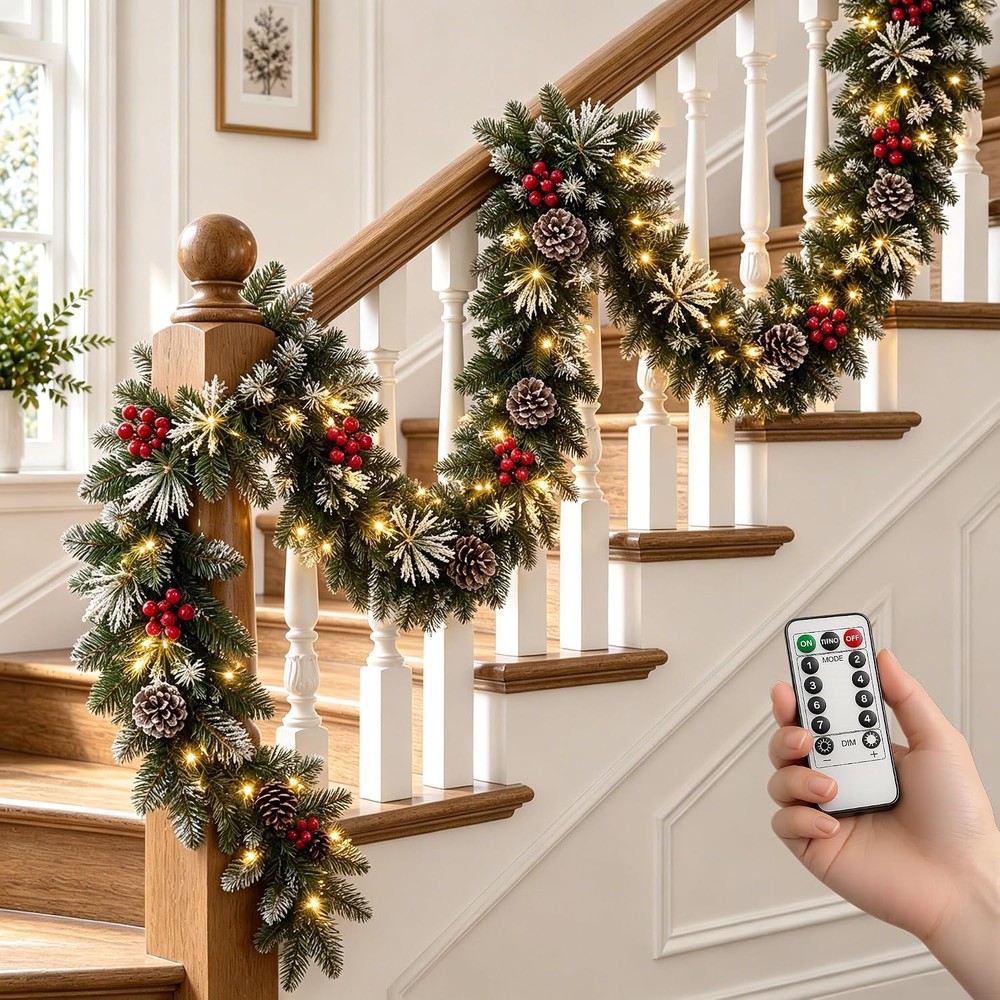
A pre-lit artificial Christmas garland saves you threading lights through the foliage every year and hides the cable neatly within the core. It is the easier option, but there are trade-offs that are worth knowing before you choose.
Advantages of pre-lit
Lights are evenly spaced and wound into the garland, with the cable hidden.
Most battery sets include a six-hour timer (on for six hours, off for eighteen, repeating daily), so they come on at the same time each evening without you remembering.
Many have a remote with brightness, flashing and fade modes, and some switch between warm white and multicolour.
Disadvantages of pre-lit
Bulbs are almost never replaceable. If a section fails in year three you are left with an unlit garland or need to thread new lights through anyway.
You are committed to the bulb colour and spacing the manufacturer chose. Warm white suits most homes; cool white can look harsh against green foliage.
The battery box or plug sits at one end, so you need to plan which end of the mantel or staircase it will finish at and where it will be hidden.
Battery, mains or USB
Battery (usually 3 x AA) is the most common and gives you complete freedom of placement, which matters on a staircase or mantelpiece with no socket nearby. A typical set of 50 micro LEDs runs for around 100 hours on a fresh set of batteries, so roughly two to three weeks on a six-hour timer. More bulbs or larger bulbs drain faster, so budget for one or two battery changes over the season, and use good-quality alkaline or rechargeable batteries. Avoid cheap zinc batteries, which fade quickly.
Mains garlands never need batteries but need a socket within reach of the lead wire, which is often only 1.5–3m from the first bulb. Check the lead length against your socket position. Mains garlands for outdoor use must be low voltage with an outdoor-rated transformer.
USB garlands can run from a plug adaptor or a power bank, which is a neat way to get mains-like reliability on a mantelpiece without a visible cable.
Adding your own lights to a plain garland
If you would rather not be tied to built-in lights, buy a plain garland and a separate set of battery micro lights on green or copper wire. For a 270cm garland, a 5m string of 50–100 micro LEDs gives an even sparkle, and 10m or 200 LEDs gives a dense, glowing look. Wind the lights around the core before fluffing so the wire is hidden by the tips. The advantage is that when the lights eventually fail you replace a £10 string, not the garland.
Using an artificial garland outdoors
Not every artificial garland is suitable for outdoor use, and the difference is not always obvious from the photos. Before hanging a garland around a front door, porch or fence, check the following.
The listing says outdoor or indoor/outdoor. Outdoor garlands use UV-stabilised PE or PVC so the colour does not fade to blue-grey after a winter of daylight. Indoor-only garlands fade and become brittle surprisingly fast outside.
Lights rated IP44 or higher. IP44 is splash-proof and fine under a porch or in a sheltered position. For a fully exposed position, IP65 or higher is better. An IP20 rating means indoor only.
A waterproof battery box, or an outdoor transformer. Even on an IP44 garland, the battery compartment is often the weak point. Position it under cover, tuck it inside the porch, or wrap it in a sealed bag.
Plain or berry styles rather than flocked or glittered. Rain washes snow effect and glitter off and leaves a mess on the doorstep.
Wind is the main enemy outdoors. Secure the garland at least every 50–60cm with cable ties or garland ties, not just at the ends, and fix the ends firmly before working along the middle. A garland framing a front door is best hung from a tension garland hanger that grips the top of the frame, or from exterior-rated adhesive hooks fitted to clean, dry paintwork in mild weather (adhesive does not bond well below about 10°C). Take the garland in, or at least let it dry fully, before putting it away for the year.
Hanging a garland without damaging anything
Mantelpiece
Removable adhesive hooks fixed to the underside or back edge of the mantel are the standard approach. Garlands are heavier than they look, so use hooks rated for the weight (check the garland's listed weight and add a margin for decorations), spaced every 40–60cm, with one at each end. Clip the garland's wire core to the hooks with garland ties or loops of floristry wire so it cannot slide. Heavy candlesticks or stocking holders placed on top of the garland help anchor it and hide the fixings. If you have a wooden mantel and hang a heavy garland every year, two small discreet cup hooks screwed into the underside are a permanent and more reliable solution.
Banister
Start at the top of the stairs and work down, so gravity helps rather than fights you. Decide whether you want a tight wrap around every spindle or a looser drape that catches every second or third. Attach the garland to the underside of the handrail, so the rail is still usable and children cannot pull it down. Garden twine, ribbon or clear cable ties around the handrail every three or four spindles will hold a 270cm garland without marking varnished wood; avoid double-sided tape, which can lift varnish. Secure both ends first, then add ties along the middle so no single fixing carries the weight.
Doorways
A tension garland hanger across the top of the frame avoids any fixings. Otherwise, use removable hooks at the top corners and midpoint, and secure the two drops at the bottom so they do not swing. Keep the drops clear of the door's swing and any handles.
Dining table
No fixing needed. Lay the garland straight down the centre, or weave gently around candlesticks and bowls. Battery lights are better than mains here, because nobody wants a cable running off the table. Keep foliage well clear of real candle flames.
Shaping a new garland (do not skip this)
Every artificial garland arrives compressed, and will look flat and disappointing until it is shaped. This takes ten to twenty minutes for a 270cm garland and makes more difference to the finished look than anything else.
Lay the garland on the floor with the central wire facing down.
Straighten any kinks in the core wire.
Work along the garland from one end. At each cluster, lift the branches up and outwards, fanning them in different directions so that some point up, some sideways and some forward. Bend the tips of individual needles outwards.
Use the longer tips to fill any gaps along the spine, and reposition cones, berries or lights so they are evenly spaced and visible.
If the garland is pre-lit, switch the lights on while shaping so you can see where they sit.
Once hung, step back and adjust. A garland always needs a second look in place.
Fireplaces, candles and safety
Artificial garlands are plastic. Many are made from flame-retardant PVC, but check the listing rather than assuming. Keep any garland well away from open flames and heat, and never let a garland drape below the mantel when a real fire is lit. If you use a fireplace regularly, lay the garland flat on top of the mantel rather than hanging it down the front.
Use LED candles rather than real ones anywhere near a garland. If you do use real candles on a mantelpiece or table, keep a generous gap between flame and foliage, and never leave them unattended.
Pre-lit garlands use LEDs, which stay cool. Do not daisy-chain mains garlands beyond the manufacturer's stated limit, and do not run cables under rugs.
Small berries, bells and cones can detach. Hang garlands out of reach of toddlers and pets, and position berry garlands where fallen berries will be noticed.
Storing a garland so it lasts
A well-stored artificial garland lasts ten years or more. A crushed one has to be reshaped every year and gradually loses tips.
Remove the batteries before storing to avoid leaks corroding the contacts.
Remove any decorations you added and store them separately.
Flatten the tips gently towards the core so the garland takes up less room, then either coil it loosely in a large circle inside a storage bag or box, or wrap it around a length of cardboard tube or a piece of card. Do not fold it sharply or the core wire kinks.
Keep flocked garlands in their own bag so the snow effect does not transfer onto everything else.
Store somewhere cool, dry and dark. Lofts that get hot in summer and damp in winter are hard on plastic and can make needles brittle and colours fade. A cupboard or under a bed is better.
Quick checklist before you buy
Measured the route with string, including swags and drops, and added 10–20 per cent.
Checked the stated width (25–30cm for a full look) and tip count (250 or more on a 270cm garland).
Read reviews for "sparse" or "thin" and looked at customer photos rather than studio shots.
Checked the material: PE or PE/PVC mix for realism, PVC for budget wrapping.
For pre-lit: battery or mains, warm white or multicolour, timer included, lead wire length, where the battery box will sit.
For outdoors: listing says outdoor, lights are IP44 or higher, battery box is waterproof, style is not flocked or glittered.
Thought about fixings: hooks rated for the weight, garland ties or wire to secure.
If buying more than one to join, bought the same product so they match.
FAQs
How long should an artificial Christmas garland be for a mantelpiece?
Measure the mantel and add about 30cm at each end for overhang, so a 120 - 150cm mantel needs a 180 - 200cm garland. If you want it to swag in the middle or hang down the sides, add another 60 - 90cm per drop or swag, which usually means a 270cm garland. A 180cm garland is enough for most UK mantelpieces laid flat.
How many garlands do I need for a staircase?
A typical 13-step UK staircase needs around 4.5 - 5.5m for a gentle drape and 6 - 7m for a full wrap around every spindle, so plan on two 270cm (9ft) garlands for most staircases, or three if you want it very full. Measure the handrail plus the height of the bottom newel post, then multiply by 1.5 for a drape or 2 for a full wrap.
Can you join artificial garlands together?
Yes. Most garlands have a wire loop or hook at each end. Overlap the ends by 10 - 15cm, twist a few branch tips together and secure with a garland tie or floristry wire, then fluff the tips over the join. Buy the same product for each section so the colour and needle style match.
What is the most realistic type of artificial Christmas garland?
Garlands with injection-moulded PE needles, mixed foliage types (for example pine blended with cedar or cypress) and two-tone colouring look the most realistic. All-PVC garlands with flat, shiny, uniformly green needles look the most artificial. Real pine cones and matt berries also look more convincing than glossy plastic ones.
What does the tip count on a garland mean?
The tip count is the number of individual branch ends along the garland, and it is the best indicator of how full it will look. On a 270cm garland, under 200 tips tends to look sparse, 250 - 350 is full, and 400 or more is premium density. Width also matters: 25 - 30cm looks generous on its own, while anything under 20cm usually needs doubling up.
Are pre-lit garlands worth it?
Pre-lit garlands save time and hide the cable neatly, and most battery versions include a six-hour daily timer. The downsides are that the bulbs usually cannot be replaced if they fail, and you are committed to the maker's choice of light colour and spacing. If you want flexibility, buy a plain garland and a separate 5m string of battery micro lights, which can be replaced cheaply.
How long do batteries last in a pre-lit garland?
A typical 50 micro-LED garland on 3 x AA batteries runs for around 100 hours, which is two to three weeks on a six-hour timer. Garlands with more or larger bulbs drain faster. Use good alkaline or rechargeable batteries, and expect one or two changes over the Christmas period.
Can artificial Christmas garlands be used outdoors?
Only if the listing says outdoor or indoor/outdoor. Outdoor garlands use UV-stabilised plastic so they do not fade, and any lights should be IP44 or higher (IP65 for fully exposed positions). Keep the battery box or transformer under cover, secure the garland every 50–60cm against wind, and avoid flocked or glittered garlands outside because rain washes the finish off.
Is it safe to hang an artificial garland over a fireplace?
Yes if the fireplace is not in use, or if the garland sits flat on top of the mantel and well away from heat. Never let a garland drape below the mantel while a real fire is lit, keep it away from candles, and check whether the garland is described as flame-retardant. LED lights stay cool and are safe within the foliage.
How do you make an artificial garland look fuller?
Shape it properly first: lay it flat, straighten the core wire, then fan every branch cluster out in different directions, working along the whole length. If it is still thin, twist two garlands together, tuck in a few extra foliage picks or fresh greenery, or add a string of micro lights, which draws the eye to the tips rather than the gaps.
How do you hang a garland on a banister without damaging it?
Fix the garland to the underside of the handrail using garden twine, ribbon or clear cable ties every three or four spindles, starting at the top of the stairs and securing both ends before the middle. Avoid double-sided tape, which can lift varnish. Removable adhesive hooks also work on painted or varnished wood if they are rated for the weight.
How should you store an artificial garland?
Take the batteries out, remove any decorations you added, gently flatten the tips towards the core, and either coil the garland loosely in a bag or box or wrap it around a cardboard tube. Avoid sharp folds, which kink the wire. Store it somewhere cool, dry and dark rather than a hot loft, and keep flocked garlands in their own bag.
Are artificial garlands safe around pets and children?
The foliage itself is usually harmless but small berries, bells and pine cones can detach and are a choking hazard. A long garland also poses a strangulation risk in the same way as a blind cord, so keep banister and doorway garlands fixed securely at several points, never leave loose loops or trailing ends within a child's reach, and keep cots and beds well away from anything a child could pull down. In a house with toddlers or pets, choose a plain garland for low positions and keep decorated garlands up on the mantelpiece or over a doorway.
We use cookies on our website to give you the most relevant experience by remembering your preferences and repeat visits. By clicking “Accept All”, you consent to the use of ALL the cookies. However, you may visit "Cookie Settings" to provide a controlled consent. View privacy & cookies policy.
This website uses cookies to improve your experience while you navigate through the website. Out of these, the cookies that are categorized as necessary are stored on your browser as they are essential for the working of basic functionalities of the website. We also use third-party cookies that help us analyze and understand how you use this website. These cookies will be stored in your browser only with your consent. You also have the option to opt-out of these cookies. But opting out of some of these cookies may affect your browsing experience.
Necessary cookies are absolutely essential for the website to function properly. These cookies ensure basic functionalities and security features of the website, anonymously.
Cookie
Duration
Description
cookielawinfo-checkbox-advertisement
1 year
The cookie is set by GDPR cookie consent to record the user consent for the cookies in the category "Advertisement".
cookielawinfo-checkbox-analytics
11 months
This cookie is set by GDPR Cookie Consent plugin. The cookie is used to store the user consent for the cookies in the category "Analytics".
cookielawinfo-checkbox-functional
11 months
The cookie is set by GDPR cookie consent to record the user consent for the cookies in the category "Functional".
cookielawinfo-checkbox-necessary
11 months
This cookie is set by GDPR Cookie Consent plugin. The cookies is used to store the user consent for the cookies in the category "Necessary".
cookielawinfo-checkbox-others
11 months
This cookie is set by GDPR Cookie Consent plugin. The cookie is used to store the user consent for the cookies in the category "Other.
cookielawinfo-checkbox-performance
11 months
This cookie is set by GDPR Cookie Consent plugin. The cookie is used to store the user consent for the cookies in the category "Performance".
viewed_cookie_policy
11 months
The cookie is set by the GDPR Cookie Consent plugin and is used to store whether or not user has consented to the use of cookies. It does not store any personal data.
Functional cookies help to perform certain functionalities like sharing the content of the website on social media platforms, collect feedbacks, and other third-party features.
Cookie
Duration
Description
na_id
1 year 1 month
This cookie is set by Addthis.com to enable sharing of links on social media platforms like Facebook and Twitter
na_rn
1 month
This cookie is used to recognize the visitor upon re-entry. This cookie allows to collect information on user behaviour and allows sharing function provided by Addthis.com
na_sc_e
1 month
This cookie is used to recognize the visitor upon re-entry. This cookie allows to collect information on user behaviour and allows sharing function provided by Addthis.com
na_sr
1 month
This cookie is set by Addthis.com. This cookie is used for sharing of links on social media platforms.
na_srp
1 minute
This cookie is used to recognize the visitor upon re-entry. This cookie allows to collect information on user behaviour and allows sharing function provided by Addthis.com
na_tc
1 year 1 month
This cookie is set by the provider Addthis. This cookie is used for social media sharing tracking service.
ouid
1 year 1 month
The cookie is set by Addthis which enables the content of the website to be shared across different networking and social sharing websites.
Performance cookies are used to understand and analyze the key performance indexes of the website which helps in delivering a better user experience for the visitors.
Cookie
Duration
Description
_gat
1 minute
This cookies is installed by Google Universal Analytics to throttle the request rate to limit the colllection of data on high traffic sites.
d
3 months
This cookie tracks anonymous information on how visitors use the website.
YSC
session
This cookies is set by Youtube and is used to track the views of embedded videos.
Analytical cookies are used to understand how visitors interact with the website. These cookies help provide information on metrics the number of visitors, bounce rate, traffic source, etc.
Cookie
Duration
Description
__gads
1 year 24 days
This cookie is set by Google and stored under the name dounleclick.com. This cookie is used to track how many times users see a particular advert which helps in measuring the success of the campaign and calculate the revenue generated by the campaign. These cookies can only be read from the domain that it is set on so it will not track any data while browsing through another sites.
_ga
2 years
This cookie is installed by Google Analytics. The cookie is used to calculate visitor, session, campaign data and keep track of site usage for the site's analytics report. The cookies store information anonymously and assign a randomly generated number to identify unique visitors.
_gid
1 day
This cookie is installed by Google Analytics. The cookie is used to store information of how visitors use a website and helps in creating an analytics report of how the website is doing. The data collected including the number visitors, the source where they have come from, and the pages visted in an anonymous form.
Advertisement cookies are used to provide visitors with relevant ads and marketing campaigns. These cookies track visitors across websites and collect information to provide customized ads.
Cookie
Duration
Description
DSID
1 hour
This cookie is setup by doubleclick.net. This cookie is used by Google to make advertising more engaging to users and are stored under doubleclick.net. It contains an encrypted unique ID.
IDE
1 year 24 days
Used by Google DoubleClick and stores information about how the user uses the website and any other advertisement before visiting the website. This is used to present users with ads that are relevant to them according to the user profile.
test_cookie
15 minutes
This cookie is set by doubleclick.net. The purpose of the cookie is to determine if the user's browser supports cookies.
uid
1 year 1 month
This cookie is used to measure the number and behavior of the visitors to the website anonymously. The data includes the number of visits, average duration of the visit on the website, pages visited, etc. for the purpose of better understanding user preferences for targeted advertisments.
uuid
3 months
To optimize ad relevance by collecting visitor data from multiple websites such as what pages have been loaded.
VISITOR_INFO1_LIVE
5 months 27 days
This cookie is set by Youtube. Used to track the information of the embedded YouTube videos on a website.
 A warm welcome from The Artificial Flowers Company. We offer artificial flower arrangements, silk flowers, hanging baskets, topiary balls, topiary plants and much more - we hope you find what you're looking for!
