artificial hanging baskets, topiary balls, hedges and topiary trees
Artificial plants
Artificial plants bring greenery to places where real plants can be difficult to grow or maintain. Our collection of realistic faux plants works indoors and outdoors, with no watering, feeding or worrying about whether you’ve put them in the right spot.
Artificial plants: the complete buying guide (indoor and outdoor)
Last updated: October 2026
Artificial plants have come a long way from the dusty plastic palm in the dentist's waiting room. The best are now hard to tell from the real thing at arm's length, and they bring greenery to the places real plants fail: the dark hallway, the north-facing patio, the balcony nobody waters, the office with no windows. But the gap between good and bad is wide, and the single biggest mistake buyers make is putting an indoor plant outside. This guide is in two halves. The first covers indoor artificial plants: which species convince, how to judge quality and how to style and clean them. The second covers outdoor artificial plants: what "UV-resistant" actually means, how to plant, anchor and overwinter them, and what to do on a balcony. A few shared basics first.
1. What you're buying: plugs, bushes, potted plants and trees
Plug plants. Small individual plants (pansies, primulas, heathers, succulents) on a short plastic "root" spike, sold in multiples. Designed to be pushed into soil, foam or gravel in beds, pots and troughs, exactly as you'd plant real bedding. The most flexible format and the cheapest way to fill a border or window box.
Bushes. A cluster of stems joined at one base, like a small shrub: ferns, grasses, ivy, boxwood, flowering bushes. Made for pots, baskets and troughs; too bulky at the base for vases.
Potted plants. A finished plant already set in a plain plastic starter pot with a foam or cement base, ready to drop into a decorative planter. Most indoor houseplants and smaller outdoor shrubs are sold this way.
Trees and large floor plants. 90cm to 2m+, usually with a natural wood or moulded trunk and a weighted starter pot. Often shipped in two or three sections that slot together.
Succulents and cacti. Sold loose or potted, usually unrooted. The most forgiving category of all, because real succulents already look slightly artificial.
Hanging and trailing plants. Ivy, string of pearls, pothos, ferns in hanging pots or as loose trails to drape from shelves.
Hanging baskets, topiary, hedging, window boxes and vase flowers each have their own guide on this site; this one covers everything else.
2. How to judge quality from the photos
You can't touch it, so look hard at the close-ups and the specification:
Leaf colour that varies. Two or three greens on one plant, lighter new growth at the tips, the odd yellowing or curled leaf. A plant in one flat shade is the number one giveaway.
Matt, not glossy. Real leaves reflect light softly. A high-shine finish looks like what it is, unless the real plant is genuinely waxy (rubber plant, fiddle leaf fig, laurel).
Visible veins and texture, ideally moulded rather than printed.
Uneven, asymmetric growth. Mixed leaf sizes, stems at different angles, a canopy that isn't a perfect sphere. Machine-neat means mass-produced.
Wired stems you can bend and reposition. Rigid stems sit however they left the factory.
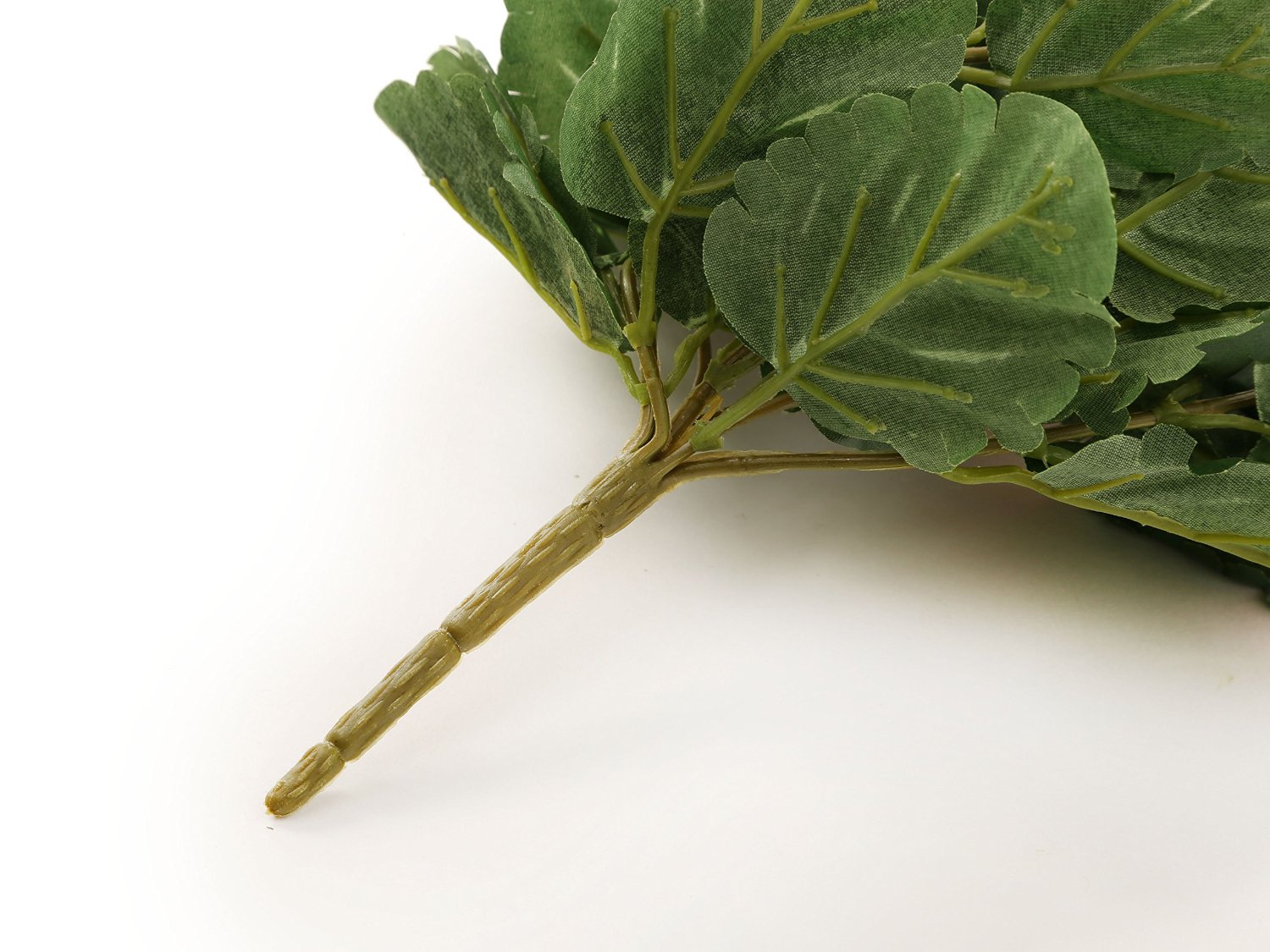
The trunk and stem. On trees, a textured, bark-like trunk (real wood or well-moulded) matters more than the leaves; a smooth green pole is the first thing anyone notices. On plants, look for a believable stem colour and where the leaves join.
The base. Moss, soil or bark finish over the starter pot, rather than exposed white foam or a blob of cement.
Named material. "PE", "polyethylene", "real touch", "UV-stabilised" are specific claims. "Lifelike" and "premium" are not.
Stated dimensions, including whether the height includes the pot, and the spread.
3. Size: the mistake everyone makes
Nearly every disappointed review of an artificial plant, ours included, is about size. Product photos are shot to make plants look generous, and a 30cm bush can look like a 60cm one against a plain background. The dimensions are always in the description: get a tape measure out and mark the height and spread against the spot or the pot before you order. If you're buying a plant to fill a particular planter, buy or measure the planter first. And for trees, check whether the stated height includes the starter pot (usually) and the pot you'll put it in (never).
4. Pots: what's included and what isn't
Artificial plants are photographed in handsome planters, and in almost every case the planter isn't included. You'll get a plain plastic starter pot, or for plug plants and bushes, just the plastic root. That's not a swindle; it lets you match the pot to your room or garden. But budget for it, and choose the pot with the job in mind: wide and heavy for anything outdoors or tall, with drainage holes for anything that will see rain, and an opening a few centimetres wider than the starter pot so it drops inside and sits below the rim.
To finish: sit the starter pot on a layer of gravel or sand in the planter, pack more sand, gravel or dry soil around it until it's rigid, and dress the surface with bark, slate, pebbles or moss so no plastic shows. That ten minutes is the difference between "placed" and "planted".
Part 1: Indoor artificial plants
5. Why go artificial indoors?
The average Briton spends around £300 a year on houseplants, and roughly half of us admit to killing them: an average of five each, mostly from overwatering (54%) or too little light (30%). That second reason is the point. Real plants need a window; most of the places we actually want greenery, like hallways, landings, bathrooms, the corner by the TV and the office with no natural light, don't have one. Artificial plants go exactly where real ones die.
They also suit people who travel, rent, or have cats, dogs and toddlers; they don't drop leaves, attract fungus gnats or leave water rings on the furniture; and a good one looks the same on the day you buy it and five years later. If you love tending real plants, keep the ones on the windowsill and go artificial everywhere else. Most people end up with a mix.
6. Which plants convince, and which rarely do
Choosing the right species does more for realism than spending more money. The rule: small, matt, irregular leaves are easy to fake; large, glossy, uniform leaves are hard.
Reliably convincing at any price: succulents and cacti (the real ones look plastic anyway), olive, eucalyptus, ferns (Boston, maidenhair, asparagus), lavender, boxwood, grasses, ivy and trailing pothos, snake plant, aloe, air plants.
Convincing in good versions, obvious in cheap ones: fiddle leaf fig, rubber plant, bird of paradise, areca and kentia palm, yucca, orchids, peace lily, bamboo.
Hard to get right at all: monstera and other huge-leaved plants (the leaves look thick and the holes look stamped), anything with fake water droplets, anything in a colour that doesn't exist in nature.
Two more tricks. Put the plant where the real one would live: a fern in a bathroom, a succulent on a sunny sill, an olive by the French doors. And if you want a large statement plant, a tall olive or eucalyptus in a good planter will fool more people than a monstera at twice the price.
7. Styling: making them look alive
Fluff everything. Plants arrive compressed. Spend five minutes opening out every branch, splaying the leaves so no two sit in the same plane, and bending a couple of stems to lean towards the nearest window as a real plant would.
Repot into a real planter. The plastic starter pot is a giveaway. Drop it into ceramic, terracotta, a basket or a wooden planter, pack round it, and top with moss or soil.
Group in odd numbers at different heights. Three plants of varied size in a corner read as a collection; one lone plant on a shelf reads as an ornament.
Mix real and artificial. One real plant on the windowsill lends credibility to three artificial ones behind it, and nobody checks which is which.
Keep them clean. See below. Dust is the single biggest thing that makes artificial plants look artificial.
8. Light, heat and indoor fading
Indoor plants fade too, slowly. Window glass lets UVA through, so a standard (non-UV) plant on a south-facing sill will pale noticeably within a year or two, greens first turning yellowish then grey. Heat speeds it up: a sill above a radiator or a shelf under a halogen spotlight ages plastic faster than light alone, and can make cheaper leaves tacky or brittle. Conservatories are effectively outdoors for this purpose and need UV-stabilised plants.
The darker the spot, the longer the plant lasts, and the darker spots are exactly where you need artificial. Save your sunniest positions for UV-stabilised pieces or for real plants, give sill plants a quarter turn every week or two, and keep everything away from radiators, hobs and spotlights.
9. Pets and children
Many of Britain's favourite houseplants are poisonous to cats and dogs: peace lily, pothos (devil's ivy), monstera, philodendron, snake plant, ZZ plant, aloe, dieffenbachia, cyclamen and, most seriously, sago palm (liver failure) and true lilies (fatal kidney failure in cats from pollen or vase water alone). Artificial versions of exactly these plants let you have the look with no toxin. Two sensible caveats: artificial leaves and small decorative berries aren't edible either and can be a chewing or choking hazard for puppies, kittens and toddlers, so keep them out of reach; and stick to mid-range or better products, because the cheapest plastics are the ones most likely to contain things you'd rather weren't chewed. If a pet does nibble a leaf, it'll usually discover it's no fun and leave it alone.
10. Cleaning indoor plants
Every two or three weeks: a feather duster, a soft brush or a hairdryer on cool, working from the top down. Twice a year: wipe leaves with a cloth barely dampened in cool water, or for sturdy plastic plants, a quick lukewarm shower in the bath followed by a shake and an air-dry on a towel. Don't use detergent, furniture polish, window cleaner or hairspray (sticky, attracts more dust), don't soak anything with a fabric or flocked finish, and let plants dry fully before they go back on wood or fabric. Real-touch and latex-coated leaves should only ever be wiped dry or barely damp.
Part 2: Outdoor artificial plants
11. Why go artificial outdoors?
Outdoor artificial plants earn their keep in the places real planting struggles: the north-facing side return, the paved courtyard with no soil, the dry strip under a tree, the balcony with no tap, the front door of a holiday let or second home that nobody visits for weeks. They give you a finished look on the day you plant them, they look identical in January and July, and there's no watering, feeding, deadheading, slug patrol or replanting twice a year. Compared with real bedding, which needs replacing each spring and autumn at £20–£40 a trough and watering daily in a dry spell, a set of good artificial plug plants is a one-off purchase that lasts several seasons.
Be honest about the trade-offs too: they don't feed bees, they don't smell, and they don't grow. Most people use them alongside real planting rather than instead of it, filling the gaps where nothing else will go.
12. UV-resistant, UV-stabilised or neither: what the label means
This is the most important paragraph in the outdoor half. Sunlight breaks down the pigments and the plastic itself in artificial foliage. Untreated indoor plants left outside go bluish or chalky and then brittle within three to six months; there's no reliable way to weatherproof them after the fact. Outdoor-rated plants resist that, but there are two very different ways they do it:
Surface-sprayed UV coating. A standard plastic plant sprayed with a UV-blocking finish. It works, until rain and sun wear it off, typically within one to two years. Many products sold simply as "UV-resistant" are this.
Inherent UV stabilisation. UV inhibitors are blended into the polyethylene (PE) pellets before the leaves are moulded, so the protection runs right through the material and can't wash off or scratch away. These hold their colour for three to five years or more in full UK sun, and are what "UV-stabilised" should mean.
How to tell: a listing that names the material (PE, polyethylene) and says UV-stabilised, or gives a fade guarantee (a year is standard among UK sellers), has been made for the outdoors. A listing that just says "UV-resistant" with nothing else may be sprayed; treat it as a sheltered-spot plant. A listing that says nothing is indoor only, however green it looks. Fabric ("silk") leaves are indoor only full stop: outside they rot, mould and tear.
13. Where will it go? Matching the plant to the spot
Rule of thumb: if direct sun reaches the plant at any time of day, treat the spot as exposed.
Enclosed porch, out of direct sun: an indoor plant is fine.
Enclosed porch or conservatory with sun through the glass: UV-stabilised.
Open porch or canopy: keeps rain off but not low morning or evening sun. UV-stabilised if the sun reaches it.
Balcony: sun and wind. UV-stabilised, and plan for wind (section 16).
Open patio, border or front step: full exposure. UV-stabilised only.
South- or west-facing wall: the harshest spot in a UK garden. UV-stabilised only, and turn pots a quarter every few weeks so one side doesn't take all the sun.
North-facing wall, shaded courtyard, under trees: the kindest spots, and where real plants fail. Any outdoor-rated plant will last longest here.
Flower colours fade before greens, and reds and purples before whites and yellows. For your sunniest positions lean on foliage, and put your flowering plugs where they get part shade.
14. Planting out: beds, borders, pots and troughs
Artificial plants come with a plastic root spike, a starter pot or a bare stem, and none of those hold themselves in the ground. How you fix them decides whether they're still there after the first windy night.
Plug plants in soil (beds, borders, graves, troughs of compost). Push the root spike into the soil as you would a real plant, then pack the soil hard around it. For anything exposed, first cable-tie the spike to a fist-sized ball of chicken wire or to a short tent peg and bury that, so the plant is anchored below the surface. Mulch over the top with bark or gravel. One honest note from experience: plugs in open beds can't be lifted when bad weather comes the way a basket can, so if you want to move them in winter, plant them in troughs and pots instead.
Plugs and bushes in pots and troughs. Weight the base with gravel or a sealed bag of sand, add a block of dry floral foam or polystyrene cut to fit (never the green wet foam, which drinks rain and crumbles), push the stems through, and dress the top with soil, bark or pebbles. For windy spots lay a piece of chicken wire over the foam and feed each stem through it. For a permanent display, expanding foam or a light pour of concrete around the stems does the job for good.
Potted plants and trees. Keep the starter pot. Drop it into a heavier outdoor planter with drainage, fill the bottom third with gravel or bricks, pack sand or soil around the starter pot until nothing moves, and top-dress. Make sure wooden trunks never stand in water; they rot.
Spacing. Plant artificial plugs closer than you would real ones, because they won't fill out. A 60cm trough needs six to ten plugs or three to four bushes to look full.
15. Wind: anchoring and weighting
Wind causes more trouble outdoors than anything else. Artificial plants weigh a fraction of real ones and the taller they are, the more they catch. The rules are simple: weight low (gravel, sand, bricks in the base of the pot), base wide (a wide heavy planter beats a tall narrow one), position sheltered (against a wall, in a corner, on the lee side of the house), and fix where you can (a cable tie through a drainage hole to a hook or railing, or a chain to a ground bolt under the gravel, which also deters theft). When a storm is forecast, lay tall plants on their side or move them under cover. Our guide to weighing down a hanging basket and ideas for windy coastal gardens apply to any outdoor plant.
16. Balconies and roof terraces
Balconies are where many outdoor artificial plants end up, and they combine every challenge: full sun, funnelled wind, no soil, height above a pavement and a lease. Specific points:
Check the lease or tenancy first. Most allow planters but many restrict railing-mounted planters, fixings into walls or balustrades, and anything visible from outside. Ask in writing.
Wind is a safety issue, not a nuisance. A gust can slide a light pot across a smooth floor and over the edge. Choose heavy wide planters, weight them, thread galvanised wire through drainage holes to the base of the railing, and group pots so they brace each other with the heaviest on the windward side. Never leave an empty pot out.
Railing planters need a locking clamp sized to your rail (40–80mm is typical) and should hang on the inside where possible.
Drainage matters to your downstairs neighbour: use saucers or planters that don't overflow onto the balcony below.
Fire safety. For flats with a floor over 11m (roughly four storeys), the Building Regulations restrict combustible materials on balconies, and fire services discourage plastic foliage on any balcony because dropped cigarettes from above are the commonest cause of balcony fires. A few freestanding plants you can move are a different proposition from a wall of fixed foliage, but check your building's fire risk assessment and keep plants away from barbecues and heaters.
17. Rain, frost, storms and winter
Rain is fine for UV-stabilised plastic. What isn't fine is water sitting in a pot: it turns foam mushy, breeds algae, rusts wire and rots wooden trunks. Every outdoor pot needs drainage holes; drill them if yours doesn't, and sit the plant on a layer of gravel so it stays above any water that collects.
Frost rarely harms good-quality UV plastic, but repeated freeze-thaw makes cheaper materials brittle, so don't bend, fluff or move plants in freezing weather, and check that planters are frost-proof (terracotta often isn't).
Storms: no plant is storm-proof. Move what you can under cover, lay tall plants down, and check anchors and fixings afterwards.
Winter generally: UV-stabilised plants can stay out all year, and most people leave them because year-round green is the point. They'll last longer with a winter rest in a dry shed or garage out of direct sun: clean them, dry them fully, store upright and not crushed, and bring them out in spring with a fluff. Plugs in open beds have to stay put, which is why we suggest troughs for anything you'll want to lift.
18. Cleaning outdoor plants
Once or twice a year, and after pollen season: brush off loose debris, rinse with a gentle hose from the top down (never into foam bases), wipe stubborn grime with a damp cloth and a drop of washing-up liquid, and let everything dry. No pressure washers, hot water or solvents, which strip UV coatings and loosen glued leaves. A clear UV-protection spray each spring extends colour life on sprayed-coating plants especially. Full method in how to clean outdoor artificial flowers.
19. How long do outdoor artificial plants last?
Plant type
Typical outdoor life in UK conditions
Indoor plant left outside
3–6 months before colour shifts and plastic goes brittle
Spray-coated "UV-resistant"
1–2 years in full sun; longer in shade; re-spray annually
Inherently UV-stabilised PE
3–5 years in full sun; often considerably longer on a shaded or north-facing wall
Greens outlast flowers, shade beats sun, and a plant that's been anchored properly outlasts one that's spent every windy day rolling around the patio. When a plant does tire, rotate it to a less prominent spot or swap the faded plugs rather than replacing the lot.
20. Artificial plants for businesses
Offices, receptions, restaurants, salons, show homes, care homes and holiday lets are where artificial plants make the most obvious sense: no plant-care contract, no dying ficus in the corner, and the same look for every visitor. For indoors, buy the best quality you can for anything at eye level and ask the supplier for a flame-retardant certificate if your fire risk assessment requires one. For outdoors, use UV-stabilised plants only, anchor and weight everything in public areas (chain to a ground bolt under gravel where theft is a risk), and put a twice-yearly check and clean in the diary. Two sets rotated seasonally halve the sun exposure on each and look like a business that bothers.
21. Buyer's checklist
Before you click "buy":
Indoors or outdoors? If outdoors, does the listing name the material and say UV-stabilised, or give a fade guarantee?
Have you measured the spot and the pot against the stated dimensions, and checked whether height includes the starter pot?
Is the pot included? If not, have you budgeted for a heavy, wide one with drainage?
Does the close-up show varied leaf colour, a matt finish, veins and an uneven canopy?
On a tree, does the trunk look like bark rather than a pole?
Is it a species that fakes well (succulent, olive, eucalyptus, fern, boxwood, grass) or one to buy carefully (monstera, large glossy leaves)?
How will you anchor it: soil and chicken wire, dry foam and gravel, or sand round a starter pot?
Will it be in full sun? If so, have you leaned towards foliage and paler colours?
Balcony? Have you checked the lease, planned for wind and sorted drainage?
Pets or toddlers? Have you kept it out of reach and avoided small berries?
Do you have somewhere dry to store it over winter, or have you accepted it stays out?
We hope this helps you choose plants you'll still be pleased with in five years. If you have a question we haven't covered, get in touch and we'll be glad to help.
FAQs
Can you put artificial plants outside?
Only if they're made for it. Standard indoor artificial plants fade to a bluish or chalky colour and turn brittle within three to six months outdoors. Outdoor artificial plants are made from UV-stabilised plastic (usually polyethylene) with inhibitors blended into the material, and last three to five years or more in UK sun. If a listing doesn't say UV-stabilised or UV-resistant, treat it as indoor only.
What's the difference between UV-resistant and UV-stabilised artificial plants?
UV-resistant often means a surface spray that wears off in one to two years and needs reapplying. UV-stabilised means the protection is mixed into the plastic itself before moulding, so it can't wash or scratch off and lasts three to five years or more. Look for a named material (PE/polyethylene), the word "stabilised" or a fade guarantee.
How do you plant artificial plants outside so they don't blow away?
In soil, push the root spike in and pack hard, and for exposed spots first cable-tie the spike to a ball of chicken wire or a tent peg and bury it. In pots, weight the base with gravel or sand, set stems in dry floral foam or polystyrene with chicken wire over the top, and dress with soil or pebbles. For permanent displays, expanding foam or a little concrete holds stems for good.
How long do outdoor artificial plants last?
UV-stabilised plants last about three to five years in full UK sun and longer on shaded or north-facing walls. Spray-coated UV plants last about one to two years before fading. Indoor plants left outside fail within months. Greens outlast flower colours, and plants anchored and cleaned properly last longest.
Can artificial plants stay outside in winter?
UV-stabilised outdoor plants can stay out all year and cope with frost and rain. Make sure pots drain so water doesn't sit in the base, avoid handling foliage in freezing weather when plastic is brittle, and move or lay down tall plants in storms. A winter rest in a dry shed extends their life but isn't essential.
Which artificial plants look the most realistic?
Species with small, matt, irregular leaves: succulents, olive, eucalyptus, ferns, lavender, boxwood, grasses and ivy. Large glossy leaves such as monstera and rubber plant need a top-quality finish to convince. Look for varied leaf colour, visible veins, an uneven canopy and, on trees, a bark-textured trunk.
Do artificial plants fade indoors?
Slowly, yes. Window glass lets UVA through, so a non-UV plant on a sunny sill can pale within a year or two, and heat from radiators and spotlights speeds this up. Conservatories need UV-stabilised plants. Place standard plants away from direct sun and give sill plants a quarter turn every week or two.
Are artificial plants safe for cats and dogs?
They remove the poisoning risk of real houseplants such as peace lily, pothos, monstera, snake plant, philodendron, sago palm and lilies, all of which are toxic to pets. Artificial leaves aren't toxic but can be a chewing hazard, so keep plants out of reach of puppies and kittens and avoid small decorative berries.
Do artificial plants come with pots?
Usually not. Most are supplied in a plain plastic starter pot, or with just a plastic root spike, and are photographed in decorative planters that aren't included. Choose a planter a few centimetres wider than the starter pot, heavy and with drainage for outdoors, and pack sand or gravel around the pot before dressing the surface.
How do I clean artificial plants?
Indoors, dust every two or three weeks with a soft brush or hairdryer on cool and wipe with a barely damp cloth twice a year. Outdoors, brush off debris and rinse gently with a hose from the top down
We use cookies on our website to give you the most relevant experience by remembering your preferences and repeat visits. By clicking “Accept All”, you consent to the use of ALL the cookies. However, you may visit "Cookie Settings" to provide a controlled consent. View privacy & cookies policy.
This website uses cookies to improve your experience while you navigate through the website. Out of these, the cookies that are categorized as necessary are stored on your browser as they are essential for the working of basic functionalities of the website. We also use third-party cookies that help us analyze and understand how you use this website. These cookies will be stored in your browser only with your consent. You also have the option to opt-out of these cookies. But opting out of some of these cookies may affect your browsing experience.
Necessary cookies are absolutely essential for the website to function properly. These cookies ensure basic functionalities and security features of the website, anonymously.
Cookie
Duration
Description
cookielawinfo-checkbox-advertisement
1 year
The cookie is set by GDPR cookie consent to record the user consent for the cookies in the category "Advertisement".
cookielawinfo-checkbox-analytics
11 months
This cookie is set by GDPR Cookie Consent plugin. The cookie is used to store the user consent for the cookies in the category "Analytics".
cookielawinfo-checkbox-functional
11 months
The cookie is set by GDPR cookie consent to record the user consent for the cookies in the category "Functional".
cookielawinfo-checkbox-necessary
11 months
This cookie is set by GDPR Cookie Consent plugin. The cookies is used to store the user consent for the cookies in the category "Necessary".
cookielawinfo-checkbox-others
11 months
This cookie is set by GDPR Cookie Consent plugin. The cookie is used to store the user consent for the cookies in the category "Other.
cookielawinfo-checkbox-performance
11 months
This cookie is set by GDPR Cookie Consent plugin. The cookie is used to store the user consent for the cookies in the category "Performance".
viewed_cookie_policy
11 months
The cookie is set by the GDPR Cookie Consent plugin and is used to store whether or not user has consented to the use of cookies. It does not store any personal data.
Functional cookies help to perform certain functionalities like sharing the content of the website on social media platforms, collect feedbacks, and other third-party features.
Cookie
Duration
Description
na_id
1 year 1 month
This cookie is set by Addthis.com to enable sharing of links on social media platforms like Facebook and Twitter
na_rn
1 month
This cookie is used to recognize the visitor upon re-entry. This cookie allows to collect information on user behaviour and allows sharing function provided by Addthis.com
na_sc_e
1 month
This cookie is used to recognize the visitor upon re-entry. This cookie allows to collect information on user behaviour and allows sharing function provided by Addthis.com
na_sr
1 month
This cookie is set by Addthis.com. This cookie is used for sharing of links on social media platforms.
na_srp
1 minute
This cookie is used to recognize the visitor upon re-entry. This cookie allows to collect information on user behaviour and allows sharing function provided by Addthis.com
na_tc
1 year 1 month
This cookie is set by the provider Addthis. This cookie is used for social media sharing tracking service.
ouid
1 year 1 month
The cookie is set by Addthis which enables the content of the website to be shared across different networking and social sharing websites.
Performance cookies are used to understand and analyze the key performance indexes of the website which helps in delivering a better user experience for the visitors.
Cookie
Duration
Description
_gat
1 minute
This cookies is installed by Google Universal Analytics to throttle the request rate to limit the colllection of data on high traffic sites.
d
3 months
This cookie tracks anonymous information on how visitors use the website.
YSC
session
This cookies is set by Youtube and is used to track the views of embedded videos.
Analytical cookies are used to understand how visitors interact with the website. These cookies help provide information on metrics the number of visitors, bounce rate, traffic source, etc.
Cookie
Duration
Description
__gads
1 year 24 days
This cookie is set by Google and stored under the name dounleclick.com. This cookie is used to track how many times users see a particular advert which helps in measuring the success of the campaign and calculate the revenue generated by the campaign. These cookies can only be read from the domain that it is set on so it will not track any data while browsing through another sites.
_ga
2 years
This cookie is installed by Google Analytics. The cookie is used to calculate visitor, session, campaign data and keep track of site usage for the site's analytics report. The cookies store information anonymously and assign a randomly generated number to identify unique visitors.
_gid
1 day
This cookie is installed by Google Analytics. The cookie is used to store information of how visitors use a website and helps in creating an analytics report of how the website is doing. The data collected including the number visitors, the source where they have come from, and the pages visted in an anonymous form.
Advertisement cookies are used to provide visitors with relevant ads and marketing campaigns. These cookies track visitors across websites and collect information to provide customized ads.
Cookie
Duration
Description
DSID
1 hour
This cookie is setup by doubleclick.net. This cookie is used by Google to make advertising more engaging to users and are stored under doubleclick.net. It contains an encrypted unique ID.
IDE
1 year 24 days
Used by Google DoubleClick and stores information about how the user uses the website and any other advertisement before visiting the website. This is used to present users with ads that are relevant to them according to the user profile.
test_cookie
15 minutes
This cookie is set by doubleclick.net. The purpose of the cookie is to determine if the user's browser supports cookies.
uid
1 year 1 month
This cookie is used to measure the number and behavior of the visitors to the website anonymously. The data includes the number of visits, average duration of the visit on the website, pages visited, etc. for the purpose of better understanding user preferences for targeted advertisments.
uuid
3 months
To optimize ad relevance by collecting visitor data from multiple websites such as what pages have been loaded.
VISITOR_INFO1_LIVE
5 months 27 days
This cookie is set by Youtube. Used to track the information of the embedded YouTube videos on a website.

 A warm welcome from The Artificial Flowers Company. We offer artificial flower arrangements, silk flowers, hanging baskets, topiary balls, topiary plants and much more - we hope you find what you're looking for!