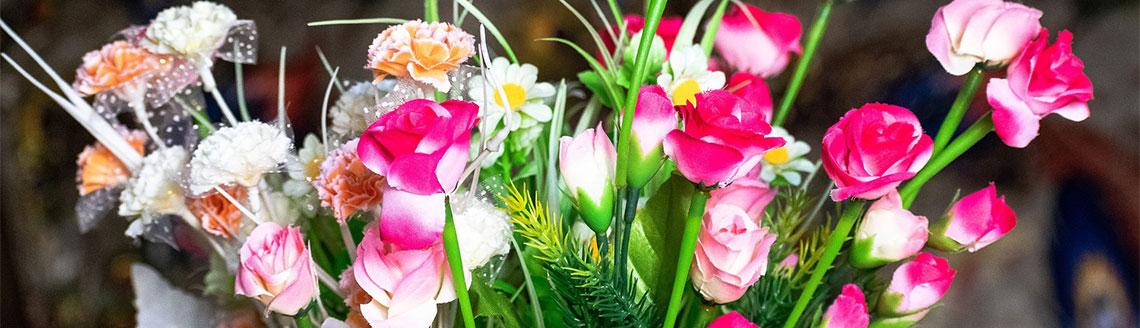
Hanging baskets are one of the simplest ways to add colour at eye level, brightening up walls, porches, fences and patios. But if you’ve ever struggled with daily watering, drooping blooms by August, or baskets that look tired before the season is over, you’ll know they can also be hard work. There’s a clever middle path that gives you the best of both worlds: a real-and-faux hanging basket that stays beautiful all year while still doing genuine good for bees and butterflies.
The idea is straightforward. You use high-quality artificial flowers for permanent, reliable colour, then add a small number of real nectar-rich plants nearby so pollinators still have something to feed on. Below, we’ll walk you through how to plan, build and care for this kind of display, along with honest advice about what works outdoors and what to keep in mind.
Why combine real and faux in the first place?
It might sound contradictory to mix artificial flowers with living ones, but the two complement each other surprisingly well. Faux flowers give you structure, consistency and colour that never fades on a dull day or wilts in a heatwave. Real plants give you the movement, scent and nectar that pollinators rely on.
The practical benefits of using artificial flowers in a hanging basket include:
- No daily watering, which is the most common reason real baskets fail in summer
- Reliable colour from spring through to winter, with no gaps between flowering flushes
- A great solution for shaded spots where many flowering plants struggle
- No pollen, which is helpful for allergy-sensitive households
- Less mess from dropped petals and dead-heading
- A consistent look at height, where real baskets are awkward to reach and maintain
By letting your artificial hanging basket carry the visual weight, you only need a few real plants to support pollinators, rather than a whole basket you must water every single day. It’s a kinder workload and a more dependable display.
Choosing your artificial flowers and foliage
The secret to a convincing faux basket is variety. Gardeners often describe a good planting as a mix of “thriller, filler and spiller” – something showy, something to fill out the body of the basket, and something to trail over the edges. The same principle applies beautifully to artificial arrangements.
Look for:
- Trailing stems such as artificial ivy, trailing fuchsia or cascading petunia bushes to soften the rim and create that lush, spilling-over look
- Fuller bushes of flowers like geraniums, begonias or pansies to give the basket its main body of colour
- Foliage fillers such as small fern bushes or variegated ivy to add depth and stop the basket looking flat
For colour, you can either keep things tonal and gentle – soft pinks, whites and greens – or go bold with mixed brights. Because faux flowers don’t fade with the seasons, you can also plan a colour scheme that suits your home all year rather than just one short summer.
If you’d rather not build from scratch, a ready-made artificial hanging basket gives you an instant, balanced display you can hang straight away and simply position your real pollinator plants alongside.
How to assemble your faux hanging basket
Building an artificial basket is far less messy than planting a real one, and there’s no compost or watering involved. Here’s a simple method.
You’ll need: an empty hanging basket, a bucket or large pot to hold it steady, a block of dry florist’s foam (oasis), a knife, some florist’s wire, pliers, and your chosen artificial flowers and foliage.
- Steady the basket. Set it inside a bucket or wide pot so it stays still and your hands are free.
- Add weight if needed. A plastic bag filled with sand or stones in the base helps stop a lightweight basket swinging or blowing about outdoors.
- Fit the foam. Cut a block of dry foam to sit snugly inside, then secure it by threading wire through one side of the basket, through the foam, and back out the other side.
- Fluff your stems. Gently bend out each branch and open up the foliage so the flowers look full and natural rather than flat-packed.
- Build from the centre out. Push taller, showier stems into the middle, then work outwards with fuller bushes, and finish with trailing pieces around the edge.
- Add through the sides. For extra realism, poke a few trailing stems through the gaps in the sides of the basket, as though the planting is genuinely growing out of it.
Step back regularly as you work, turning the basket to check it looks balanced from every angle, since hanging baskets are usually viewed from below and from the side.
Adding real nectar plants for the bees and butterflies
This is where your display does its bit for wildlife. Rather than trying to make a whole living basket work, concentrate your real plants into one or two manageable containers placed near your faux basket. Pollinators don’t mind where the nectar comes from, as long as it’s there.
For real plants to function as a genuine food source rather than a token gesture, scale matters. A small pot can offer a quick stop, but pollinators – especially bees – need a proper meal to make foraging worthwhile craftingherblooms.com. A larger, generously planted container works far harder than a few stems dotted about.
Good nectar-rich choices that thrive in containers and baskets include:
- Verbena – trailing, long-flowering and a reliable favourite with bees and butterflies beespartners.dk
- Lavender – fragrant, drought-tolerant and much loved by bees
- Nepeta (catmint), marjoram and salvia – sturdy, generous nectar sources that flower over a long season craftingherblooms.com
- Fuchsia and petunias – familiar basket plants that also offer nectar
Aim to choose plants that flower at slightly different times so there’s a continuous supply from late spring through to autumn, rather than one short burst that’s over in a few weeks.
A note on timing and care for the real plants
If you’re planting tender summer plants like verbena and petunias, hold off until the risk of frost has passed – usually late May or early June in the UK rhs.org.uk. Use a good peat-free multipurpose compost, and water slowly and thoroughly so the moisture seeps in rather than running straight out rhs.org.uk.
Living containers can dry out quickly in warm or windy weather, so check them daily in summer by lifting or nudging them – if they feel very light, they need water rhs.org.uk. An occasional liquid feed between spring and early autumn will keep them flowering, and regular dead-heading prolongs the display. The good news is that this is the only part of your arrangement that needs that kind of attention – your faux basket simply looks after itself.
Styling the two together
The trick to making a real-and-faux display look intentional rather than mismatched is to echo the colours and shapes between them. A few ideas:
- Pick up a colour from your real plants in your artificial flowers, so the eye reads them as one scheme
- Hang the faux basket as the main feature and place a real nectar planter on a windowsill, shelf or plant stand just beneath or beside it
- Use a pair of brackets so a faux basket and a smaller real basket flank a doorway together
- Group containers so pollinators find a generous cluster of nectar in one spot
Bees and butterflies forage by sight as well as scent, so the bright, dependable colour of your artificial flowers can actually help draw them towards the real nectar plants nearby. Having a shallow water source close by makes the area even more welcoming to wildlife.
Honest advice about using faux flowers outdoors
Artificial flowers are wonderfully low-maintenance, but it’s worth being realistic about outdoor life. Sunlight, rain, frost and wind all take a toll over time, and even good-quality faux flowers can gradually fade if they’re in strong, direct sun all day, every day.
To keep your basket looking its best for longer:
- Where possible, choose a spot with some shelter, such as under a porch, eaves or a covered area, which reduces exposure to harsh sun and heavy weather
- Be aware that very sunny, fully exposed positions are where colours are most likely to fade over the seasons
- Bring baskets in or store them somewhere dry over the harshest winter weather if you want to extend their life and keep them pristine
- Give them an occasional gentle clean to remove dust, pollen and cobwebs – a soft brush or a careful rinse usually does the job
Unless a product is specifically described as suitable for outdoor use, treat any faux display as best protected from the worst of the elements. A sheltered position is always kinder to artificial flowers and helps them stay looking fresh.
Buying considerations
When choosing artificial flowers for this kind of project, think about:
- Size and proportion – match the fullness of your faux planting to the size of your basket so it doesn’t look sparse or overstuffed
- Realism – look for varied tones, natural-looking foliage and stems with some flexibility, which read far more convincingly than flat, uniform flowers
- Trailing options – good spillers make the biggest difference to how lush a basket looks
- Colour longevity – richer, well-made flowers tend to hold their colour better outdoors
If you enjoy this combined approach, the same principle works across other parts of the garden too. Artificial topiary balls and topiary trees give you year-round structure by a doorway, artificial hedges and plants fill awkward shaded corners, and silk flower arrangements bring colour indoors – all while a few well-chosen real nectar plants keep your patch genuinely useful to pollinators.
Bringing it all together
A real-and-faux hanging basket is a thoughtful, practical compromise. You get permanent, fuss-free colour from artificial flowers that won’t wilt in a heatwave or fade by midsummer, and you still give bees and butterflies somewhere to feed by adding a generous container of real nectar plants nearby. It suits busy households, shaded spots, allergy-sensitive families and anyone who wants their display to look good all year without daily watering.
Start with a well-balanced faux basket built around a thriller, filler and spiller mix, add a single hardworking pollinator planter close by, echo the colours between them, and position everything somewhere reasonably sheltered. The result is a display that looks after itself, looks lovely for far longer than a traditional basket, and still does its bit for the wildlife on your doorstep.
 A warm welcome from The Artificial Flowers Company. We offer artificial flower arrangements, silk flowers, hanging baskets, topiary balls, topiary plants and much more - we hope you find what you're looking for!